What is the Apgar score?
The Apgar score is a standardised, rapid description of a newborn's condition immediately after birth and of how the baby is responding to any resuscitation. It was described in 1952 (published in 1953) by Dr Virginia Apgar, an anaesthesiologist at Columbia University, and remains the most widely used newborn assessment in the delivery room.
Five signs are each scored 0, 1 or 2, giving a total of 0 to 10. Her surname conveniently became a backronym for the five signs — Appearance (colour), Pulse (heart rate), Grimace (reflex irritability), Activity (muscle tone) and Respiration (respiratory effort).

What are the 0, 1 and 2 criteria for each Apgar sign?
| Sign (APGAR) | 0 | 1 | 2 |
|---|---|---|---|
| Appearance — colour | Pale or blue all over | Body pink, extremities blue (acrocyanosis) | Completely pink |
| Pulse — heart rate | Absent | Below 100/min | Above 100/min |
| Grimace — reflex irritability | No response to stimulation | Grimace | Cry, cough or sneeze (vigorous response) |
| Activity — muscle tone | Limp, floppy | Some flexion | Well flexed, resists extension / active movement |
| Respiration — effort | Absent | Slow, irregular, weak or gasping | Good, crying vigorously |
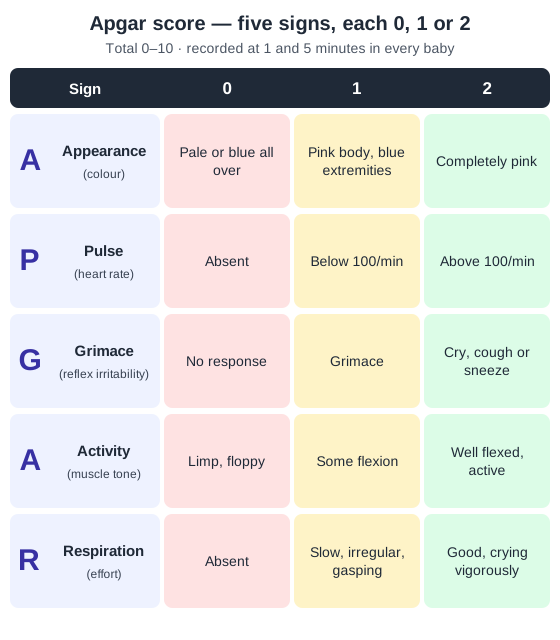
Score each sign independently and add them. Work from the stem's exact words: 'minimal response' or 'grimace' = 1; 'some flexion' = 1; 'irregular, gasping' = 1; 'heart rate 60/min' = 1 (present but under 100); 'cyanosed' or 'blue' = 0; 'pink body, blue extremities' = 1.
Apgar = Colour + Heart rate + Reflex irritability + Tone + Respiratory effort (each 0–2; total 0–10)
Outside the Apgar, heart rate is the vital sign resuscitation teams use to judge whether their interventions are working (BJA Education 2021).
When is the Apgar score recorded — 1, 5, 10 or 20 minutes?
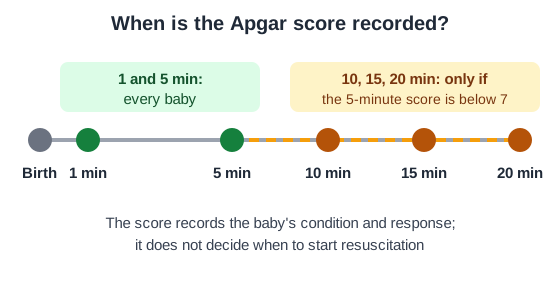
The score is recorded at 1 minute and 5 minutes after delivery in all infants. If the 5-minute score is less than 7, scoring continues at 5-minute intervals up to 20 minutes — that is, at 10, 15 and 20 minutes.
| Time | Recorded in | Main use |
|---|---|---|
| 1 minute | All babies | Condition at birth; tolerance of the birth process |
| 5 minutes | All babies | Response to transition and to any resuscitation; best-studied for prognosis |
| 10, 15, 20 minutes | Only if the 5-minute score is < 7 | Tracks ongoing recovery; persistent very low scores carry higher risk |
How do you calculate the Apgar score in a vignette?
Calculation questions are pure pattern recognition once each descriptive phrase is mapped to its point value. Three worked examples covering the common phrasings:
| Finding in the stem | Sign | Points |
|---|---|---|
| Example 1 (1 minute): heart rate 124/min | Pulse | 2 |
| Robust cry | Respiration | 2 |
| Pink body, blue hands and feet | Appearance | 1 |
| Slight flexion, no active movement | Activity | 1 |
| Grimaces on sole stimulation, does not pull away or cry | Grimace | 1 |
| Total | 7 (reassuring) | |
| Example 2 (1 minute): heart rate 92/min | Pulse | 1 |
| Slow, irregular breathing | Respiration | 1 |
| Flaccid | Activity | 0 |
| No response to stimulation | Grimace | 0 |
| Body pink, extremities blue | Appearance | 1 |
| Total | 3 (low) | |
| Example 3 (5 minutes): blue all over | Appearance | 0 |
| Heart rate 50/min | Pulse | 1 |
| Grimace to a nasal catheter | Grimace | 1 |
| Some flexion of the extremities | Activity | 1 |
| Irregular gasping respiration | Respiration | 1 |
| Total | 4 (moderately abnormal) — keep scoring every 5 min |
How do you interpret a low or normal Apgar score?
| Total score | Interpretation |
|---|---|
| 7–10 | Reassuring |
| 4–6 | Moderately abnormal |
| 0–3 | Low |
A score of 0–3 means either cardiopulmonary arrest or severe bradycardia, hypoventilation or CNS depression (Nelson). Most low scores are caused by difficulty establishing ventilation rather than a primary cardiac problem, and most such babies respond to bag-and-mask ventilation or intubation.
Scores are affected by factors other than hypoxia: gestational age (prematurity), birth weight, maternal medications, drugs or anaesthesia, and congenital anomalies can all lower the score. A preterm baby may score low on tone and reflex irritability simply because of immaturity.
At the population level, a 5-minute score of 0–3 carries a clearly higher risk of neonatal death and cerebral palsy. In a Norwegian study of more than 235,000 newborns, almost a quarter of babies with such scores died and about 10% of survivors developed cerebral palsy (Williams Obstetrics). Yet most individual babies with low scores do not develop cerebral palsy — which is exactly why the score is not used alone to predict outcome.
What should the Apgar score NOT be used for?
This is the conceptual heart of the topic and a common source of 'which statement is false' questions. The AAP and ACOG position, reflected in the Neonatal Resuscitation Program (NRP) and summarised in StatPearls, is:
- Not to decide resuscitation. Apgar scores should not be used to determine the initial need for intervention, which interventions are indicated, or when to start them. Resuscitation must begin before the 1-minute score is assigned.
- Not as proof of asphyxia. The Apgar score alone is not evidence of asphyxia or of an intrapartum hypoxic event.
- Not to predict long-term neurological outcome in an individual baby. It is not a diagnostic tool for asphyxia or long-term neurological outcome, and should not be used alone to predict adverse neonatal outcomes.
- Not comparable across gestations without context. Prematurity, maternal drugs and anomalies lower the score independent of hypoxia.
How is the Apgar score different from the resuscitation assessment at birth?
Both happen in the first minutes of life and both look at breathing, tone and heart rate, so students often merge them. They answer different questions: the resuscitation assessment asks what should I do right now?, while the Apgar score asks how is this baby doing at 1, 5 and later minutes, and how is it responding?
| Feature | Apgar score | Resuscitation assessment (NRP-style) |
|---|---|---|
| Purpose | Standardised record of condition and response | Decide whether the baby needs help, and what next |
| Timing | 1 and 5 minutes; every 5 min to 20 min if < 7 | Immediately at birth, then repeatedly |
| Inputs | Colour, heart rate, reflex irritability, tone, respiratory effort | Term gestation? Good tone? Breathing or crying? Then heart rate |
| Decides intervention? | No | Yes |
| Key vital sign | All five weighted equally | Heart rate — its rise is the sign that resuscitation is working |
If a baby is term, breathing or crying and has good tone, it can stay with the mother for skin-to-skin care; if not, it needs closer assessment and support — all before anyone writes down a 1-minute Apgar.
How does the Apgar score fit into the criteria for perinatal asphyxia?
Because a low Apgar alone is non-specific, asphyxia severe enough to cause brain injury is defined by a combination of findings. Nelson lists, in addition to an Apgar score of 0–3, fetal acidosis (pH < 7); seizures, coma or hypotonia; and multiorgan dysfunction. Williams highlights cord arterial pH < 7.0 with a base deficit ≥ 12 mmol/L as the objective marker of metabolic acidosis.
| Domain | Finding |
|---|---|
| Metabolic acidosis | Umbilical arterial pH < 7.0 (base deficit ≥ 12 mmol/L) |
| Apgar | 0–3 (more ominous when it persists beyond 5 minutes) |
| Neurology | Seizures, coma or hypotonia (neonatal encephalopathy) |
| Other organs | Multiorgan dysfunction |
What are the expanded, specified and combined Apgar scores?
The conventional score is influenced by maturity and by what the team is doing (a ventilated baby may be pink with a good heart rate). To make the record meaningful, the AAP and ACOG encourage an expanded Apgar reporting form that documents, alongside each score, the resuscitative interventions in use at that minute — for example positive-pressure ventilation, CPAP or an endotracheal tube — with scoring continued up to 20 minutes.
| Variant | What it adds | Range |
|---|---|---|
| Conventional Apgar | Five clinical signs | 0–10 (depressed if < 7) |
| Specified Apgar | Scores the signs as observed, independent of gestational age and interventions | 0–10 |
| Expanded Apgar | Records the resuscitation interventions being given at each time point | Documentation form |
| Combined Apgar | Combines the specified and expanded scores (proposed by Rüdiger et al.) | 0–17 (depressed if < 10 in the PLoS One study) |
In a prospective cohort of 942 admitted neonates (Dalili et al., PLoS One 2016), a low 5-minute Combined Apgar remained associated with mechanical ventilation, intraventricular haemorrhage and neonatal death after adjustment for gestational age, birth weight and resuscitation, whereas a low conventional score lost significance. It is a research tool — the conventional score is still what exams test.
What are the common Apgar exam traps?
- 'Respiratory rate' is not a component — respiratory effort is (UPSC CMS 2011 pattern).
- Heart rate < 100 but present = 1, not 0. Only an absent heart rate scores 0.
- Gasping or irregular breathing = 1, not 0.
- Acrocyanosis = 1; only a completely pink baby scores 2.
- Grimace alone = 1; a cry, cough or sneeze on stimulation = 2.
- Scoring stops at 5 minutes if the score is ≥ 7; otherwise every 5 minutes to 20 minutes.
- Apgar does not decide resuscitation, does not prove asphyxia and does not by itself predict an individual baby's neurological outcome.
- Prematurity, low birth weight, maternal medications or anaesthesia and congenital anomalies can lower scores without asphyxia.