In a cohort, 70 of 7000 alcohol consumers developed chronic liver disease, while 3 of 3000 teetotallers developed it. Taking the incidence in drinkers as 0.01 and in non-drinkers as 0.001, what fraction of the disease among drinkers is attributable to alcohol (the attributable fraction in the exposed)?
- A.0.9
- B.0.01
- C.0.09
- D.0.1
Show answer and explanation
Answer: A. 0.9
Correct answer: 0.9 (an attributable fraction of 90 percent).
Incidence in the exposed (Ie) = 0.01 and in the unexposed (Iu) = 0.001. The attributable risk (risk difference) = Ie - Iu = 0.009. The attributable fraction in the exposed = (Ie - Iu) / Ie = 0.009 / 0.01 = 0.9, i.e. 90 percent of chronic liver disease among drinkers is due to alcohol. (The absolute risk difference 0.009 was not offered, so the fraction 0.9 is the intended answer.)
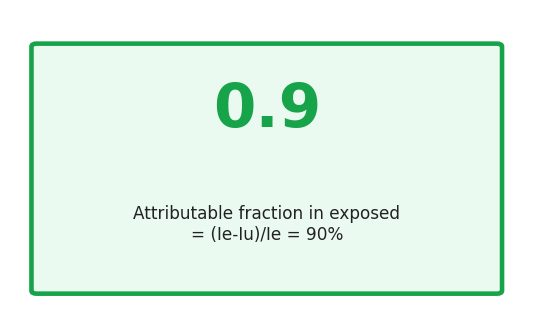 Attributable fraction = (0.01 - 0.001) / 0.01 = 0.9 (90 percent).
Incorrect Options:
- 0.01: 0.01 is only the incidence in drinkers, not the attributable fraction.
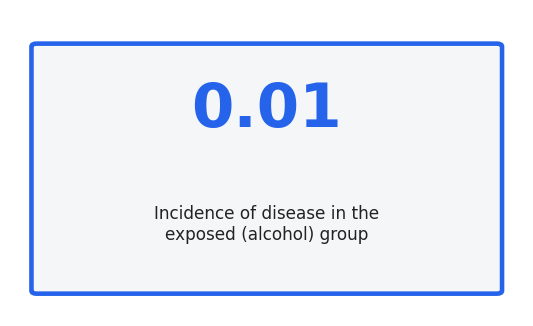 0.01 is only the incidence in drinkers, not the attributable fraction.
- 0.09: 0.09 does not correspond to any step of the calculation.
 0.09 does not correspond to any step of the calculation.
- 0.1: 0.1 is a distractor value.
 0.1 is a distractor value.
High-Yield Facts:
- Attributable risk (risk difference) = incidence in exposed minus incidence in unexposed.
- Attributable fraction in the exposed = (Ie - Iu) / Ie, expressed as a proportion or percentage.
- Population attributable risk uses the incidence in the whole population instead of the exposed.
- A high attributable fraction implies a large preventable burden if the exposure is removed.
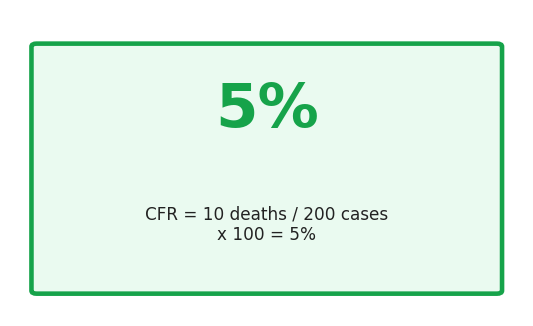 CFR = 10 deaths / 200 cases x 100 = 5 percent.
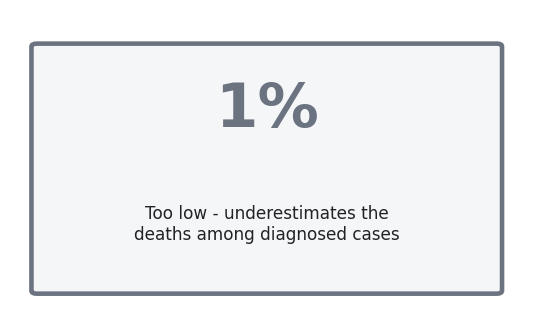 1 percent underestimates deaths among the diagnosed cases.
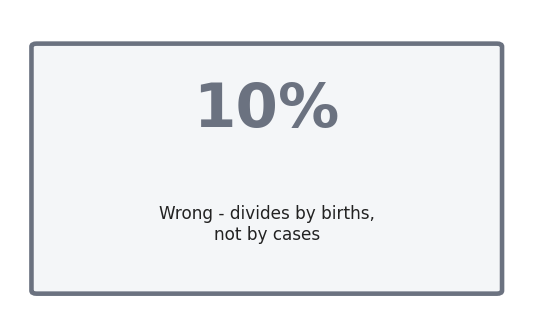 10 percent wrongly uses a denominator other than the number of cases.
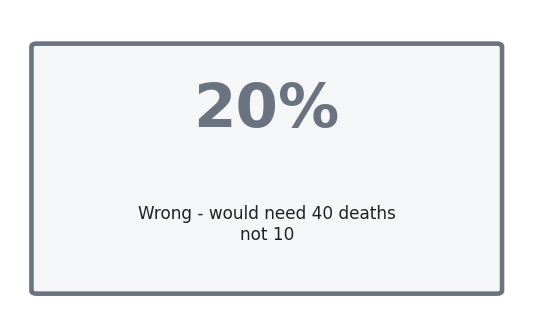 20 percent would need 40 deaths among 200 cases.
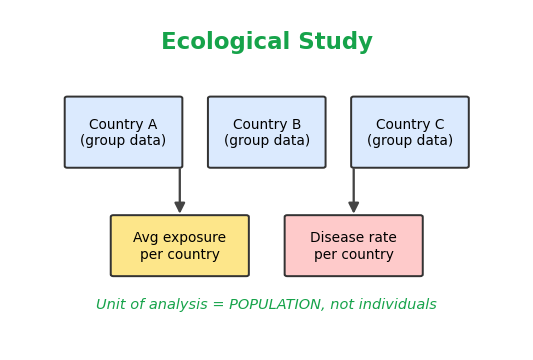 Ecological study: the group (population) is the unit of analysis.
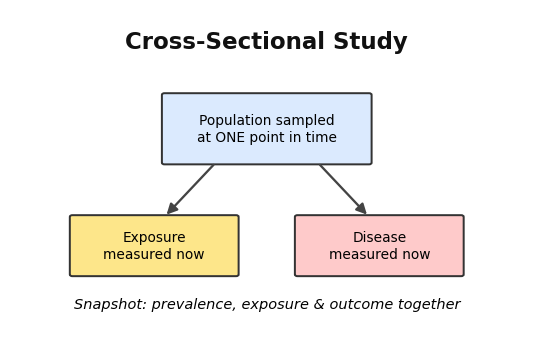 Cross-sectional: exposure and outcome measured in individuals at one time point.
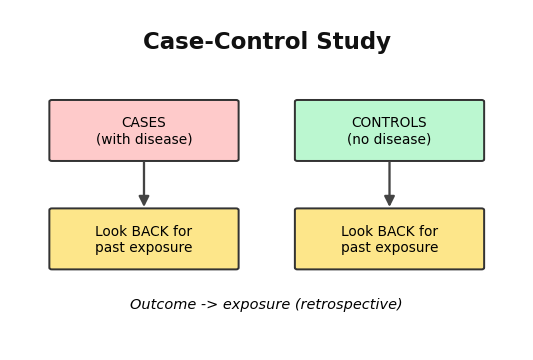 Case-control: starts from diseased and non-diseased individuals, looks back at exposure.
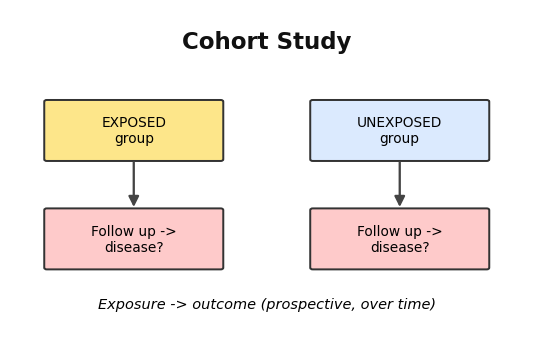 Cohort: follows exposed and unexposed individuals forward for outcomes.