A 4-year-old girl is found on routine examination to have a continuous machinery murmur below the left clavicle. Echocardiography confirms a small patent ductus arteriosus (PDA) with a left-to-right shunt, normal chamber sizes and no pulmonary hypertension. She is entirely asymptomatic. What is the most appropriate management?
- A.Close only if symptomatic
- B.Watch until adolescence
- C.Elective device closure
- D.Trial of indomethacin
Show answer and explanation
Answer: C. Elective device closure
Correct answer: C. Elective device closure.
Any PDA that remains audible beyond infancy will not close spontaneously and carries a lifelong risk of infective endarteritis, and (with larger shunts) of volume overload. The standard of care for a persistent PDA in a child is therefore elective closure, most often by a transcatheter device (occluder), reserving surgical ligation for anatomy unsuitable for a device.
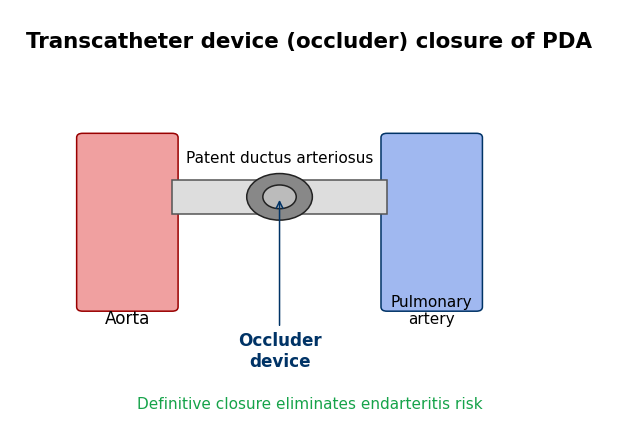
Transcatheter occluder device deployed within the ductus.
Incorrect Options:
- A. Close only if symptomatic: waiting for symptoms leaves the endarteritis risk unaddressed.
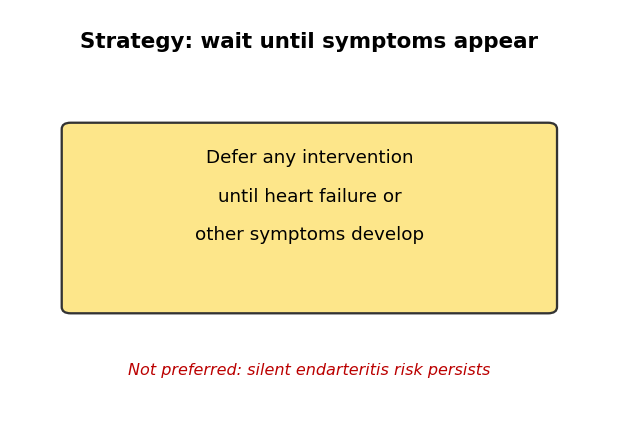
Awaiting symptoms is not the preferred strategy. - B. Watch until adolescence: a duct patent at 4 years will not spontaneously close.
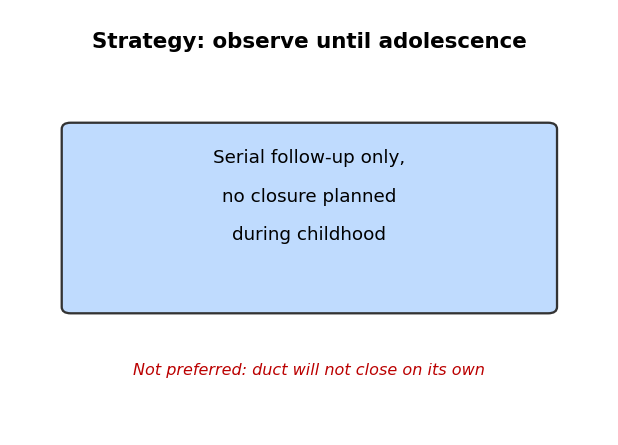
Continued observation alone does not remove the risk. - D. Trial of indomethacin: prostaglandin inhibitors close the duct only in preterm neonates and are ineffective in a term child.
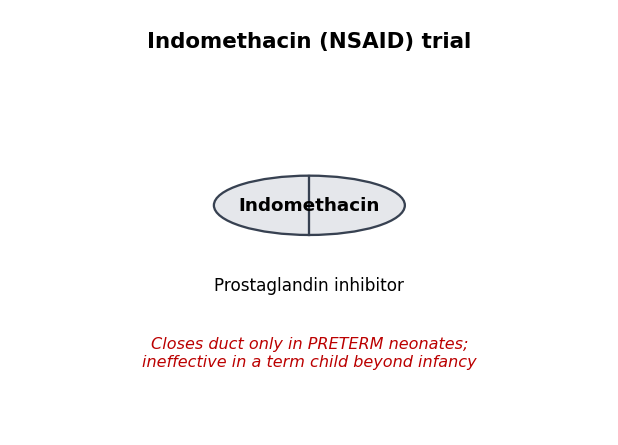
Indomethacin works only during early neonatal life.
High-Yield Facts:
- Ductal patency in the fetus depends on prostaglandin E2; it normally closes functionally within 1-3 days of birth.
- Classic sign of a PDA is a continuous machinery murmur in the left infraclavicular area with bounding pulses.
- Indomethacin or ibuprofen close a PDA in preterm infants; a term child needs device or surgical closure.
- Prostaglandin E1 is used to keep the duct OPEN in duct-dependent congenital heart lesions.