What is the Glasgow Coma Scale and why was it created?
The Glasgow Coma Scale (GCS) is a bedside tool that describes a patient's level of consciousness by watching three behaviours: whether the eyes open, how well the patient talks, and how well the patient moves in response to a defined stimulus. It was published in The Lancet in 1974 by the Glasgow neurosurgeons Graham Teasdale and Bryan Jennett. Their aim was simple: to give doctors and nurses a common language for describing consciousness after acute brain injury, so that deterioration could be spotted early and communicated clearly.
The scale was first meant to be charted as three separate responses. A single summed score (3–15) came later (1979), and in 2018 the GCS-Pupils (GCS-P) score was added to fold pupil reactivity into the same number. Today the GCS is used well beyond head injury — in stroke, poisoning, sepsis and any cause of altered sensorium — and it appears in trauma protocols (ATLS), triage tools and intubation decisions.
How is each GCS component scored?
Each component is scored separately according to the best (highest) response you can elicit. The official Glasgow assessment aid uses slightly updated wording (e.g. 'to sound', 'to pressure', 'normal flexion'); older textbooks use 'to speech', 'to pain', 'withdrawal'. Both describe the same levels and give the same numbers.
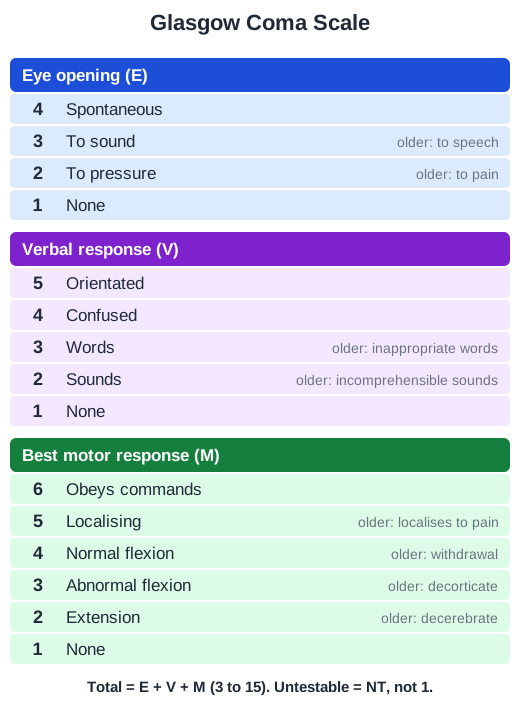
| Score | Current term (official aid) | Older textbook term | What you observe |
|---|---|---|---|
| 4 | Spontaneous | Opens spontaneously | Eyes already open before any stimulus |
| 3 | To sound | To speech / to command | Opens after a spoken or shouted request |
| 2 | To pressure | To pain | Opens only after a physical stimulus (e.g. fingertip pressure) |
| 1 | None | No eye opening | No opening at any time, with no interfering factor |
| NT | Not testable | — | Eyes closed by a local factor (e.g. severe periorbital swelling) |
| Score | Current term | Older term | What you observe |
|---|---|---|---|
| 5 | Orientated | Oriented | Correctly gives name, place and date |
| 4 | Confused | Confused conversation | Not orientated but communicates in coherent sentences |
| 3 | Words | Inappropriate words | Intelligible single words, no meaningful conversation |
| 2 | Sounds | Incomprehensible sounds | Only moans or groans |
| 1 | None | No verbal response | No audible response, with no interfering factor |
| NT | Not testable | — | A factor interferes with speech (e.g. endotracheal tube, tracheostomy) |
| Score | Current term | Older term | What you observe |
|---|---|---|---|
| 6 | Obeys commands | Obeys commands | Performs a two-part request (e.g. squeeze and release) |
| 5 | Localising | Localises to pain | Brings the hand above the clavicle towards a stimulus on the head or neck |
| 4 | Normal flexion | Withdrawal | Bends the arm at the elbow rapidly; features not predominantly abnormal |
| 3 | Abnormal flexion | Flexor (decorticate) posturing | Slow, stereotyped flexion — arm across chest, forearm rotates, thumb clenched, leg extends |
| 2 | Extension | Extensor (decerebrate) posturing | Extends the arm at the elbow |
| 1 | None | No movement | No movement in arms or legs, with no interfering factor |
| NT | Not testable | — | Paralysed or other limiting factor |

For physical stimulation the official aid recommends three sites: fingertip pressure, a trapezius pinch, and pressure at the supraorbital notch. A peripheral stimulus (fingertip) is used to see whether the eyes open or the limb flexes; a central stimulus (trapezius or supraorbital) is needed to test localising, because localising means the hand moves up towards a stimulus above the clavicle.
How do you calculate a GCS score in exam vignettes?
Read the vignette one component at a time and pick the level that matches best. Examiners like to hide one component in an unusual phrase, so translate each clue before adding.
| Vignette findings | Breakdown | Total | Severity band |
|---|---|---|---|
| Opens eyes when spoken to, confused conversation, localises pain | E3 V4 M5 | 12 | Moderate |
| Opens eyes only to pain, speaks random inappropriate words, withdraws from pain | E2 V3 M4 | 9 | Moderate |
| Opens eyes to pain, only groans, one arm localises while the other shows abnormal flexion | E2 V2 M5 (best side counts) | 9 | Moderate |
| No eye opening, no sounds, extensor posturing | E1 V1 M2 | 4 | Severe |
| Eyes open spontaneously, oriented, obeys | E4 V5 M6 | 15 | Mild (normal consciousness) |
| Intubated, opens eyes to pain, abnormal flexion | E2 VNT M3 | Report components; do not add a false V1 | Severe range |
Two more habits save marks. First, always write the breakdown (E3 V4 M5 = 12) — two patients with the same total can be very different clinically. Second, when a vignette gives only a total ("GCS 10"), map it straight to the severity band and to the management step being asked about.
How is head-injury severity graded by GCS?
| Severity | GCS | Typical exam clue |
|---|---|---|
| Mild | 13–15 | Brief loss of consciousness, now talking; most head injuries fall here |
| Moderate | 9–12 | Drowsy, confused; often needs CT and admission |
| Severe | 3–8 | Comatose; airway protection is the first priority |
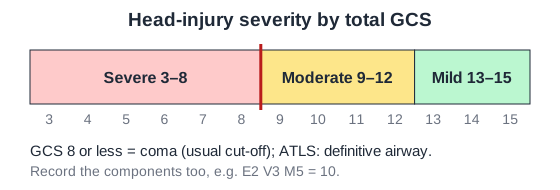
These bands (mild 13–15, moderate 9–12, severe 3–8) are the ones used by StatPearls, most trauma literature and Indian exam keys. The GCS total is only a first-pass severity label: CT findings, pupils, age and the trend over the next hours matter as much. For NEET PG and INI-CET, answer with 13–15 / 9–12 / 3–8 unless the question defines its own cut-offs.
How is GCS recorded in intubated or aphasic patients (NT, T)?
Sometimes a component simply cannot be tested: the patient has an endotracheal tube or tracheostomy (no speech), severe facial swelling (eyes cannot open), or is paralysed. The official Glasgow guidance is clear: record that component as NT — not testable, and do not substitute a score of 1. Writing V1 for an intubated patient would make them look deeper in coma than they are.
| Notation | Meaning | Where it is used |
|---|---|---|
| VNT (e.g. E3 VNT M6) | Verbal not testable | Official GCS guidance; do not report a total when a component is NT |
| T suffix (e.g. 8T) | Intubated; verbal component not scored — E + M only (range 2T–10T); some units count V as 1 (range 3T–11T) | Common in surgical texts and trauma units |
| V-ET / VT | Verbal untestable because of an endotracheal tube | Some charts and StatPearls |
Whichever notation is used, the eye and motor components can still be followed in an intubated patient and their trend remains useful. The motor response is especially valuable because it is independent of speech.
What is the GCS-P (GCS-Pupils) score?
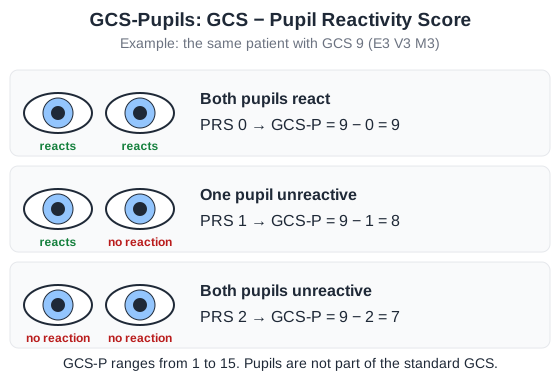
The GCS-Pupils score (GCS-P), introduced in 2018 by the Glasgow group, combines two of the strongest early indicators of outcome after head injury — the GCS and pupil reactivity — into one number. You first work out the Pupil Reactivity Score (PRS) and then subtract it from the GCS.
GCS-P = GCS − PRS
PRS: both pupils react = 0; one pupil unreactive = 1; both pupils unreactive = 2. GCS-P therefore ranges from 1 to 15.
| Pupils unreactive to light | PRS |
|---|---|
| Neither pupil (both react) | 0 |
| One pupil | 1 |
| Both pupils | 2 |
Example: a patient with E3 V3 M3 (GCS 9) and both pupils briskly reactive has PRS 0, so GCS-P = 9. The same patient with one fixed dilated pupil has PRS 1 and GCS-P = 8. The extra range at the bottom (down to 1) improves prognostic discrimination in the most severe injuries, where plain GCS bunches everyone at 3.
How is the GCS modified for infants and young children?
A preverbal child cannot give name, place and date or obey a two-part command, so the adult verbal and motor levels do not fit. Paediatric (modified) GCS versions keep the same 3–15 structure but change the descriptors. They are typically used in children under about 2 years, and many units apply them up to 5 years. Several versions exist and wording differs between institutions, but the logic is the same: the verbal score rewards age-appropriate vocalisation and the motor score rewards normal spontaneous movement.
| Component | Score | Infant / preverbal child |
|---|---|---|
| Eyes | 4 | Open spontaneously |
| Eyes | 3 | Open to sound (voice or shout) |
| Eyes | 2 | Open to pain |
| Eyes | 1 | No response |
| Verbal | 5 | Alert; coos, babbles, or uses words to usual ability |
| Verbal | 4 | Less than usual ability; irritable but consolable cry |
| Verbal | 3 | Cries to pain or is inconsolable |
| Verbal | 2 | Moans to pain |
| Verbal | 1 | No response |
| Motor | 6 | Normal spontaneous movements (replaces 'obeys commands') |
| Motor | 5 | Withdraws to touch (some versions: localises pain) |
| Motor | 4 | Withdraws to pain |
| Motor | 3 | Abnormal flexion |
| Motor | 2 | Abnormal extension |
| Motor | 1 | No response |
How does GCS guide decisions in head injury and trauma?
- Trend matters more than one reading. A fall of 2 or more points, or a drop in the motor score, is a red flag for an expanding lesion. The classic PYQ picture is the lucid interval of an extradural haematoma: GCS 15 after the injury, then rapid deterioration with a fixed dilated pupil on the side of the clot (third-nerve compression from uncal herniation) — urgent surgical evacuation.
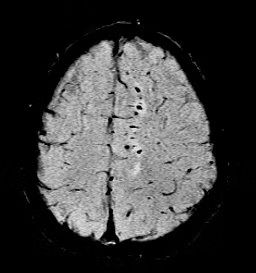
- Deep coma with a normal CT after high-speed rotational injury suggests diffuse axonal injury; MRI (especially susceptibility-weighted imaging) shows the small haemorrhages at the grey–white junction, corpus callosum and brainstem.
- GCS ≤ 8 = protect the airway (ATLS primary survey: Airway with cervical spine protection, Breathing, Circulation, Disability, Exposure). 'Disability' is where GCS and pupils are checked.
- Cushing reflex (hypertension + bradycardia + irregular breathing) with a low GCS signals raised intracranial pressure and impending herniation — secure the airway first, then image.
- Outside trauma, GCS is used to describe altered sensorium in poisoning, meningitis, stroke and sepsis, but the head-injury severity bands were designed for trauma.
What are the common GCS exam traps?
| Trap | Correct approach |
|---|---|
| Lowest possible GCS is 0 | Lowest is 3 (E1 V1 M1) — even a patient with no response scores 3 |
| Summing the worse limb when motor responses are asymmetric | Use the best motor response |
| Confusing withdrawal (M4) with abnormal flexion (M3) | Withdrawal = rapid, arm moves away from the body; abnormal flexion = slow, stereotyped, arm across the chest with thumb clenched |
| Localising vs withdrawal | Localising (M5) = hand reaches above the clavicle towards a central stimulus; merely pulling the limb away is M4 |
| 'Confused' vs 'inappropriate words' | Confused (V4) = sentences, wrong orientation; inappropriate words (V3) = isolated words, no conversation |
| Scoring V1 in an intubated patient | Record VNT (or a 'T' suffix); do not add a misleading total |
| Pupils as a GCS component | Pupils are only in GCS-P, not the standard GCS |
| Mixing up the band edges (is 13 mild? is 8 moderate?) | Standard bands: 13–15 mild, 9–12 moderate, 3–8 severe — 8 is severe, 13 is mild |