Written & reviewed by: Kinase Medical Team · Last reviewed: 30 September 2026 · Editorial policy
Key features
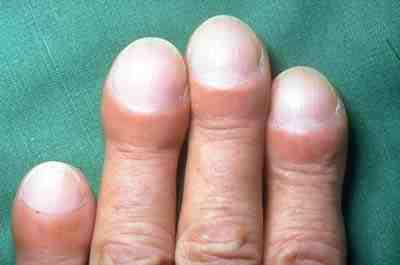
- Loss of the normal angle (Lovibond angle) between the nail plate and proximal nail fold, with increased nail convexity.
- Soft, spongy nail bed; widened fingertip — the digit is thicker at the nail base than at the distal interphalangeal joint.
- Schamroth sign: the diamond-shaped window between opposed index fingernails is lost.
- Causes: lung/heart disease in most cases (lung cancer, lung abscess, interstitial pulmonary fibrosis, cyanotic congenital heart disease, endocarditis); GI causes such as inflammatory bowel disease and cirrhosis; and thyroid acropachy (Graves' disease, usually with pretibial myxoedema and exophthalmos).
- Can be part of hypertrophic osteoarthropathy (secondary forms are often linked to malignancy); a primary form is inherited.
Differential diagnosis
| Condition | How to tell it apart |
|---|---|
| Koilonychia | Thin, spoon-shaped, concave nails — the opposite curvature — classically with iron deficiency. |
How it appears in NEET PG
Hand photographs are common in medicine image questions; clubbing is asked as the sign itself or linked to an underlying lung, heart or liver disease in the vignette.
Frequently asked questions
What is the Schamroth window test?
Place the backs of the two index fingers' distal phalanges together. Normally a small diamond-shaped gap is seen between the nails; in clubbing it disappears.
What are the common causes of clubbing?
Mostly lung and heart diseases — lung cancer, lung abscess, interstitial pulmonary fibrosis and cyanotic congenital heart disease — plus some GI diseases such as inflammatory bowel disease and cirrhosis.
What is hypertrophic osteoarthropathy?
A syndrome of clubbing with periosteal new bone formation and joint pain; the secondary form is usually linked to an underlying chronic disease or malignancy.
Sources
- DermNet — Hypertrophic osteoarthropathy and digital clubbing
- DermNet — Nail terminology
- Harrison's Principles of Internal Medicine (textbook)
Keep practising
For exam preparation and medical education only — not a substitute for clinical judgement, diagnosis or treatment of any patient.