Why can cervical cancer be prevented by screening?
Cervical cancer is caused by persistent infection with high-risk human papillomavirus (HPV). StatPearls puts the share of cases due to persistent high-risk HPV at about 99.7%, with HPV-16 and HPV-18 alone causing about 70%. Most infections are harmless: about 90% clear within 2 years. Only the infections that persist go on to cause precancer.
The window for prevention is long. WHO notes that it usually takes 15–20 years for abnormal cells to become cancer, and only 5–10 years in women with weakened immunity such as untreated HIV. Women living with HIV are 6 times more likely to develop cervical cancer. That long precancerous phase — cervical intraepithelial neoplasia (CIN) — is what screening is designed to catch and treat.
HPV infects the transformation zone (squamocolumnar junction), where metaplastic change is constant. The viral oncogenes E6 and E7 disrupt cell-cycle control and produce koilocytes — squamous cells with an enlarged, hyperchromatic nucleus and a perinuclear halo, which StatPearls calls pathognomonic of HPV infection. Every screening test is really a way of sampling or looking at this zone.

What does the WHO 2021 guideline recommend?
The second edition of the WHO screening and treatment guideline (2021) contains 23 recommendations and 7 good practice statements. Its biggest shift is the choice of primary test: WHO recommends HPV DNA detection as the primary screening test rather than VIA or cytology (strong recommendation). Programmes already using quality-assured cytology may continue until HPV testing is running, while VIA-based programmes are told to transition rapidly because VIA is hard to quality-assure.
| Parameter | General population of women | Women living with HIV |
|---|---|---|
| Primary test | HPV DNA (strong recommendation) | HPV DNA (strong recommendation) |
| Age to start | 30 years | 25 years |
| Interval with HPV DNA | Every 5 to 10 years | Every 3 to 5 years |
| Interval with VIA or cytology (where HPV testing is not yet available) | Every 3 years | Every 3 years |
| When to stop | After age 50, once there are two consecutive negative results at the recommended interval | Same rule — after 50, two consecutive negative results |
| Approach | Screen-and-treat or screen, triage and treat (either acceptable) | Screen, triage and treat |
- Priority age group: women aged 30–49 years; women aged 50–65 who have never been screened come next.
- Minimum standard: screening even twice in a lifetime is beneficial while a programme moves towards regular intervals.
- Self-sampling: HPV DNA testing can use samples taken by a health-care provider or self-collected samples.
- Why not start before 30? Cervical cancer is rare before 30 (about 3 per 100 000 at age 20), and WHO cites data that about 60% of CIN2 lesions in women under 30 regress within 24 months.
Which screening tests are used and how do they differ?
| Test | What it detects | Strengths | Limitations |
|---|---|---|---|
| HPV DNA test | High-risk HPV DNA (PCR-based); some tests give HPV16/18 genotype | Most sensitive; negative result gives long reassurance; allows self-sampling; most cost-effective in WHO modelling | Needs laboratory or point-of-care platform; many positives are transient infections, so triage is often added |
| VIA (visual inspection with acetic acid) | Acetowhite areas at the transformation zone after acetic acid is applied | Cheap, immediate result, allows treatment in the same visit | Subjective, wide variation in accuracy, hard to quality-assure; unsuitable when the transformation zone is not visible |
| Cytology (Pap smear or liquid-based cytology) | Abnormal exfoliated cells, reported in the Bethesda system | Long track record; specific | Needs trained cytology services and a second visit; less sensitive than HPV testing |
WHO found that HPV DNA screening followed by treatment produces greater reductions in CIN2+, advanced cancer and cervical cancer deaths than VIA, with fewer overall treatments and fewer preterm deliveries. After a negative HPV test, the risk of later cancer is up to 70% lower than after negative cytology — which is why the HPV interval can be so much longer.
For comparison, the US (USPSTF) schedule quoted in StatPearls is cytology every 3 years from 21 to 29, then from 30 to 65 either cytology every 3 years, high-risk HPV testing alone every 5 years, or co-testing every 5 years. It advises no screening after 65 with adequate prior negative screening, and none after hysterectomy with removal of the cervix for a non-cancer reason.
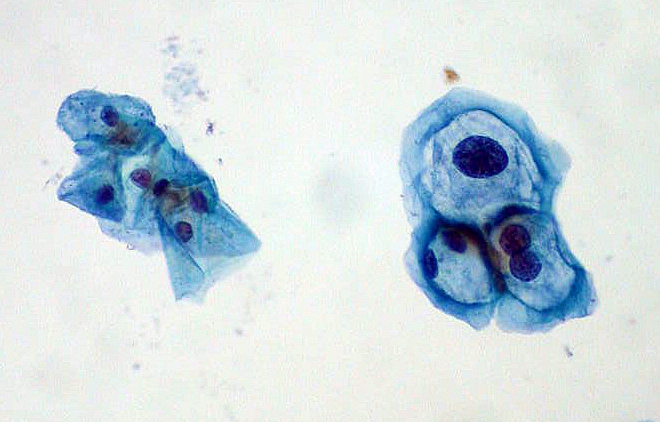
How is a Pap smear reported in the Bethesda system?
The Bethesda System was set up at a National Cancer Institute workshop in 1988 and revised in 1991, 2001 and 2014. It replaced the old Pap class I–V scheme and collapsed the three CIN grades into a two-tier squamous terminology: LSIL and HSIL. A report states specimen type, adequacy, a general category and the detailed interpretation.
| Category | Includes | Usual next step |
|---|---|---|
| ASC-US — atypical squamous cells of undetermined significance | Equivocal squamous changes | HPV test (reflex); colposcopy if HPV positive |
| ASC-H — atypical squamous cells, cannot exclude HSIL | Changes suspicious of high grade | Immediate colposcopy |
| LSIL — low-grade squamous intraepithelial lesion | HPV effect, mild dysplasia, CIN 1 | Repeat or colposcopy depending on HPV result and risk |
| HSIL — high-grade squamous intraepithelial lesion | Moderate and severe dysplasia, carcinoma in situ, CIN 2 and CIN 3 | Immediate colposcopy |
| AGC / AIS — atypical glandular cells; adenocarcinoma in situ | Endocervical or endometrial glandular abnormality | Further evaluation; WHO suggests LLETZ or cold knife conization for histologically confirmed AIS |
| Squamous cell carcinoma / adenocarcinoma | Invasive cancer | Biopsy and staging |
- Adequacy: the presence of endocervical or transformation-zone cells is an indicator of adequacy, not a requirement. Any smear showing abnormal cells is by definition satisfactory.
- Unsatisfactory smear (too few cells, obscured by blood, mucus or inflammation): repeat, usually within 2 to 4 months.
- Sampling tools: an endocervical broom, or an extended-tip spatula plus an endocervical brush.
- Organisms reported: Trichomonas, Candida, shift in flora suggesting bacterial vaginosis, Actinomyces, herpes simplex and cytomegalovirus changes.
What happens after a positive screening test?
WHO describes two pathways. In screen-and-treat, a woman who tests HPV positive is treated without further testing. In screen, triage and treat, a positive HPV test is followed by a triage test — partial genotyping (HPV16/18), colposcopy, VIA or cytology — and only triage-positive women are treated. WHO found the benefits similar; screen-and-treat gives slightly more treatments, while HPV16/18 genotyping triage may prevent slightly more cancers.
Colposcopy is examination of the cervix under magnification. 5% acetic acid is applied for 1–2 minutes; dysplastic cells dehydrate and turn acetowhite. Lugol's iodine may follow: dysplastic areas fail to take up the brown iodine and look yellow — a positive Schiller test means a non-staining area. Biopsies are taken from abnormal areas. The colposcopy is adequate only if the entire squamocolumnar junction is seen.
- Indications for colposcopy (StatPearls): abnormal Pap test, positive high-risk HPV test, positive VIA, a suspicious-looking cervix with postcoital or postmenopausal bleeding even if the Pap is negative, and follow-up after treatment.
- Swede score: a 10-point colposcopic score; in the original study a score of 5 or more was 100% sensitive for CIN2+, and biopsy is recommended at that threshold.
- Nomenclature: the IFCPC 2011 terminology classifies the transformation zone as type 1, 2 or 3 by how much of it is visible.

| Option | Type | When used |
|---|---|---|
| Cryotherapy / thermal ablation | Ablative — destroys the transformation zone | Lesion and transformation zone fully visible; used in India's same-day pathway after a positive VIA |
| LLETZ (large loop excision of the transformation zone) | Excisional — gives a specimen for histology | Transformation zone not fully visible (ablation unsuitable); adenocarcinoma in situ |
| Cold knife conization (CKC) | Excisional, in theatre | When histological margins are critical; WHO suggests LLETZ or CKC for adenocarcinoma in situ |
- Timing: treat as soon as possible and within six months of the decision; in pregnancy, treatment is deferred until after delivery.
- Treatment failure: about 10% after ablation in the general population (about 30% in women living with HIV); lower after excision.
- Follow-up: retest with HPV DNA at 12 months after treatment; after a positive HPV test with a negative triage test, retest at 24 months (12 months in women living with HIV).
How does India screen for cervical cancer?
Cervical cancer is the second most common cancer among women in India, with over 1.2 lakh new cases and nearly 80 thousand deaths a year (GLOBOCAN 2022, as cited by the Health Ministry). Screening is delivered through the National Programme for Prevention and Control of Non-Communicable Diseases (NP-NCD) — launched in 2010 as NPCDCS and since renamed.
- Policy document: the Health Ministry's Operational Framework: Management of Common Cancers (2016).
- Test: VIA (visual inspection with acetic acid) at primary-care level.
- Who and how often: women aged 30–65 years, once every 5 years.
- After a positive VIA: referral to a secondary-care hospital for confirmation by colposcopy, biopsy if needed, and assessment for ablative treatment (cryotherapy or thermal ablation) on the same day.
What is India's HPV vaccination programme?
On 28 February 2026 the Prime Minister launched a nationwide HPV vaccination campaign for 14-year-old girls from Ajmer, Rajasthan. India's national technical advisory group on immunisation (NTAGI) had recommended HPV vaccine for the Universal Immunization Programme in 2022.
| Feature | Detail |
|---|---|
| Target group | Girls aged 14 years (completed 14 but not yet 15); annual cohort about 1.2 crore |
| Vaccine | Gardasil-4 — quadrivalent, HPV types 6, 11, 16, 18 |
| Schedule | Single dose, aligned with WHO recommendations |
| Dose and route | 0.5 ml intramuscular, left upper arm |
| Delivery | 90-day campaign at government facilities only, then on routine immunisation session days |
| Consent and records | Voluntary, free; parental or guardian consent recorded on U-WIN; vaccine stock managed on eVIN |
| Defer or avoid | Moderate or severe illness (until recovery), severe allergic reaction to an earlier vaccine, known yeast allergy, girls outside the target age |
WHO's position: HPV vaccination is a priority for all girls aged 9–14, before sexual debut. Since the 2022 SAGE review, a one- or two-dose schedule is acceptable for girls 9–14 and young women 15–20; women older than 21 get two doses 6 months apart. Immunocompromised people, including those living with HIV, should receive three doses if feasible (at least two). India's indigenous quadrivalent vaccine, Cervavac, was approved in 2023.
What are the WHO cervical cancer elimination targets?
The World Health Assembly endorsed the Global strategy to accelerate the elimination of cervical cancer in August 2020, and WHO launched it on 17 November 2020. Elimination as a public health problem means 4 or fewer new cases per 100 000 women per year. Three targets — the 90–70–90 targets — are to be met by 2030:
- 90% of girls fully vaccinated with HPV vaccine by age 15.
- 70% of women screened by age 35 and again by age 45.
- 90% of women identified with cervical disease receiving treatment (precancer treated, invasive cancer managed).
What are the common exam traps?
- WHO start age is 30, not 21. Age 21 is the US cytology start; WHO starts at 30 (25 in HIV).
- Primary test per WHO is HPV DNA, not VIA and not Pap — VIA is a fallback and a triage option.
- Schiller test positive = iodine-negative (yellow) area. The abnormal area fails to take up iodine.
- Acetowhite change follows acetic acid, not iodine.
- HSIL includes CIN 2 and CIN 3; LSIL corresponds to CIN 1 and HPV effect.
- Type 3 transformation zone rules out VIA and ablation — use excision (LLETZ).
- India's HPV drive uses a single dose of quadrivalent vaccine for 14-year-old girls; WHO's preferred age band is 9–14.
- Immunocompromised girls need more doses (three if feasible), not fewer.