What is severe acute malnutrition?
Severe acute malnutrition (SAM) is the life-threatening end of childhood undernutrition. It presents in two main clinical forms — marasmus (severe wasting) and kwashiorkor (oedematous malnutrition) — plus a mixed form, marasmic kwashiorkor. The 2023 WHO guideline prefers the descriptive terms severe wasting and nutritional oedema, but exams still use the classic names.
| Category | Weight-for-height/length (WHZ/WLZ) | MUAC | Oedema |
|---|---|---|---|
| Severe wasting | < −3 SD | < 115 mm | — |
| Nutritional oedema | Any | Any | Bilateral pitting oedema (starts in the feet) |
| SAM | < −3 SD | and/or < 115 mm | and/or nutritional oedema |
| Moderate wasting | ≥ −3 and < −2 SD | 115 to < 125 mm | None |
Kwashiorkor is a word from the Ga language of Ghana, loosely 'the sickness a baby gets when the new baby comes' — the displaced child weaned early onto a low-protein, high-carbohydrate diet. Children aged 6–24 months are at the highest risk (StatPearls — Severe Acute Malnutrition).
How do kwashiorkor and marasmus differ?
| Feature | Marasmus | Kwashiorkor |
|---|---|---|
| Basic deficit | Prolonged deficit of total energy (and protein) | Classically protein deficit with near-adequate energy; now seen as multifactorial (oxidative stress, micronutrients, gut microbiota, aflatoxin) |
| Oedema | Absent | Bilateral pitting oedema — the defining sign |
| Wasting | Severe: loss of fat and muscle, visible ribs, loose skin folds | Often little visible wasting — masked by oedema |
| Face | 'Old man' appearance from loss of facial fat | Swollen, oedematous |
| Appetite and mood | Hungry, irritable, food-seeking | Poor appetite, apathetic, listless |
| Skin | Dry, loose, wrinkled | Flaky-paint dermatosis — dark patches that peel to leave pale skin, worst at pressure points |
| Hair | Usually no depigmentation | Pale, dry, sparse, easily pluckable; flag sign |
| Liver | No fatty-liver hallmark | Hepatomegaly from fatty liver |
| Serum albumin | — | Low (hypoalbuminaemia) |
| Weight-for-age (Wellcome) | < 60%, no oedema | 60–80% with oedema |
| Prognosis | Serious | Often worse — oedema, fatty liver and multi-organ involvement |
The hair flag sign is alternating horizontal bands of pale and normally pigmented hair, reflecting alternating periods of poor and adequate nutrition (PMC6126787; DermNet). It is typical of kwashiorkor-type protein-calorie malnutrition; a similar banding with dark stripes has been reported after cycles of high-dose methotrexate.

Why do children with kwashiorkor develop oedema and fatty liver?
The textbook explanation is hypoalbuminaemia: too little dietary protein reaches the liver, albumin synthesis falls, plasma oncotic pressure drops and fluid leaks into the tissues. StatPearls now frames kwashiorkor as multifactorial — deficiencies of antioxidants (notably glutathione), sulphur amino acids (methionine, cysteine) and micronutrients cause oxidative stress, impaired hepatic protein synthesis and gut-microbiota changes that damage the gut-liver axis, increase vascular permeability and lower oncotic pressure.
The albumin story is incomplete: a Nature Reviews primer (Bhutta et al., 2017) notes that the degree of hypoalbuminaemia correlates poorly with the severity of oedema or the speed of its resolution. Do not treat the oedema with diuretics — the WHO Pocket Book states that oedema is partly due to potassium and magnesium deficiency, and that total body sodium is high even when plasma sodium is low.
Hepatic steatosis is a striking feature of kwashiorkor. It is classically attributed to poor export of fat from the liver, but one study found very-low-density lipoprotein secretion was not impaired, and reduced hepatic fat oxidation may contribute (Bhutta et al.). For exams, remember the association: kwashiorkor = fatty liver with hepatomegaly.
| System | Change |
|---|---|
| Metabolism | Lower metabolic rate; fat and muscle mobilised once glycogen runs out (within a day) |
| Hormones | Insulin, IGF-1 and T3 fall; cortisol and growth hormone rise |
| Immunity | Thymus, lymph nodes and tonsils atrophy; infections present without the usual signs |
| Gut | Villous atrophy and malabsorption |
| Heart | Reduced contractility, bradycardia, hypotension — easily overloaded by IV fluid |
| Brain | Ketones used as fuel; delayed growth and development |
How is malnutrition classified — WHO z-scores and Wellcome?
| Weight-for-age | Oedema present | Oedema absent |
|---|---|---|
| 60–80% | Kwashiorkor | Undernourished (underweight) |
| < 60% | Marasmic kwashiorkor | Marasmus |
The Wellcome criteria remain a favourite exam table because they separate the three clinical forms with only two variables. They are historical: current WHO practice uses weight-for-height z-score, MUAC and oedema, because weight-for-age is confounded by stunting (a short child can be underweight without being wasted).
| Index | Low value means | Time course |
|---|---|---|
| Weight-for-height (WHZ) | Wasting — acute malnutrition | Recent, acute |
| Height-for-age (HAZ) | Stunting — chronic malnutrition | Long-standing |
| Weight-for-age (WAZ) | Underweight — composite of both | Mixed |
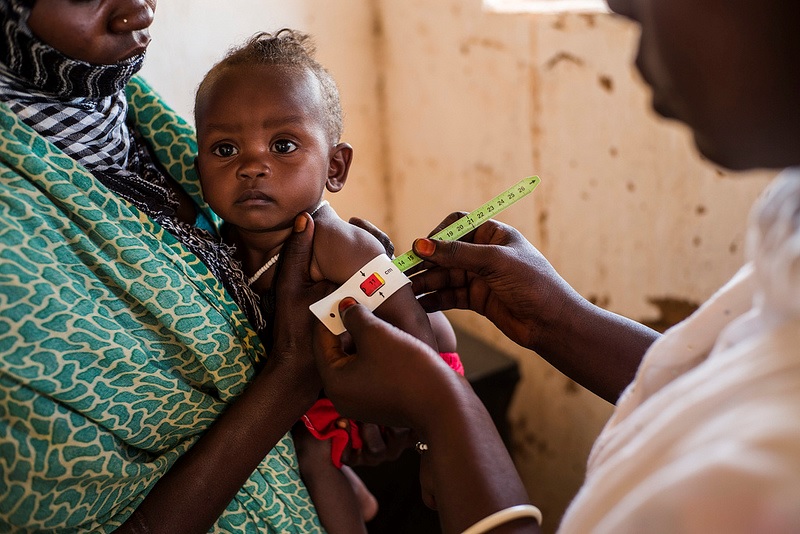
| MUAC (6–59 months) | Wasting; < 115 mm = severe, 115–124 mm = moderate | Acute; used for community screening |
Nutritional oedema is graded by extent. Bhutta et al. describe + as oedema of the feet and lower legs, ++ as extension to the arms and +++ as oedema reaching the face; training charts vary slightly, but +++ (generalised, including the face) is always 'severe' and on its own is an indication for inpatient care.
Which children with SAM need admission?
Most children with uncomplicated SAM — good appetite, no danger signs — do better with community-based outpatient treatment using RUTF and a course of oral amoxicillin (StatPearls; WHO 2013 recommendation retained in 2023). Complicated SAM needs inpatient care.
| Admit for inpatient care if any of | Outpatient care if all of |
|---|---|
| One or more IMCI danger signs (cannot drink or breastfeed, vomits everything, convulsions, lethargic or unconscious) | Passed the appetite test (eats the test RUTF) |
| An acute medical problem — e.g. severe pneumonia, severe dehydration, severe anaemia, hypothermia, open or infected skin lesions | No danger signs and no acute medical problem |
| Severe nutritional oedema (+++) | Oedema absent or not severe |
| Poor appetite — failed the appetite test | Caregiver able to attend follow-up |
What are the WHO 10 steps of SAM management?
Inpatient management has two phases: stabilisation (about days 1–7) and rehabilitation (weeks 2–6). The WHO Pocket Book lays this out as ten steps, several of which run through both phases.
| Step | What to do | Key numbers |
|---|---|---|
| 1. Hypoglycaemia | Feed F-75 at once; if not available, 50 mL of 10% glucose or sucrose orally/NG; IV 10% glucose if unconscious | Glucose < 3 mmol/L; IV 10% glucose 5 mL/kg; feed 2-hourly day and night |
| 2. Hypothermia | Clothe, cover head, warm room, skin-to-skin (kangaroo) with mother; feed | Axillary < 35 °C; ward 25–30 °C |
| 3. Dehydration | Oral/NG ReSoMal, not standard ORS; no IV fluid unless in shock | 5 mL/kg every 30 min for 2 h, then 5–10 mL/kg/h for 4–10 h |
| 4. Electrolytes | Extra potassium and magnesium in feeds; low-sodium fluids; no diuretics for oedema | K 3–4 mmol/kg/day; Mg 0.4–0.6 mmol/kg/day |
| 5. Infection | Assume infection: broad-spectrum antibiotics; measles vaccine if due | Uncomplicated: oral amoxicillin; complicated: ampicillin + gentamicin |
| 6. Micronutrients | Multivitamin, folic acid, zinc, copper; no iron in stabilisation | Folic acid 5 mg day 1 then 1 mg/day; zinc 2 mg/kg/day; copper 0.3 mg/kg/day; iron 3 mg/kg/day once gaining weight |
| 7. Cautious feeding | F-75, small frequent feeds; continue breastfeeding | 100 kcal/kg/day, protein 1–1.5 g/kg/day, fluid 130 mL/kg/day (100 mL/kg/day if severe oedema) |
| 8. Catch-up growth | Change to F-100 or RUTF once appetite returns and oedema settles | 150–220 kcal/kg/day, protein 4–6 g/kg/day; good gain > 10 g/kg/day |
| 9. Sensory stimulation | Tender loving care, cheerful environment, structured play, involve the mother | Throughout the stay; structured play therapy |
| 10. Prepare for follow-up | Teach feeding and play at home, plan immunisation and follow-up visits | Weekly weighing after early discharge |
Weight gain during rehabilitation is graded as poor < 5 g/kg/day (full re-assessment needed), moderate 5–10 g/kg/day (check intake and look for missed infection) and good > 10 g/kg/day. Watch for heart failure (rising pulse and respiratory rate) as feeds are increased.
How do F-75, F-100 and RUTF differ?
| Food | Energy and protein | Phase | Purpose |
|---|---|---|---|
| F-75 | 75 kcal and 0.9 g protein per 100 mL; low fat, protein and sodium | Stabilisation (first 2–7 days) | Restore metabolism without overloading — not for weight gain |
| F-100 | 100 kcal and 2.9 g protein per 100 mL | Rehabilitation (inpatient) | Rapid catch-up growth |
| RUTF | Energy-dense paste, usually peanut-based with milk powder and oil; WHO prefers at least 50% of protein from dairy | Outpatient treatment and inpatient rehabilitation | Home treatment of uncomplicated SAM |
| ReSoMal | Less sodium, more potassium than standard ORS | Dehydration | Oral/NG rehydration in SAM |
The number in each name is its energy per 100 mL — F-75 gives 75 kcal and F-100 gives 100 kcal. The transition from F-75 to RUTF is made over 2–3 days once the child is stable, has an appetite and has reduced oedema; if the child takes less than half the RUTF in 12 hours, F-75 is resumed and the switch retried (WHO 2013 recommendation, standing in 2023). Typical outpatient regimens give about two RUTF sachets a day to a child with MUAC < 115 mm or oedema (StatPearls).
What is refeeding syndrome and how is it prevented in SAM?
Refeeding syndrome is a potentially fatal shift of fluid and electrolytes when nutrition is restarted too quickly after starvation. Carbohydrate triggers insulin release, which drives phosphate, potassium and magnesium into cells; total body stores are already depleted, so serum levels crash. Hypophosphataemia is its hallmark (StatPearls — Refeeding Syndrome), with hypokalaemia, hypomagnesaemia and thiamine deficiency.
- Consequences: arrhythmias, heart failure, respiratory muscle weakness, rhabdomyolysis, confusion and sudden death; thiamine deficiency can cause lactic acidosis and Wernicke encephalopathy.
- Prevention in SAM: start with F-75 (low protein and sodium), give small frequent feeds, increase slowly, and add potassium and magnesium to the feeds.
- Thiamine and phosphate supplements are given early to prevent hypophosphataemia and its complications (StatPearls).
- Feeding to appetite (rather than force-feeding through a nasogastric tube) may lower the risk (Bhutta et al.).
When can a child exit SAM treatment?
The 2023 WHO guideline updated the exit rule. A child aged 6–59 months should exit nutritional treatment only when all of these are met:
- WHZ/WLZ ≥ −2 SD and MUAC ≥ 125 mm, observed on at least 2 consecutive visits; and
- No nutritional oedema for at least 2 consecutive visits.
Follow-up matters because relapse is common: StatPearls cites relapse rates of 3% to 37% within 6–12 months and recommends following children for at least 3–6 months after treatment. In outpatient programmes, recovery rates of 65–80% with a median time to recovery of 8–9 weeks are reported.
How is malnutrition asked in NEET PG and INI-CET?
- Picture of an oedematous child with skin peeling and pale hair → kwashiorkor; 'old man' wasted child → marasmus.
- Cut-offs — MUAC < 115 mm, WHZ < −3 SD, bilateral pitting oedema; MUAC 115–124 mm = moderate.
- Wellcome table — weight-for-age 60–80% + oedema = kwashiorkor; < 60% + oedema = marasmic kwashiorkor.
- Order of the 10 steps — first step is hypoglycaemia; iron is not given in the stabilisation phase.
- Therapeutic foods — kcal and protein per 100 mL of F-75 and F-100; ReSoMal vs ORS.
- Refeeding syndrome — hypophosphataemia.
Practise recalled questions on the NEET PG PYQ and INI-CET PYQ pages, and see the most repeated topics. Related nutrition topic: rickets.