Which Plasmodium species infect humans and how do they differ?
Five species infect humans: P. falciparum, P. vivax, P. ovale, P. malariae and P. knowlesi. P. falciparum causes the highest morbidity and mortality and is the commonest species worldwide. P. vivax is present in South Asia, the Western Pacific and Central America, P. ovale predominates in sub-Saharan Africa, P. malariae is widespread (South America, Asia and Africa) but less frequent, and P. knowlesi is found in South-East Asia. Infections with P. falciparum are the most likely to progress to severe malaria: cerebral malaria, acute renal failure, severe anaemia or ARDS.
| Feature | P. falciparum | P. vivax | P. ovale | P. malariae |
|---|---|---|---|---|
| Incubation | 8–11 days | 8–17 days | 10–17 days | 18–40 days (can be years) |
| Fever periodicity | Irregular, may be every 48 h | Tertian: every 48 h | Tertian: every 48 h | Quartan: every 72 h |
| Hypnozoites / relapse | No | Yes | Yes | No |
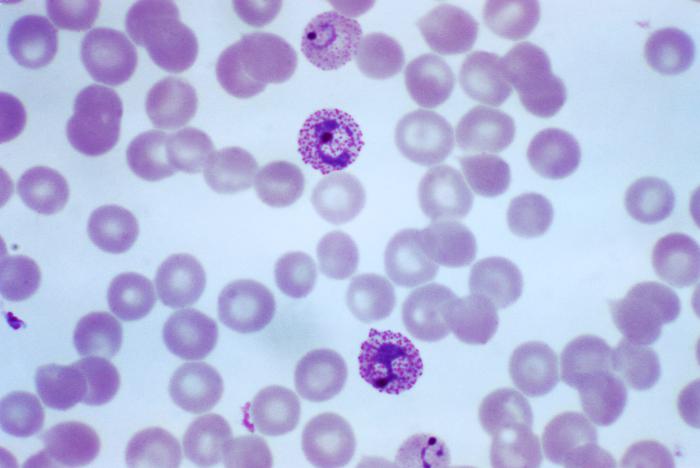
| Infected red cell | Normal size; Maurer's clefts; multiple infection common; ring forms often with 1–2 chromatin dots | Enlarged 1.5–2×, distorted; fine Schüffner's dots; large amoeboid trophozoite | Normal to 1.25×, round to oval, often fimbriated; Schüffner's dots | Normal to 0.75× (smaller); band forms, basket forms; Ziemann's stippling rarely |
| Mature schizont | 8–24 merozoites (rarely seen in peripheral blood) | 12–24 merozoites | 6–14 merozoites | 6–12 merozoites, rosette arrangement |
| Gametocyte | Crescent or sausage shaped | Round to oval, fills the red cell | Round to oval | Round to oval |
| Red cell preference | Cells of all ages (heavy parasitaemia) | Reticulocytes | — | Older red cells |
What is the malaria life cycle in humans and the mosquito?
There are two hosts. In the human (asexual cycle): an infected female Anopheles injects sporozoites while taking a blood meal. Within about 60 minutes they reach the liver and invade hepatocytes. They mature into schizonts (exo-erythrocytic schizogony), which rupture and release merozoites. In P. vivax and P. ovale, some parasites stay dormant as hypnozoites and can cause relapse weeks or years later. Merozoites invade red cells; the ring-stage trophozoite matures to a trophozoite and then a schizont, which ruptures to release more merozoites (erythrocytic schizogony). Some parasites differentiate into male and female gametocytes. The blood stage causes all clinical disease.

In the mosquito (sporogonic cycle): gametocytes are ingested with a blood meal. In the mosquito gut microgametes penetrate macrogametes to form zygotes, which become motile ookinetes. These cross the midgut wall and form oocysts, which grow and rupture to release sporozoites that migrate to the salivary glands, ready to infect the next person. The mosquito becomes infective about 10–14 days after biting an infected person (NCVBDC), and a person develops malaria 9–30 days after an infective bite.
| Stage | Where | Notes |
|---|---|---|
| Sporozoite | Mosquito salivary gland → human blood | Infective stage; reaches the liver within about 60 minutes |
| Schizont (hepatic) and hypnozoite | Liver | Hypnozoites only in P. vivax and P. ovale; need primaquine |
| Merozoite | Released from schizonts | Invades red cells |
| Ring → trophozoite → schizont | Red cell | Pigment (hemozoin) from haemoglobin digestion |
| Gametocyte | Red cell | Taken up by the mosquito; target of primaquine |
| Ookinete → oocyst | Mosquito midgut wall | Sporogony; sporozoites released from oocyst |
How does malaria cause disease?
- Red-cell destruction: parasites digest haemoglobin, forming hemozoin pigment, and make the red cell less deformable, causing haemolysis or splenic clearance. Free heme stimulates endothelial activation.
- Cytokines: toxins induce IFN-gamma and TNF-alpha. TNF suppresses haematopoiesis and contributes to anaemia; the liver and spleen enlarge, sometimes massively.
- Sequestration: infected red cells adhere to capillary endothelium; with P. falciparum this explains cerebral malaria and organ dysfunction.
- Parasitaemia and symptoms: symptoms start at about 0.002% parasitaemia in non-immune patients and about 0.2% in previously exposed patients; severe infection usually has about 5%.
- Anaemia: more severe in falciparum (all red cell ages, sequestration), moderate in vivax (reticulocytes) and malariae (older cells). Thrombocytopenia occurs in 60–70% of cases.
- Paroxysm: rigors, then fever for several hours, then sweating and fall to normal; it follows the synchronous rupture of schizonts.
Children have more seizures (60–80% in severe malaria), hypoglycaemia and severe anaemia but less pulmonary oedema and renal failure than adults. Pregnant women, especially in the second and third trimesters, are more likely to develop severe malaria; P. falciparum in pregnancy causes maternal anaemia, low birth weight, miscarriage, stillbirth and congenital malaria. Blackwater fever (massive intravascular haemolysis with haemoglobinuria and renal failure) is rare and has been linked to repeat falciparum infections treated with quinine and possibly G6PD deficiency.
How is malaria diagnosed?
| Test | Key points |
|---|---|
| Giemsa-stained thick and thin smear | Gold standard. Thick film detects low parasitaemia; thin film identifies species and stage. Use oil immersion. A single negative smear does not exclude malaria: repeat at 12 and 24 hours if suspicion is high |
| Rapid diagnostic test (RDT) | Detects HRP-2, parasite LDH or aldolase antigens; HRP-2 detects P. falciparum only. Cannot quantify parasite load; can remain positive for weeks after infection. India introduced bivalent RDT (falciparum and vivax) from 2013 |
| PCR | Detects very low parasitaemia and confirms species, useful when microscopy cannot separate vivax from ovale |
| Other | Microhematocrit centrifugation (acridine orange fluorescence); malarial pigment in monocytes and neutrophils on smear in severe disease |

How do the antimalarial drugs work and what are their key adverse effects?
| Drug | Action | Points to remember |
|---|---|---|
| Chloroquine / hydroxychloroquine | Blood schizonticide: interferes with parasite haemoglobin metabolism and raises intracellular pH | Resistance is a concern in P. falciparum in South Asia |
| Primaquine | Hypnozoitocidal (radical cure of P. vivax and P. ovale) and gametocidal | Contraindicated in G6PD deficiency (haemolysis; bite cells and Heinz bodies), pregnancy and infants. Stop if dark urine or blue lips. Take after a meal |
| Artemisinin derivatives (artesunate, artemether) | Rapidly active, per StatPearls against all parasite life-cycle stages | Backbone of ACT; artemisinin monotherapy production and sale is banned in India. Not given in the first trimester (ACT) |
| Sulfadoxine-pyrimethamine (SP) | ACT partner drug (antifolate) | Not for children under 5 months |
| Lumefantrine | ACT partner drug (artemether-lumefantrine, ACT-AL) | Not recommended in the first trimester or children under 5 kg (India) |
| Quinine | Blood schizonticide | Hypoglycaemia (take with food in pregnancy); used in the first trimester and as an alternative parenteral drug; add doxycycline or clindamycin |
| Atovaquone-proguanil | Atovaquone inhibits the electron transport chain; proguanil sensitises mitochondria | Active against erythrocytic and extra-erythrocytic forms (StatPearls) |
What is the India (NCVBDC) treatment of uncomplicated malaria?
The National Drug Policy on Malaria (2013) and the 2025 NCVBDC training module set the programme regimens. Treatment is given only to parasitologically confirmed cases (by microscopy or RDT). The key is to match the regimen to the species and, for falciparum, to the region.
| Situation | Drugs and doses |
|---|---|
| P. vivax | Chloroquine 25 mg/kg over 3 days (10 mg/kg day 1, 10 mg/kg day 2, 5 mg/kg day 3) plus primaquine 0.25 mg/kg daily for 14 days (supervised). Primaquine is contraindicated in infants, pregnant women and G6PD deficiency |
| P. falciparum: all states except the north-east | ACT-SP: artesunate 4 mg/kg daily for 3 days plus sulfadoxine 25 mg/kg with pyrimethamine 1.25 mg/kg on day 1 plus a single dose of primaquine 0.75 mg/kg on day 2. SP not for children under 5 months (use alternate ACT) |
| P. falciparum: north-eastern states | ACT-AL: co-formulated artemether 20 mg plus lumefantrine 120 mg, age- or weight-based, twice daily for 3 days, plus primaquine 0.75 mg/kg on day 2. Chosen because of SP partner-drug resistance. Not under 5 kg or in the first trimester |
| Mixed (vivax + falciparum) | Full course of area-specific ACT plus primaquine 0.25 mg/kg daily for 14 days |
| P. falciparum in pregnancy | First trimester: quinine 10 mg/kg three times daily for 7 days. Second and third trimester: area-specific ACT (ACT-AL in the north-east, ACT-SP elsewhere). No primaquine in pregnancy |
| Suspected treatment failure | If no response in 72 hours despite full treatment and no vomiting or diarrhoea: oral quinine plus tetracycline or doxycycline; report to the district or state malaria officer |
| Item | Detail |
|---|---|
| Pre-referral | Do an RDT, make a blood smear, give a parenteral artemisinin derivative or quinine in suspected cerebral malaria, and send the case sheet and slide with the patient |
| Artesunate | 2.4 mg/kg IV or IM at 0 h, 12 h, 24 h, then once daily |
| Artemether | 3.2 mg/kg IM on admission, then 1.6 mg/kg/day |
| Arteether | 150 mg IM daily for 3 days, adults only |
| Quinine | 20 mg salt/kg loading on admission (not if quinine already given) over IV infusion or divided IM, then 10 mg/kg every 8 hours; infusion rate not above 5 mg/kg per hour |
| Duration | Initial parenteral treatment for at least 48 hours (choose one of the four options); once started, parenteral therapy is given for a minimum of 24 hours even if the patient can take tablets sooner |
| Follow-up | After artemisinin: full course of area-specific oral ACT plus single-dose primaquine. After quinine: oral quinine 10 mg/kg three times a day to complete 7 days plus doxycycline 3 mg/kg once daily (or clindamycin 10 mg/kg twice daily; doxycycline avoided in pregnancy and under-8s), or area-specific ACT |
| Pregnancy | Severe malaria in any trimester can be treated with artemisinin derivatives, which do not aggravate hypoglycaemia as quinine does |
How does WHO and international guidance differ from the India programme?
| Topic | WHO guidelines for malaria | India (NCVBDC) |
|---|---|---|
| Falciparum ACT choices | Any one of: artemether-lumefantrine, artesunate-amodiaquine, artesunate-mefloquine, dihydroartemisinin-piperaquine, artesunate + SP, artesunate-pyronaridine. AS+SP and ASPY not in the first trimester | Region-specific: ACT-SP, or ACT-AL in the north-east |
| Gametocidal primaquine in falciparum | Single dose 0.25 mg/kg with an ACT in low-transmission areas (not pregnant women, infants under 1 month, or breastfeeding women of infants under 1 month); G6PD testing not required; not recommended where transmission is moderate to high | 0.75 mg/kg single dose on day 2 |
| Vivax and ovale radical cure | High total dose 7 mg/kg: 0.5 mg/kg/day for 14 days or 1 mg/kg/day for 7 days in G6PD-non-deficient patients (the 7-day option only with at least 70% G6PD activity). WHO notes that a low total dose of 3.5 mg/kg (0.25 mg/kg/day for 14 days, or 0.5 mg/kg/day for 7 days) may be used in South Asia and the Americas, where the added benefit of the high dose may be small | 0.25 mg/kg/day for 14 days (total 3.5 mg/kg) |
| Severe malaria | IV or IM artesunate for at least 24 hours until oral therapy tolerated, then a full ACT course | Artesunate, artemether, arteether or quinine as above |
| CDC regimen (via StatPearls) | Chloroquine phosphate 600 mg then 300 mg at 6, 24 and 48 h for chloroquine-sensitive infection; vivax or ovale add primaquine 30 mg daily for 14 days or tafenoquine 300 mg once; severe malaria IV artesunate 2.4 mg/kg at 0, 12, 24 and 48 h | Not part of the programme regimens |
Tafenoquine is mentioned in CDC guidance via StatPearls but is not part of the NCVBDC regimens quoted above. Always read which guideline the question names. See also antiprotozoal and anthelmintic drugs, G6PD deficiency and medical entomology: mosquito, flea, louse.
What are the common exam traps?
- Hypnozoites exist only in P. vivax and P. ovale. Falciparum and malariae do not relapse. The drug for hypnozoites is primaquine.
- Schüffner's dots + enlarged red cell = vivax (ovale also has dots but red cells are normal size and fimbriated). Banana-shaped gametocyte = falciparum. Band form = malariae.
- Tertian = 48 h (vivax, ovale); quartan = 72 h (malariae). Falciparum fever is irregular.
- RDT limitations: HRP-2 detects falciparum only; a positive result can persist for weeks.
- Primaquine is contraindicated in G6PD deficiency, pregnancy and infants.
- First-trimester falciparum in India = quinine; second and third trimester = ACT.
- North-east India = ACT-AL; rest of India = ACT-SP.
- Severe malaria = artesunate 2.4 mg/kg at 0, 12, 24 h then daily (IV or IM).