What is Meckel's diverticulum?
Meckel's diverticulum is the most common congenital anomaly of the gastrointestinal tract. It is a remnant of the omphalomesenteric (vitelline) duct — the embryonic channel that joins the yolk sac to the midgut — which failed to obliterate completely. It is a true diverticulum: it contains all layers of the small-bowel wall, unlike an acquired pulsion diverticulum.
Most people with a Meckel's diverticulum never know it: it is often found incidentally on imaging or at surgery. When it does cause trouble, the cause is usually acid from ectopic gastric mucosa inside it, or mechanical complications such as obstruction and diverticulitis.
Where does Meckel's diverticulum come from embryologically?
The vitelline (omphalomesenteric) duct connects the yolk sac to the gut and supplies nutrition until the placenta takes over. At about 7 weeks of gestation the duct normally separates from the intestine and involutes. If it fails to separate or involute — partly or completely — a spectrum of remnants results. If the duct detaches from the umbilicus but remains attached to the gut with no other attachment, a Meckel's diverticulum forms.

| Remnant | What persists | Clinical consequence |
|---|---|---|
| Meckel's diverticulum | Intestinal end of the duct as a blind pouch | Bleeding, obstruction, diverticulitis; often silent |
| Omphalomesenteric (vitelline) fistula | Duct stays open from the gut to the umbilicus | Drains through the umbilicus |
| Omphalomesenteric cyst | A cystic remnant of the duct | Cyst between gut and umbilicus |
| Fibrous band | Obliterated cord from the diverticulum to the umbilicus | Can cause small-bowel obstruction (band, volvulus) |
What is the rule of 2s in Meckel's diverticulum?
The rule of 2s is the classic way to recall the features:
| The '2' | Feature |
|---|---|
| 2% of the population | Prevalence is about 2%, though the exact figure is hard to pin down because most are silent |
| 2% symptomatic | Only a small minority ever cause symptoms |
| 2 years of age | Children are usually under 2 when symptomatic (average age of presentation about 2.5 years) |
| 2 : 1 male to female | Twice as common in males |
| 2 feet from the ileocaecal valve | In the ileum, about 2 feet proximal to the valve |
| 2 inches long | About 2 inches or shorter |
| 2 types of mucosa | Gastric or pancreatic ectopic tissue |
Why does Meckel's diverticulum bleed?
Normally, pancreatic bicarbonate in the duodenum neutralises acid secreted by gastric mucosa. In a Meckel's diverticulum, ectopic gastric mucosa secretes acid into the ileum where nothing neutralises it, so the adjacent ileal mucosa ulcerates and bleeds. The bleeding site is usually distal to the diverticulum, not within it.
- Two types of ectopic tissue: gastric and pancreatic. The ectopic mucosa can also be jejunal or mixed.
- About 15% of patients have ectopic tissue within the diverticulum.
- Risk factors for becoming symptomatic: age under 50, male sex, diverticulum longer than 2 cm, ectopic tissue, broad base, attached fibrous band.
- The origin of the ectopic tissue is unknown.
How does Meckel's diverticulum present?
Symptomatic cases usually present in the first decade, with an average age of about 2.5 years. The classic picture is painless rectal bleeding, typically described as currant-jelly or brick-coloured stool in children, while adults present with melaena. The bleeding often stops spontaneously as the splanchnic vessels constrict with hypovolaemia. Some patients nonetheless have abdominal pain.
| Presentation | Notes |
|---|---|
| Painless rectal bleeding | Commonest complication in children; leads to anaemia. Accounts for about 50% of lower GI bleeding in children under 2 years |
| Small-bowel obstruction | Commonest complication in adults: omphalomesenteric band, internal hernia, volvulus, incarceration, or intussusception with the diverticulum as the lead point |
| Meckel's diverticulitis | Inflammation, which can progress to perforation and peritonitis; can give appendicitis-like symptoms |
| Recurrent or atypical intussusception | Diverticulum acts as the lead point |
How is Meckel's diverticulum diagnosed?
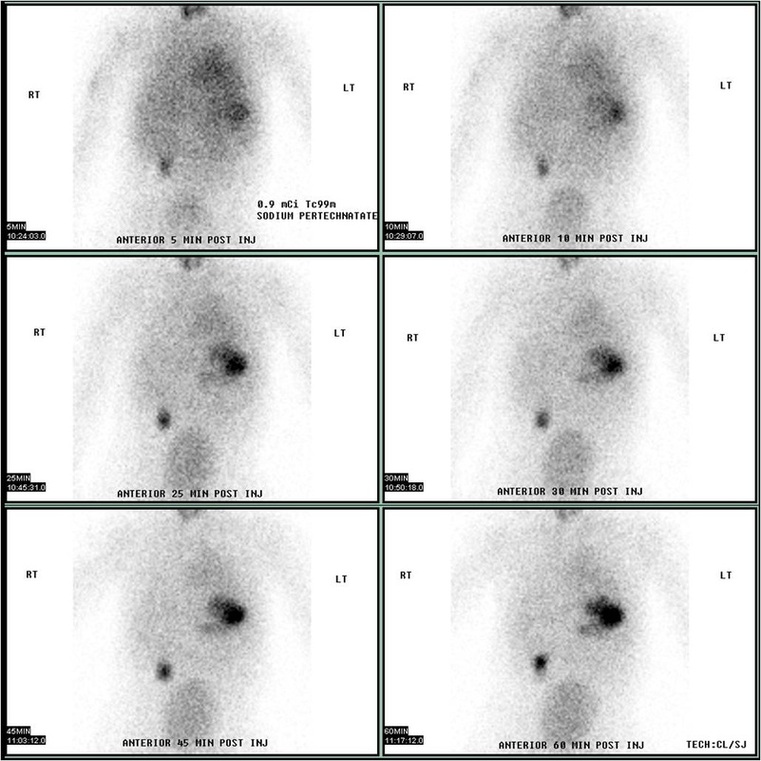
A plain abdominal X-ray is very low yield, and barium studies rarely fill the diverticulum. The most sensitive test is the Meckel radionuclide scan: technetium-99m is injected and taken up by the ectopic gastric mucosa, outlining the diverticulum. Uptake can be improved with cimetidine, ranitidine or glucagon.
| Test | Role |
|---|---|
| Meckel scan (Tc-99m pertechnetate) | Most sensitive; detects ectopic gastric mucosa |
| Tagged RBC scan | Detects active bleeding |
| CT abdomen and pelvis | May show inflammation or obstruction at the diverticulum |
| Mesenteric angiography | When scans are negative and bleeding is brisk; shows an anomalous SMA branch (long, non-branching) feeding the diverticulum. Needs bleeding above about 0.5 mL/min |
| Double-balloon enteroscopy, capsule endoscopy | Alternative ways to find the source |
| Laparoscopy or laparotomy | If tests are inconclusive or the patient is haemodynamically unstable |
How is Meckel's diverticulum treated?
Resuscitate first: volume resuscitation and blood transfusion for significant blood loss. Definitive treatment of a symptomatic diverticulum is surgical excision, laparoscopic or open, taking the diverticulum together with the adjacent ileum (bowel resection), because the ulcer that bleeds lies in the neighbouring ileum.
- Incidental diverticulum found at surgery for another reason: most surgeons recommend removal.
- Asymptomatic diverticulum discovered otherwise: surgery versus observation is controversial.
- There is a growing trend to laparoscopic excision.
- Complications to watch for: haemorrhage with anaemia, obstruction, intussusception, diverticulitis, perforation and peritonitis.
What are the common exam traps in Meckel's diverticulum?
- It is a true diverticulum (all layers), not a false one.
- It arises from the vitelline (omphalomesenteric) duct, which links the yolk sac to the gut.
- Bleeding is painless; the ulcer is in the adjacent ileum.
- Child: bleeding is the commonest complication; adult: obstruction is commonest.
- Best test: Tc-99m pertechnetate scan; cimetidine, ranitidine or glucagon can enhance uptake.
- Ectopic tissue: gastric (acid, bleeding) and pancreatic.
- Treatment: resection of the diverticulum with adjacent ileum.
See also intestinal obstruction, acute appendicitis (whose symptoms Meckel's diverticulitis can mimic) and anorectal disorders for other causes of rectal bleeding.