Written & reviewed by: Kinase Medical Team · Last reviewed: 30 September 2026 · Editorial policy
Key features
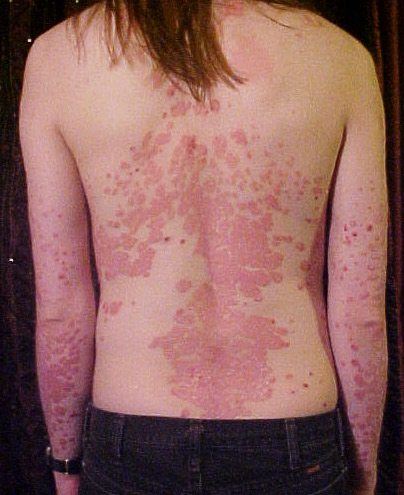
- Well-demarcated, erythematous, thickened plaques covered by thick silvery (micaceous) scale; on darker skin the plaques look brown, purple or grey rather than red.
- Typical sites: extensor elbows and knees, scalp, lumbosacral region/trunk and gluteal fold.
- Auspitz sign — pinpoint bleeding when the scale is lifted off a plaque.
- Koebner (isomorphic) phenomenon — new lesions appear at sites of trauma.
- Nail changes: pitting, onycholysis, ridging and dystrophy.
- Histology: acanthosis with elongated rete ridges, parakeratosis and neutrophils in the stratum corneum (Munro microabscesses).
Differential diagnosis
| Condition | How to tell it apart |
|---|---|
| Lichen planus | Flat-topped, violaceous, polygonal, itchy papules with white Wickham striae — not thick silvery scale. |
| Tinea corporis | A KOH preparation of skin scrapings shows fungal elements; psoriasis scrapings do not. |
How it appears in NEET PG
Dermatology image questions often show a plaque on the elbow, knee or back and ask for the diagnosis, the eponymous sign or the histology (Munro microabscess). Drug triggers are a common follow-up.
Frequently asked questions
What is the Auspitz sign in psoriasis?
It is the appearance of tiny bleeding points when the silvery scale is scraped off a psoriatic plaque. It reflects thinning of the epidermis over elongated dermal papillae.
Which drugs can worsen psoriasis?
Harrison's lists lithium, beta-blockers and antimalarial drugs as external factors that can exacerbate psoriasis, along with infections and stress.
Where does plaque psoriasis usually appear?
On the extensor surfaces of the elbows and knees, the scalp, the lower back and trunk and the gluteal fold, although any site can be involved.
Sources
- DermNet — Chronic plaque psoriasis
- Harrison's Principles of Internal Medicine (textbook)
- Nelson Essentials of Pediatrics (textbook)
Keep practising
- NEET PG Dermatology previous-year questions
- Molluscum Contagiosum
- Oral Lichen Planus (Wickham Striae)
- All clinical images
For exam preparation and medical education only — not a substitute for clinical judgement, diagnosis or treatment of any patient.