What is the anion gap?
Plasma is electrically neutral: total cations equal total anions. A routine renal panel, however, measures only the main ions — sodium among the cations and chloride and bicarbonate among the anions. Because there are normally more unmeasured anions than unmeasured cations, subtracting the measured anions from sodium leaves a positive number: the anion gap (AG). It is not a real ‘gap’ in the blood — it is a calculated estimate of the anions the analyser does not report.
| Unmeasured anions (raise the AG) | Unmeasured cations (lower the AG) |
|---|---|
| Albumin — the predominant contributor | Potassium (when left out of the formula) |
| Phosphate, sulphate | Calcium, magnesium |
| Organic anions: lactate, ketoacids (β-hydroxybutyrate, acetoacetate), formate, glycolate, oxalate, salicylate | Cationic immunoglobulins (IgG paraprotein), lithium |

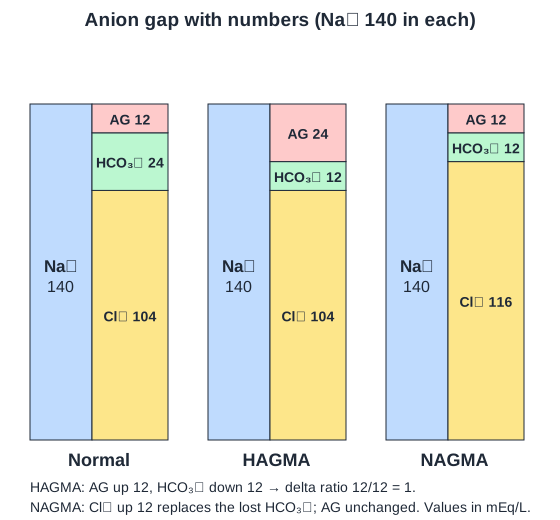
When a strong acid (HA) is added to the blood, its H+ is buffered by bicarbonate and its anion (A−) stays behind. Bicarbonate falls, chloride does not change, and the anion gap rises by roughly the amount bicarbonate falls. When bicarbonate is instead lost (diarrhoea, renal tubular acidosis), the kidney retains chloride to keep neutrality — bicarbonate falls, chloride rises, and the gap stays normal. That single idea explains the whole HAGMA/NAGMA split.
What is the anion gap formula, with and without potassium?
AG = Na⁺ − (Cl⁻ + HCO₃⁻)
The standard formula used in most laboratories and in NEET PG / INI-CET questions. Units: mEq/L (= mmol/L for these monovalent ions).
AG (with K⁺) = (Na⁺ + K⁺) − (Cl⁻ + HCO₃⁻)
Potassium is often ignored because its plasma concentration is low and varies only by a few mEq/L. Including it raises the normal range by about 4 mEq/L.
Worked example: Na⁺ 138, Cl⁻ 100, HCO₃⁻ 14 mEq/L. AG = 138 − (100 + 14) = 24 mEq/L — a high anion gap metabolic acidosis. If the question also gives K⁺ 4.0 and asks for the gap ‘including potassium’, the answer becomes 28 mEq/L. Read the stem: most exam calculations expect the formula without potassium even when K⁺ is listed.
What is a normal anion gap, and why does the range vary?
Textbooks usually quote about 8–12 mEq/L (mean ~10) without potassium and about 12–16 mEq/L when potassium is included. These are teaching numbers, not universal truths. Each laboratory should set its own reference interval because sodium, chloride and bicarbonate are measured by different methods and calibrations; bicarbonate in particular is hard to harmonise between platforms, and small errors in three measured values add up in one calculated number.
| Anion gap | Interpretation |
|---|---|
| < 8 mEq/L (below the lab's range) | Low AG — check albumin first; then paraprotein, hypercalcaemia/hypermagnesaemia, lithium, bromide, or lab error |
| ~8–12 mEq/L | Normal (use the lab's own interval) |
| Above the upper limit (e.g. > 12–14) | Look for an added acid; interpret with bicarbonate, albumin and clinical picture |
| > 20 mEq/L | Almost always a genuine high anion gap acidosis |
A raised anion gap does not always mean acidaemia. A patient can have a high gap with a near-normal pH if a metabolic alkalosis (for example from vomiting) coexists — which is exactly why the gap should be calculated on every renal panel, not only when bicarbonate is low.
How do you correct the anion gap for low albumin?
Albumin is the largest unmeasured anion, so hypoalbuminaemia lowers the anion gap and can hide a high anion gap acidosis. This matters in exactly the patients who get acid-base questions: ICU sepsis, cirrhosis, nephrotic syndrome and malnutrition.
Corrected AG = measured AG + 2.5 × (normal albumin − measured albumin in g/dL)
Normal albumin is taken as 4.0 g/dL in some references and 4.5 g/dL in others. In SI units: corrected AG = AG + 0.25 × (40 − albumin in g/L).
Example: a septic patient has AG 11 mEq/L — apparently normal — but albumin 2.0 g/dL. Corrected AG = 11 + 2.5 × (4.0 − 2.0) = 16 mEq/L, a raised gap that should prompt a lactate level.
What causes a high anion gap metabolic acidosis (HAGMA)?
Every HAGMA means an acid with an unmeasured anion has been added — made by the body (lactate, ketones), retained by failing kidneys (sulphate, phosphate, other anions) or swallowed (toxic alcohols, salicylate).
| Cause | Unmeasured anion | Key clue in a stem |
|---|---|---|
| Lactic acidosis | L-lactate | Shock, sepsis, limb or bowel ischaemia, metformin, liver failure |
| Ketoacidosis — diabetic, alcoholic, starvation | β-hydroxybutyrate, acetoacetate | Type 1 diabetes, fruity breath, Kussmaul breathing; alcoholic binge with vomiting |
| Renal failure (advanced) | Sulphate, phosphate and other retained anions | High urea/creatinine; early CKD is more often a normal-gap acidosis |
| Methanol | Formate | Illicit liquor (‘hooch’), blurred vision, optic nerve damage |
| Ethylene glycol | Glycolate, oxalate | Antifreeze, calcium oxalate crystals in urine, acute kidney injury |
| Salicylate poisoning | Salicylate + lactate/ketoacids | Early hyperventilation (respiratory alkalosis), then metabolic acidosis — often a mixed ABG |
| D-lactic acidosis | D-lactate (not detected by routine lactate assay) | Short bowel syndrome; routine (L-)lactate is normal |
| 5-oxoproline (pyroglutamic acid) | 5-oxoprolinate | Chronic paracetamol use, especially in elderly patients |
| Other glycols | Glycolate, lactate | Propylene glycol or diethylene glycol exposure |
For suspected toxic alcohols, add the serum osmolal gap (measured minus calculated osmolality). Early after ingestion the unmetabolised alcohol raises the osmolal gap while the anion gap may still be normal; as it is converted to organic acids, the osmolal gap falls and the anion gap rises. Treatment blocks alcohol dehydrogenase with fomepizole (or ethanol), with haemodialysis in severe cases.
Calculated osmolality = 2 × Na⁺ + glucose (mg/dL) ÷ 18 + BUN (mg/dL) ÷ 2.8; Osmolal gap = measured − calculated
Ethanol also raises the osmolal gap (add ethanol mg/dL ÷ 4.6 if a level is known; some references use an empirical ÷ 3.7). Cut-offs for an ‘abnormal’ gap vary between references (commonly > 10, some use > 20 mOsm); a normal gap does not exclude a late presentation, when the alcohol has already been metabolised.
What causes a normal anion gap (hyperchloraemic) metabolic acidosis?
In NAGMA the problem is bicarbonate loss or chloride gain, so chloride rises as bicarbonate falls and the gap stays normal. It is therefore also called hyperchloraemic metabolic acidosis.
| Mechanism | Examples |
|---|---|
| GI bicarbonate loss | Diarrhoea (the commonest cause), pancreatic fistula, urinary diversion into bowel (e.g. ileal conduit) |
| Renal bicarbonate loss or failure of acid excretion | Renal tubular acidosis (type 1 distal, type 2 proximal, type 4 hyperkalaemic), early CKD, carbonic anhydrase inhibitors (acetazolamide), hypoaldosteronism |
| Chloride load | Large-volume 0.9% saline (154 mEq/L chloride) resuscitation |
| Rapid loss of organic anion in urine | Recovery phase of diabetic ketoacidosis — ketoanions are excreted before bicarbonate is regenerated |
| Compensation | Renal compensation for chronic respiratory alkalosis |
How do the delta ratio and delta gap reveal mixed disorders?
In a pure HAGMA, each mEq of added acid consumes about one mEq of bicarbonate, so the rise in AG roughly equals the fall in HCO₃⁻. Comparing the two tells you whether a second metabolic process is hiding.
Delta ratio = (measured AG − 12) ÷ (24 − measured HCO₃⁻)
Delta gap = (AG − 12) − (24 − HCO₃⁻). A delta gap near zero corresponds to a delta ratio near 1.
| Delta ratio | Meaning |
|---|---|
| < 1 | Bicarbonate has fallen more than the AG rose — HAGMA + NAGMA (e.g. DKA with diarrhoea, or DKA on saline) |
| 1–2 | Pure (uncomplicated) HAGMA |
| > 2 | Bicarbonate is higher than expected — HAGMA + metabolic alkalosis (e.g. ketoacidosis with vomiting) |
These are the StatPearls bands, also used by our anion gap calculator. Some texts instead use a narrower 0.8–1.2 band for a pure HAGMA (with < 0.8 and > 1.2 for the mixed disorders), and lactic acidosis often runs a little above 1, so treat the bands as guides. Worked example: Na⁺ 130, Cl⁻ 66, HCO₃⁻ 18 in a vomiting patient. AG = 46; the gap rose by 34 but bicarbonate fell by only 6 → ratio ≈ 5.7 → a severe HAGMA (lactate) plus a metabolic alkalosis from vomiting, despite a deceptively mild bicarbonate.
What is the urine anion gap and when is it useful?
Urine AG = (urine Na⁺ + urine K⁺) − urine Cl⁻
Used only in a normal anion gap metabolic acidosis, as an indirect estimate of urinary ammonium (NH₄⁺) excretion — ammonium leaves the urine with chloride.
| Urine AG | What it implies | Typical cause |
|---|---|---|
| Negative (often −20 to −50) | Kidneys are excreting plenty of NH₄⁺ — renal acidification intact | GI bicarbonate loss (diarrhoea); proximal (type 2) RTA is not excluded |
| Positive despite acidosis | Ammonium excretion is inappropriately low | Distal (type 1) RTA or type 4 RTA |
What causes a low anion gap?
A low anion gap is uncommon and should first prompt a check of albumin and of the laboratory result itself. Genuine causes either add unmeasured cations or falsely raise measured chloride.
| Mechanism | Examples |
|---|---|
| Fewer unmeasured anions | Hypoalbuminaemia — the most common cause (if the gap is not albumin-corrected) |
| More unmeasured cations | IgG multiple myeloma (cationic paraprotein), hypercalcaemia, hypermagnesaemia, lithium toxicity, polymyxin B |
| Falsely high chloride (pseudohyperchloraemia) | Bromide or iodide-containing drugs (e.g. pyridostigmine bromide) |
| Laboratory error | Falsely high sodium or falsely low chloride/bicarbonate |
How are anion gap questions framed in NEET PG and INI-CET? (Worked cases)
Recent papers have asked the anion gap in three ways: a pure calculation, a ‘which disorder’ question built on an ABG, and a ‘which cause gives a normal gap’ question. Working through recalled values shows the traps.
| Values given | Calculation | What the examiner wants |
|---|---|---|
| Na⁺ 130, Cl⁻ 84, HCO₃⁻ 16 | AG = 130 − 100 = 30 | A clearly raised gap — HAGMA. Distractors are usually the numbers you get by adding K⁺ or by subtracting wrongly. |
| Na⁺ 145, K⁺ 4.0, Cl⁻ 90, HCO₃⁻ 20 (CKD) | AG = 145 − 110 = 35 (without K⁺) | Use the standard formula even though K⁺ is listed. Bonus: delta ratio = 23 ÷ 4 ≈ 5.8, so a metabolic alkalosis is hiding behind the HAGMA. |
| Glucose 450 mg/dL, pH 7.31, Na⁺ 135, Cl⁻ 92, HCO₃⁻ 20 | AG = 135 − 112 = 23 | HAGMA from diabetic ketoacidosis — even though bicarbonate is only mildly low. |
| Profuse diarrhoea vs DKA vs AKI vs lactic acidosis | — | Diarrhoea is the normal-gap cause; the others add unmeasured anions. |
| ‘Hooch’ (illicit liquor) with visual blurring | — | Methanol → formic acid → HAGMA with a raised osmolal gap; treat with fomepizole or ethanol ± dialysis. |
Clinical vignettes also pair the anion gap with signs from other systems: Kussmaul breathing and fruity breath (ketoacidosis), visual loss after country liquor (methanol), oxalate crystals and acute kidney injury (ethylene glycol), hypercalcaemia with anaemia and a very low gap (myeloma), and hypokalaemia with kidney stones and alkaline urine (distal RTA). Recognising the pattern often gives the answer before any arithmetic.
Where does the anion gap fit in a stepwise ABG approach?
- Check the numbers are consistent (Henderson–Hasselbalch: pH ≈ 6.1 + log [HCO₃⁻ ÷ (0.03 × PaCO₂)]).
- Acidaemia or alkalaemia? pH below or above 7.40 (normal 7.35–7.45).
- Primary process? Low HCO₃⁻ with low pH = metabolic acidosis.
- Is compensation appropriate? Expected PaCO₂ = 1.5 × HCO₃⁻ + 8 ± 2 (Winter's formula) — see Kussmaul breathing.
- Calculate the anion gap and correct it for albumin.
- If the gap is high, calculate the delta ratio to find a hidden NAGMA or metabolic alkalosis.
- Add the osmolal gap when a toxic alcohol is possible; use the urine AG when the gap is normal.
- Match the result to the clinical story — lactate, ketones, creatinine, drugs, GI losses.
