During a histology viva a demonstrator points in turn to three cutaneous receptors on a labelled skin section: first a large onion-like lamellated corpuscle sitting deep in the dermis, then a spindle-shaped encapsulated ending lying among the dermal collagen bundles, and finally bare unmyelinated terminals reaching up between the epidermal cells. In that order, the three structures are:
- A.Pacinian, Ruffini, free nerve endings
- B.Ruffini, Pacinian, Merkel
- C.Meissner, Pacinian, Ruffini
- D.Merkel, free nerve endings, Pacinian
Show answer and explanation
Answer: A. Pacinian, Ruffini, free nerve endings
Correct answer: A. Pacinian, Ruffini, free nerve endings
The deep, large, onion-like lamellated corpuscle is a Pacinian corpuscle (rapidly adapting, senses deep pressure and high-frequency vibration). The spindle-shaped ending among dermal collagen is a Ruffini ending (slowly adapting, senses skin stretch). The bare terminals climbing into the epidermis are free nerve endings (pain, temperature, crude touch). So the correct sequence is Pacinian, Ruffini, free nerve endings.
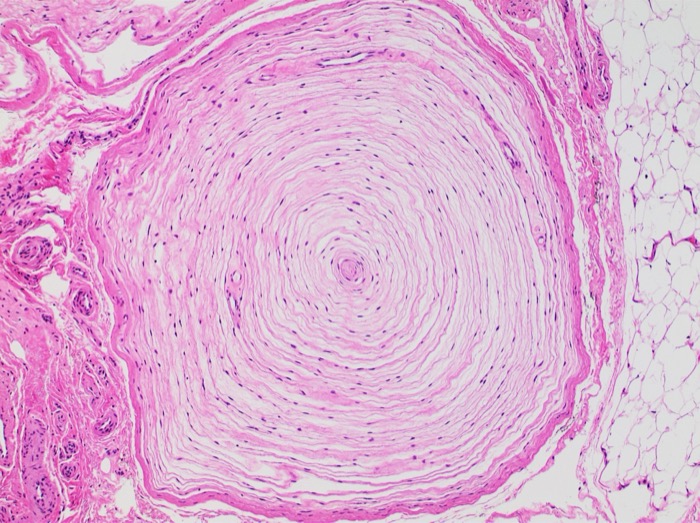
Pacinian, Ruffini, free nerve endings.
Incorrect Options:
- B. Ruffini, Pacinian, Merkel: reverses the first two and adds Merkel; the deep lamellated body is Pacinian, not Ruffini.
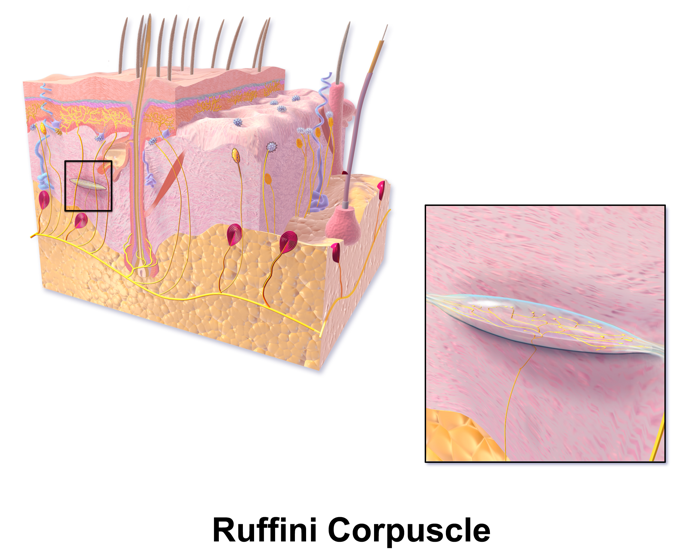
Ruffini, Pacinian, Merkel. - C. Meissner, Pacinian, Ruffini: Meissner corpuscles sit in dermal papillae for fine touch, not deep in the dermis.
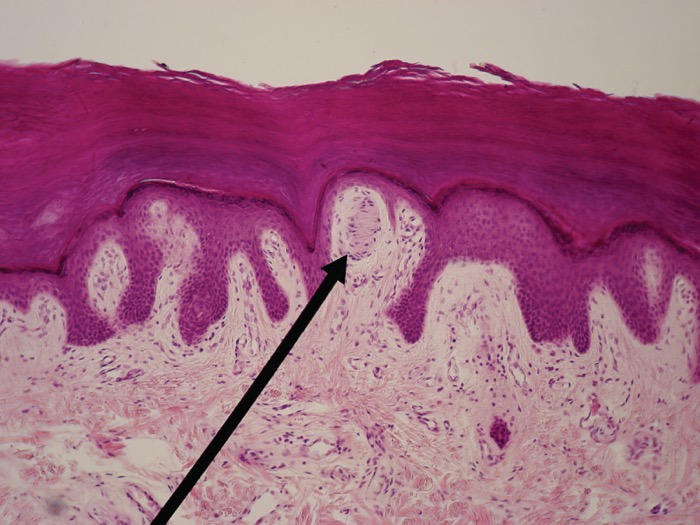
Meissner, Pacinian, Ruffini. - D. Merkel, free nerve endings, Pacinian: Merkel discs are epidermal slowly-adapting touch cells, not the deep lamellated corpuscle.
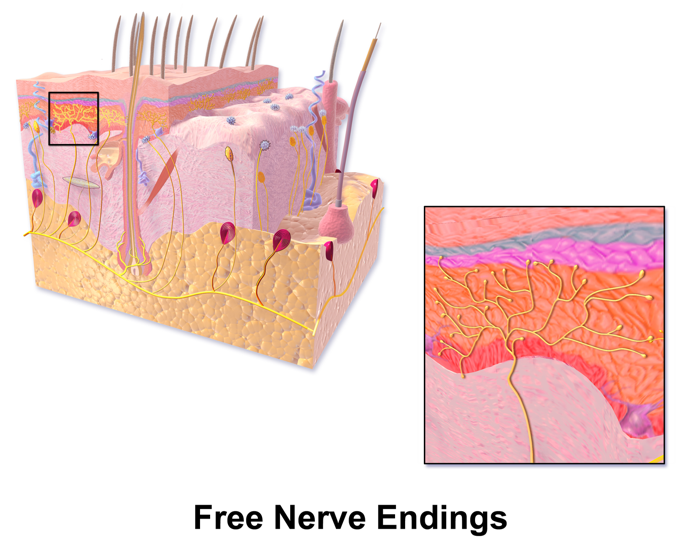
Merkel, free nerve endings, Pacinian.
High-Yield Facts:
- Pacinian and Meissner corpuscles are rapidly adapting; Merkel discs and Ruffini endings are slowly adapting.
- Pacinian corpuscle = deep pressure and vibration; Meissner = fine discriminative touch in dermal papillae.
- Ruffini endings detect sustained skin stretch; free nerve endings carry pain and temperature.
- Free nerve endings are the only unencapsulated, unmyelinated cutaneous receptors.