What is kernicterus?
Kernicterus is bilirubin-induced neurological damage, seen mostly in newborns. Strictly, the word describes the yellow staining of deep brain nuclei at autopsy; clinically it is used for chronic (permanent) bilirubin encephalopathy. The reversible early illness is called acute bilirubin encephalopathy (ABE), and the whole range of permanent disability is now grouped as kernicterus spectrum disorder.
It is rare where screening and phototherapy are routine — StatPearls estimates acute bilirubin encephalopathy at about 1 in 10,000 live births and chronic encephalopathy at about 1 in 50,000 to 100,000 — but the burden is far higher in low-income settings: 82% of kernicterus-related deaths occur in low- and lower-middle-income countries, with the greatest burden in African and South Asian populations.

Why is unconjugated bilirubin toxic to the newborn brain?
Bilirubin travels in the blood bound to albumin. It is the small unbound (free) fraction of unconjugated bilirubin that enters the brain, so anything that lowers albumin or displaces bilirubin from albumin raises the risk at the same total serum bilirubin (TSB). Serum albumin is used as a practical surrogate for free bilirubin, and the bilirubin-to-albumin ratio is sometimes used alongside TSB.
Inside the brain, bilirubin binds to neuronal and glial membranes, damages mitochondria, inhibits oxidative phosphorylation, triggers calcium release and apoptosis, and impairs axonal and dendritic growth. Neurons and oligodendrocytes are both injured.
| Frequency | Structures | Clinical correlate |
|---|---|---|
| Most often | Globus pallidus, subthalamic nucleus, hippocampus | Dystonia, choreoathetosis (basal ganglia) |
| Less often | Striatum, thalamus, cranial nerve nuclei (auditory, oculomotor), inferior olives, dentate nucleus of the cerebellum | Hearing loss (auditory pathway), upward gaze palsy, ataxia |
What are the phases of acute bilirubin encephalopathy?
Acute bilirubin encephalopathy is described in three phases. The early phase is non-specific and easy to miss — but it is the phase in which prompt treatment can halt progression and may allow full recovery.
| Phase | Typical timing | Features |
|---|---|---|
| Early | First days of severe jaundice | Lethargy, hypotonia (weakness), poor suck and poor feeding |
| Intermediate | Progressing illness | Extensor hypertonia, retrocollis (neck arched backward), opisthotonus (back arched) |
| Late / advanced | After the first week | Hypotonia replaces hypertonia in infants older than 1 week; the injury is usually permanent by now |
- The brainstem auditory evoked response (BAER / ABR) is used to detect hearing impairment, a common sequel of bilirubin toxicity.
- Scoring: the modified Bilirubin-Induced Neurologic Dysfunction (BIND) score helps screen at-risk newborns for evolving damage.
- Jaundice in the first 24 hours of life is always pathological — look for haemolysis.
What are the features of chronic kernicterus?
Chronic bilirubin encephalopathy evolves slowly over the first years of life. Its clinical picture mirrors the structures that bilirubin damages.
| Feature | Structure damaged | Note |
|---|---|---|
| Extrapyramidal movement disorder — choreoathetoid (dyskinetic) cerebral palsy, dystonia | Globus pallidus, subthalamic nucleus | 'Motor-predominant' kernicterus |
| Auditory dysfunction — sensorineural hearing loss / auditory neuropathy | Brainstem auditory nuclei and pathway | Hearing loss is the most common abnormality; 'auditory-predominant' kernicterus |
| Oculomotor abnormality — gaze palsy, especially upward gaze | Brainstem oculomotor (cranial nerve) nuclei | Visual abnormalities including gaze palsies |
| Dental enamel hypoplasia (dental dysplasia) | Developing teeth | Abnormal dentition is a recognised complication |
- Other features: hypotonia with hyperreflexia, delayed motor milestones, ataxia and, in some children, intellectual disability.
- Phenotypes: motor-predominant, auditory-predominant, subtle kernicterus (bilirubin-induced neurologic dysfunction, BIND) and kernicterus plus (all features together).
What does kernicterus look like on MRI?
Imaging is not needed to diagnose kernicterus — the diagnosis is clinical plus bilirubin levels — but MRI supports it when the picture is unclear or another encephalopathy is suspected.
| Stage | T1-weighted | T2-weighted |
|---|---|---|
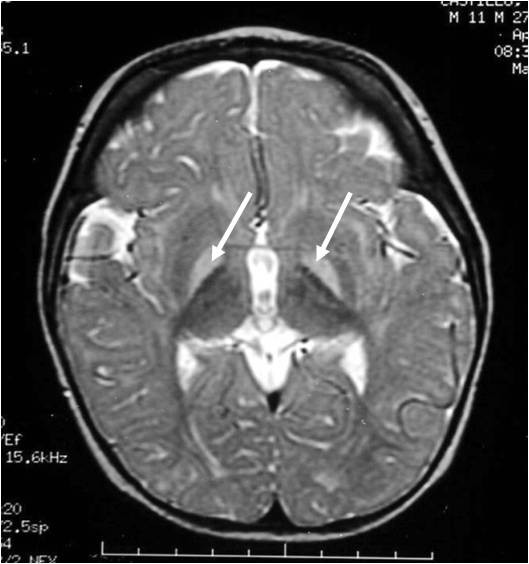
| Early (neonatal) | Hyperintense, symmetrically, in the globi pallidi (posteromedial border) | Signal change is less prominent early |
| Later / chronic | Evolves to hypointense | High signal develops as the disease progresses |
- The posteromedial border of the globus pallidus is the most sensitive place to look; the subthalamic nuclei, hippocampus, putamen, thalamus and cranial nerve nuclei can also be involved.
- Early MRI can confirm but cannot reliably exclude kernicterus spectrum disorder — studies show much better accuracy by 12 months of age.
- Imaging differentials: hypoxic-ischaemic encephalopathy, hypoglycaemia, carbon monoxide poisoning, encephalitis and inborn errors of metabolism.
What are the causes and risk factors for kernicterus?
| Mechanism | Examples |
|---|---|
| Increased production — haemolysis | Rh and ABO isoimmunisation, G6PD deficiency, hereditary spherocytosis and elliptocytosis, pyruvate kinase deficiency, thalassaemias |
| Increased production — extra red cells or blood | Polycythaemia, cephalohaematoma, subgaleal haemorrhage, bruising from birth trauma; infants of diabetic mothers |
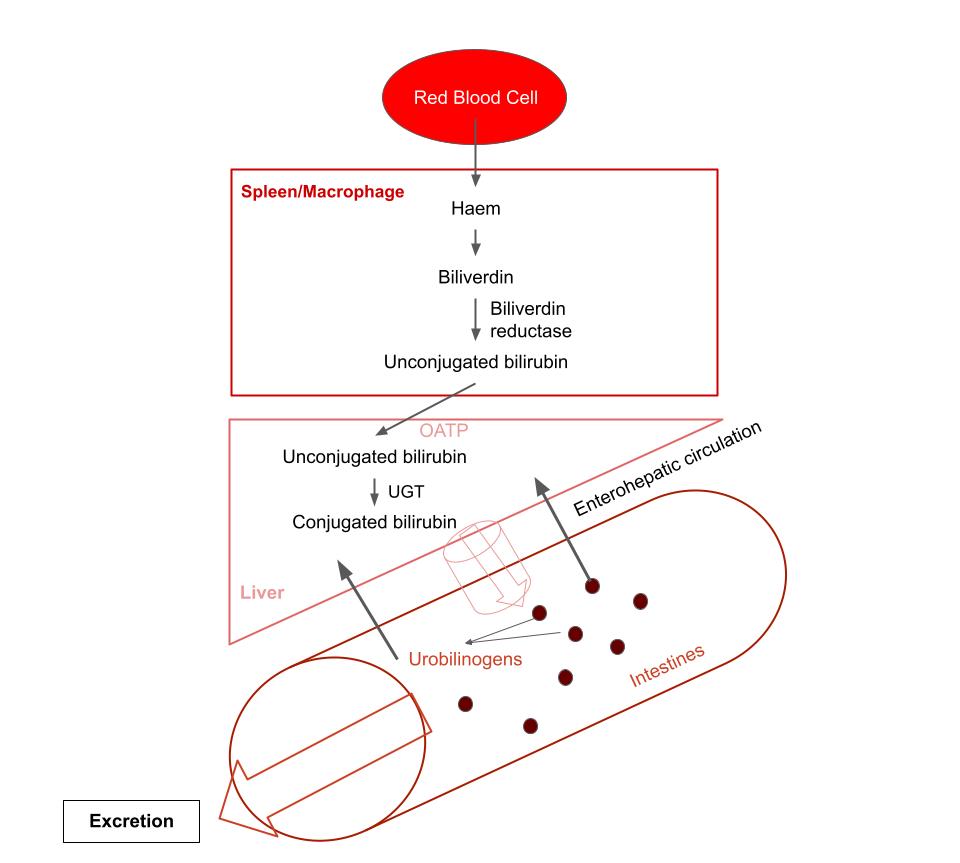
| Impaired conjugation | Newborn immaturity, Crigler-Najjar syndrome (type 1: no UGT activity), Gilbert syndrome (contributory) |
| Increased enterohepatic circulation | Suboptimal breastfeeding intake, delayed passage of stool, breast-milk jaundice (beta-glucuronidase in milk deconjugates bilirubin) |
| Drugs and other | Some drugs (eg sulfonamides, ceftriaxone) are linked to unconjugated hyperbilirubinaemia and certain drugs displace bilirubin from albumin; congenital hypothyroidism, intestinal obstruction, sepsis |
In the US Kernicterus Registry, G6PD deficiency was found in 21.3%, severe haemolysis in 20.5% and birth trauma in 15% — but no cause was found in 43.4%, which is why universal screening matters. G6PD deficiency is increasingly recognised worldwide as a major contributor.
- Bilirubin level and risk: kernicterus was classically linked to TSB around 25 mg/dL or more; the risk of chronic kernicterus is about 1 in 7 when TSB exceeds 30 mg/dL, yet it also occurs below 25 mg/dL — so the AAP uses continuous, gestation-specific curves rather than one number.
- Preterm babies and boys are at higher risk. The 2022 guideline dropped the old idea that Black race is protective, partly because of G6PD deficiency.
What does the AAP 2022 hyperbilirubinaemia guideline say?
The American Academy of Pediatrics revised its guideline in 2022 (Kemper et al, Pediatrics) for infants born at 35 weeks or more. Compared with the previous guideline it raised both phototherapy and exchange-transfusion thresholds and it individualises them by gestational age, age in hours and neurotoxicity risk factors.
| Element | What it says |
|---|---|
| Screening | Universal pre-discharge bilirubin screening (TSB or transcutaneous) with risk assessment; follow-up timed by how close the bilirubin is to the phototherapy threshold |
| Measurement | TSB is the definitive test for phototherapy and exchange decisions; transcutaneous readings screen only |
| Phototherapy threshold | Gestation-specific hour-by-hour curves; lower curves when any neurotoxicity risk factor is present |
| Escalation of care | TSB within 2 mg/dL of the exchange threshold = medical emergency: intensive phototherapy, IV hydration, neonatology input, transfer to a unit able to do exchange, TSB at least every 2 hours |
| Exchange transfusion | If signs of acute bilirubin encephalopathy appear, or TSB reaches the exchange threshold despite intensive phototherapy |
| IVIG | May be considered at 0.5–1 g/kg over 2 hours (repeatable after 12 hours) in DAT-positive isoimmune haemolysis when TSB reaches the escalation threshold despite intensive phototherapy |
| Not recommended | Routine water or dextrose-water supplements for jaundice |
How is kernicterus prevented and treated?
- Phototherapy: blue-green light (about 460–490 nm) converts bilirubin into water-soluble isomers such as lumirubin, excreted in bile and urine without conjugation. Expose maximum skin, shield the eyes, keep the baby hydrated; side effects include temperature instability, dehydration and skin darkening; rare bronze baby syndrome occurs when conjugated bilirubin is raised.
- Exchange transfusion: emergent, definitive removal of circulating bilirubin by replacing the baby's blood in small aliquots with compatible donor blood. Watch for hypoglycaemia, thrombocytopenia, hyperkalaemia (blood older than 5 days) and hypocalcaemia from citrate.
- IVIG in selected DAT-positive Rh or ABO haemolytic disease (evidence is low certainty; not routine).
- Prevent haemolytic disease: Rh(D) immunoglobulin to Rh-negative mothers prevents sensitisation and erythroblastosis fetalis.
- Support feeding: early, frequent breastfeeding reduces dehydration and enterohepatic recycling.
- Crigler-Najjar type 1 (complete absence of UGT activity, autosomal recessive): severe jaundice in the first days of life, often with encephalopathy; oral calcium phosphate with phototherapy may be considered.
- Once chronic kernicterus is established there is no disease-modifying treatment — care is rehabilitative and supportive, and the prognosis is poor.
