Rule of Nines — Burn Surface Area, Lund-Browder Chart and Parkland Formula

Written & medically reviewed by the Kinase Medical Team · Last reviewed

Quick Answer

The Wallace rule of nines estimates adult burn size by giving the head and neck 9%, each upper limb 9%, the front and back of the trunk 18% each, each lower limb 18% and the perineum 1%. Only partial- and full-thickness burns are counted. Children need the Lund-Browder chart because their heads are proportionally larger.

What is the rule of nines?

The rule of nines is a quick bedside method for estimating the percentage of total body surface area (%TBSA) that is burned. It divides the adult body into regions that are each 9% or a multiple of 9%, with the perineum making up the final 1%. The estimate drives almost every early burn decision — the need for IV fluids, the Parkland volume, and referral to a burn centre.

The concept was first discussed by Pulaski and Tennison in 1949, and A. B. Wallace popularised it in The Lancet in 1951 — which is why exams call it Wallace's rule of nines. It is deliberately crude: Schwartz describes it as 'crude but quick and effective'.

Front and back body outlines colour-coded by region: head and neck 9 percent, each upper limb 9 percent, trunk 36 percent, genitalia 1 percent, each lower limb 18 percent
Wallace rule of nines for an adult: every region is 9% or a multiple of 9%, and the perineum/genitalia make up the final 1%.Image: Jmarchn, CC BY-SA 3.0

What are the rule of nines percentages in an adult?

Wallace rule of nines — adult
RegionWhole regionFront (anterior)Back (posterior)
Head and neck9%4.5%4.5%
Each upper limb9%4.5%4.5%
Trunk — front (chest 9% + abdomen 9%)18%18%—
Trunk — back (upper back 9% + lower back 9%)18%—18%
Each lower limb18%9%9%
Perineum / genitalia1%——
Total100%
Front and back body outline chart split into regions: head 4.5 percent front and back, each arm 4.5 percent front and back, chest 9, abdomen 9, upper back 9, lower back 9, each leg 9 percent front and back, perineum 1 percent
Front and back halves of each region. Use it for partial burns: the front of the head (face) is 4.5%, and the front of one leg is 9%.Image: Rocuronium Bromide, CC0

Add it up: head 9 + two arms 18 + trunk 36 + two legs 36 + perineum 1 = 100%. A handy derivation for partial regions: each lower limb is 18%, so the thigh alone (front + back) is 9%, and the front of one thigh is 4.5%. The face alone is the front half of the head — 4.5%.

How is burn area estimated in children — rule of nines or Lund-Browder?

Infants and young children have proportionately larger heads and smaller legs, so the adult rule of nines is prone to error. A simple paediatric modification gives the head 18% and each leg 13.5%. The more accurate method is the Lund and Browder chart, which adjusts the head and leg percentages for age. Getting this right matters more in children because they have smaller circulating blood volumes, a greater surface-area-to-mass ratio and thinner skin than adults (StatPearls).
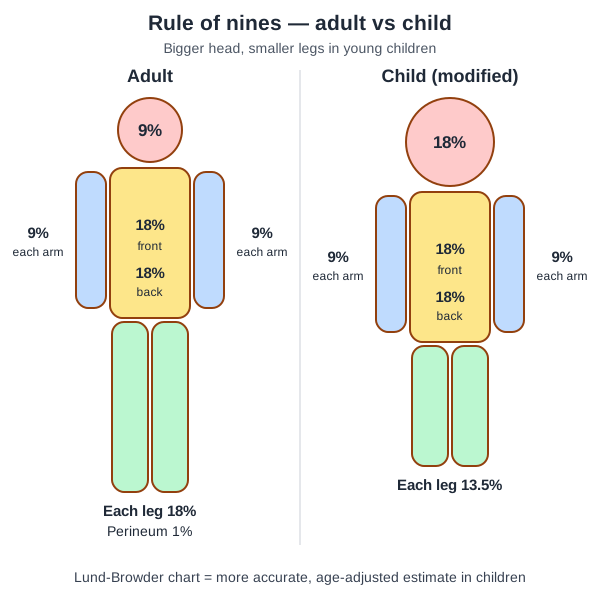
Two body diagrams comparing the adult rule of nines (head 9 percent, each leg 18 percent) with the modified paediatric rule (head 18 percent, each leg 13.5 percent); arms 9 percent and trunk 18 percent front and 18 percent back in both
In young children the head is proportionately larger and the legs smaller, so the modified rule gives the head 18% and each leg 13.5%. The Lund-Browder chart adjusts these for age and is more accurate.Image: Kinase, Kinase original
Adult rule of nines vs paediatric estimates
RegionAdult (rule of nines)Child (modified rule of nines)Lund-Browder (children)
Head9%18%Varies with age — largest in infants, falls as the child grows
Each upper limb9%9%About 10% (StatPearls)
Front of trunk18%18%About 13%
Back of trunk18%18%About 13%
Each lower limb18%13.5%Varies with age — smallest in infants, rises with growth

For babies weighing under 10 kg, a 'rule of eights' has also been proposed (about 32% trunk, 20% head, 16% each leg, 8% each arm). In obese adults the trunk is closer to 50% TBSA and each leg about 15%, so limb burns are overestimated and trunk burns underestimated by the standard rule.

What is the palm method (rule of palms)?

For small or scattered (patchy) burns, use the patient's own hand as a ruler. The palmar surface of the patient's hand including the fingers is about 1% TBSA (Schwartz; StatPearls). The palm alone, excluding the fingers, is about 0.5%.

Combine methods when needed: whole regions by the rule of nines, scattered patches by palms. Example: whole right arm (9) + whole left leg (18) + perineum (1) + one palm-sized chest patch (1) = 29%.

Which burns are counted in TBSA, and how is burn depth classified?

Only partial-thickness (second-degree) and full-thickness (third-degree) burns are included in %TBSA. Superficial (first-degree) burns — like sunburn — are excluded. Schwartz adds that soot and debris must be cleaned off so dirty skin is not mistaken for burn.

Burn depth classification (StatPearls — Burn Classification; Nelson)
DepthLayers involvedAppearancePain / blanchingHealing
Superficial (1st degree)Epidermis onlyPink-red, dry, no blistersPainful; blanches5–10 days, no scar — not counted in TBSA
Superficial partial-thickness (2nd)Epidermis + superficial (papillary) dermisRed/pink, moist, blistersVery painful; blanches with pressure2–3 weeks, minimal scarring
Deep partial-thickness (2nd)Into the deeper reticular dermisMottled pink-white, may blisterLess painful (pressure only); sluggish blanchingSlow; scarring unavoidable; often needs excision and grafting
Full-thickness (3rd)Whole epidermis and dermis, into subcutaneous tissueWhite, brown or charred; leathery, stiff, dryPainless; does not blanch> 8 weeks; needs surgery (excision and grafting)
4th degreeBeyond skin into fascia, muscle or boneCharred, deep tissue exposedPainlessReconstruction as well as grafting

How does TBSA feed into the Parkland formula?

Parkland: Ringer's lactate (mL) in first 24 h = 4 × body weight (kg) × %TBSA burned

Give half in the first 8 hours counted from the time of the burn, and the remaining half over the next 16 hours.

Worked example: a 70-kg adult with 40% partial- and full-thickness burns needs 4 × 70 × 40 = 11,200 mL in 24 hours — 5,600 mL in the first 8 hours from injury (not from arrival) and 5,600 mL over the next 16 hours. If the patient arrives 3 hours after the burn, the first half must be given over the remaining 5 hours.

Resuscitation targets and variants
ItemValueSource
FluidLactated Ringer's (crystalloid)StatPearls — Parkland Formula
Threshold for formula-based resuscitation> 20% TBSA adults; > 10% children (deep partial/full thickness)StatPearls — Parkland Formula
Urine output target — adults0.5–1 mL/kg/hStatPearls — Parkland Formula
Urine output target — children1.0–1.5 mL/kg/h (children < 30 kg: > 1 mL/kg/h)StatPearls — Parkland Formula; Rule of Nines
ChildrenAdd maintenance fluid on top of the calculated volume (hypoglycaemia risk)StatPearls — Parkland Formula
Modified Brooke formula2 mL × kg × %TBSAStatPearls — Parkland Formula
Range quoted in surgical textsParkland 3–4 mL/kg/%; American Burn Association consensus 2 mL/kg/% of Ringer's lactateSchwartz's Surgery
Parkland Burn Formula & Rule of NinesFull lecture on estimating %TBSA with the rule of nines and turning it into a Parkland fluid plan.Video: Ninja Nerd Nursing · 24:21 · Watch on YouTube · Loads from YouTube (privacy-enhanced mode) only when you press play.

How do you solve rule of nines and Parkland calculation questions?

Worked TBSA calculations (adult)
Burned areasBreakdown%TBSA
Both upper limbs + front of chest + front of abdomen9 + 9 + 9 + 936%
Entire anterior trunk + whole left arm + circumferential left thigh18 + 9 + 936%
Whole right arm + whole left leg + perineum + one palm-sized patch9 + 18 + 1 + 129%
Face + both upper limbs + anterior chest4.5 + 18 + 931.5%
Front of both lower limbs + front of trunk9 + 9 + 1836%

Parkland worked examples. (1) A 30-kg child with 15% TBSA (above the > 10% paediatric threshold): 4 × 30 × 15 = 1,800 mL in 24 h → 900 mL in the first 8 h, plus maintenance fluid on top because the patient is a child. (2) Asked only for the constant in the classic Parkland formula → 4 mL/kg/%TBSA; 2 mL/kg/%TBSA is the modified Brooke formula.

Monitoring question. The most reliable bedside guide to adequate resuscitation is hourly urine output through a urinary catheter — 0.5–1 mL/kg/h in adults and about 1–1.5 mL/kg/h in children — rather than blood pressure alone.

What are the common rule of nines exam traps?

  • Face = 4.5%, not 9%; the whole head and neck is 9%.
  • Thigh (circumferential) = 9%; the whole lower limb is 18%; front of the whole leg = 9%.
  • Front of chest = 9%; front of abdomen = 9%; the whole anterior trunk = 18%.
  • Perineum = 1% — easy to forget.
  • Do not count superficial (first-degree) burns or erythema in %TBSA.
  • Children — use Lund-Browder; the head is relatively bigger and the legs smaller.
  • Palm with fingers ≈ 1% of the patient's own TBSA.
  • Parkland 8 hours are from the time of burn, not from hospital arrival.
  • Head and neck burns are dangerous mainly because of airway (inhalation) injury — singed eyebrows or facial hair should prompt airway assessment.

Work it out with the Rule of Nines calculator

Enter the values and see each step of the calculation.

Open calculator

How it's asked in NEET PG & INI-CET

Previous-year questions on this concept, recalled from past papers. Pick an option to check your answer.

Q1Asked in INICET 2023 - 2

An adult male factory worker is brought to the emergency department after a chemical explosion at his plant. He has sustained partial- and full-thickness burns covering the entire anterior aspect of his torso (chest and abdomen), his complete right arm, and circumferentially around his right thigh. Using Wallace's Rule of Nines, calculate his estimated total body surface area (TBSA) affected by the burns.

Tap an option to check your answer.

Q2Asked in INICET MAY 2025

An adult patient is brought to the emergency department following a pressure cooker explosion. Physical examination reveals burns localized to the face (with singeing of eyebrows), both upper limbs, and the anterior chest wall. Using the Rule of Nines, what is the estimated Total Body Surface Area (TBSA) affected?

Tap an option to check your answer.

Q3Asked in INICET MAY 2025

Fluid resuscitation is the cornerstone of early burn management. According to the Muir and Barclay formula used to calculate fluid requirements in the first 36 hours post-burn, which type of fluid is primarily utilized for volume replacement?

Tap an option to check your answer.

Q4Asked in UPSC CMS 2021 Paper 1

Which one of the following is used to estimate the surface area of burn injuries in children less than 15 years of age ?

Tap an option to check your answer.

Q5Asked in UPSC CMS 2024 Paper 1

Which of the following statements are correct regarding the fluid management of pediatric inpatients with burn injuries ?

1. The Parkland formula estimates the amount of fluid to be replaced over 24 hours.

2. Volume of fluid (mL) = 4 mL × Weight (kg) × Total body surface area burn(%).

3. Additional maintenance fluid therapy is also to be given to the child.

4. Half of the resuscitation volume should be given over 6 hours and the remaining half over the next 18 hours.

Select the answer using code given below :

Tap an option to check your answer.

Practice questions

Free practice MCQs from the Kinase question bank. Attempt each one to see the correct answer; full explanations are in the app.

Q6

A young female patient presents with burn injuries involving both upper limbs, the front of her chest, and the front of her abdomen. Using Wallace's rule of nines, what is the total body surface area affected?

Tap an option to check your answer.

Q7

A 35-year-old factory worker sustains thermal burns from a furnace explosion. On examination, he has burns involving the entire anterior trunk (chest and abdomen), the entire left upper extremity, and circumferential burns of the left thigh. Using Wallace's Rule of Nines, what is the estimated total body surface area (TBSA) of the burn?

Tap an option to check your answer.

Q8

A 30-year-old woman is brought to the emergency department after a severe kitchen fire. She sustained deep partial-thickness and full-thickness burns involving her entire right upper extremity, her entire left lower extremity, the perineal/genital area, and one scattered patch on her anterior chest that is roughly the size of the patient's own palm. Using standard clinical estimations, what is her calculated total body surface area (TBSA) affected by the burns?

Tap an option to check your answer.

Q9

A 28-year-old male patient is brought to the emergency department after sustaining severe thermal burns covering approximately 40% of his total body surface area (TBSA). The attending physician initiates intravenous fluid resuscitation with Ringer's lactate. Based on the classic Parkland formula, what is the correct constant used to calculate the total fluid requirement for the first 24 hours?

Tap an option to check your answer.

Q10

A 10-year-old boy weighing 30 kg is brought to the emergency department after sustaining electrical burn injuries involving 10% total body surface area (TBSA). Fluid resuscitation is initiated using the Parkland formula. How much fluid should be administered during the first 8 hours following the burn injury?

Tap an option to check your answer.

Q11

A 35-year-old male is admitted to the intensive care unit with 40% total body surface area (TBSA) thermal burns. He is started on intravenous fluid resuscitation according to the Parkland formula. Which of the following is the most reliable clinical parameter to monitor the adequacy of end-organ perfusion and guide ongoing fluid replacement in this patient?

Tap an option to check your answer.

Q12

A patient presents to the emergency department with burn injuries covering 50% of her Total Body Surface Area (TBSA). Clinical evaluation reveals that the thermal injury extends through the entire epidermis, the entire dermis, and involves the underlying subcutaneous adipose tissue. Based on the depth of tissue involvement, how should these burns be classified?

Tap an option to check your answer.

Q13Asked in UPSC CMS 2014 Paper 2

An electrical contact burn is considered to be:

Tap an option to check your answer.

Q14Asked in UPSC CMS 2013 Paper 2

Burns involving the head and neck region are particularly dangerous because :

Tap an option to check your answer.

Practise more in the Kinase app

Subject-wise QBank, previous-year papers and Grand Tests with detailed explanations.

Frequently asked questions

What are the percentages in the rule of nines?
In an adult, the head and neck are 9%, each upper limb 9%, the front of the trunk 18%, the back of the trunk 18%, each lower limb 18% and the perineum 1%, totalling 100%. Half of a region is 4.5% (for example the face or the front of one arm), and one thigh front and back together is 9%.
Are first-degree burns included in the rule of nines?
No. Only partial-thickness (second-degree) and full-thickness (third-degree) burns are included when calculating total body surface area. Superficial first-degree burns such as sunburn are excluded because they do not cause the large fluid shifts that resuscitation formulas are designed to replace. Including them overestimates burn size and leads to excess fluid.
Why is the rule of nines not accurate in children?
Children have proportionately larger heads and smaller legs than adults, and these proportions change with age. A simple paediatric rule gives the head 18% and each leg 13.5%, but the Lund and Browder chart is preferred because it adjusts the head and leg percentages for the child's age, giving a more accurate estimate.
What percentage of body surface area is the palm?
The palmar surface of the patient's own hand including the fingers is taken as about 1% of total body surface area, which is useful for small or scattered burns. The palm alone without the fingers is about 0.5%. StatPearls notes the true value is slightly lower (about 0.7–0.8%), so the method can overestimate a little.
What is the Parkland formula?
The Parkland formula estimates crystalloid needs in the first 24 hours after a major burn: 4 mL of Ringer's lactate × body weight in kg × percentage of TBSA burned. Half is given in the first 8 hours from the time of injury and the rest over the next 16 hours, with the rate adjusted to keep adult urine output around 0.5–1 mL/kg/h.
When is formal fluid resuscitation needed in burns?
Formula-guided IV resuscitation is used for deep partial- or full-thickness burns covering more than 20% TBSA in adults and more than 10% in children. Children also receive maintenance fluid on top of the calculated volume because of their limited glycogen stores and risk of hypoglycaemia.
How much is the face in the rule of nines?
The face is about 4.5%, because the whole head and neck is 9% and the face is its anterior half. Counting the face as the full 9% is one of the commonest errors in burn-calculation questions and changes the answer in many NEET PG and INI-CET vignettes.
Which burns need skin grafting?
Full-thickness (third-degree) burns destroy the whole epidermis and dermis, take more than 8 weeks to heal on their own and need surgical treatment — excision and grafting. Deep partial-thickness burns heal slowly with unavoidable scarring and often need excision and grafting too. Superficial and superficial partial-thickness burns usually heal in 5 days to 3 weeks without grafting.

Sources

  1. StatPearls — Rule of Nines (NCBI Bookshelf)
  2. StatPearls — Parkland Formula (NCBI Bookshelf)
  3. StatPearls — Burn Classification (NCBI Bookshelf)
  4. StatPearls — Burn Evaluation and Management (NCBI Bookshelf, archived)
  5. Al-Benna S. Fluid resuscitation protocols for burn patients at ICUs of the UK and Ireland. GMS Ger Med Sci 2011 (PMC3118694)

For exam preparation and education only — not a substitute for clinical judgement or local guidelines. How we write and review these pages: editorial policy.

Revise Rule of Nines with questions

Kinase: NEET-PG & INICET has previous-year papers, a subject-wise QBank and Grand Tests with explanations — on Android, iOS and the web.