What is thanatology and how are post-mortem changes classified?
Thanatology is the branch of forensic medicine that deals with death and the changes that follow it. Its practical purpose is to estimate the time since death (TSD), also called the post-mortem interval (PMI), and to help establish the cause and manner of death. Post-mortem changes depend on ambient temperature, season, body fat, sepsis or injuries, intoxication and clothing or insulation.
| Stage | Linked to | Changes |
|---|---|---|
| Immediate | Somatic (systemic) death | Insensibility, loss of voluntary movement, cessation of respiration, circulation and nervous-system function; primary muscle relaxation |
| Early | Cellular death | Skin and eye changes, algor mortis, rigor mortis, livor mortis |
| Late | Decomposition | Autolysis, putrefaction, with adipocere formation and mummification as modifications |
What are the immediate signs of death?
- Cessation of respiration — assessed by auscultating over the upper lung fields.
- Cessation of circulation — absent heart sounds over the precordium; a persistently flat ECG supports cardiac arrest alongside clinical findings.
- Cessation of nervous-system function — absent brainstem reflexes; EEG activity absent.
- Insensibility and loss of voluntary movement — among the earliest signs.
- Primary muscle relaxation — the immediate loss of tone.
Skin and eyes. Within minutes the skin turns pale and ashen and loses elasticity, and the lips dry and harden. The cornea becomes opaque and pupillary and corneal reflexes are lost. Loss of intraocular tension makes the eyeball flaccid. In an eye left open, dust, debris and mucus form a yellow triangular area on the exposed sclera that darkens to brown-black: tache noire de la sclérotique. Segmentation of retinal vessels (the Kevorkian sign) is described but of limited forensic value. Vitreous humour potassium rises steadily after death.
What is algor mortis and how is it used to estimate time of death?
Algor mortis is post-mortem cooling. Heat production stops with circulation, and the body loses heat down the gradient to its surroundings — first mainly by radiation, later by conduction and convection. StatPearls describes algor mortis as the most accurate method of estimating time since death in the early period, and notes a rule of thumb of about 1.5 degrees Fahrenheit fall per hour. Henssge's nomogram is the most widely taught method.
PMI (hours) = (normal body temperature − rectal temperature) ÷ rate of fall of temperature per hour
The rate comes from serial rectal readings with a thanatometer (a 25-cm thermometer, 0 to 50 degrees C), inserted into the rectum for core temperature. Other sites: external auditory meatus, nasal route to the cribriform plate, or the subhepatic peritoneal cavity through a small incision.
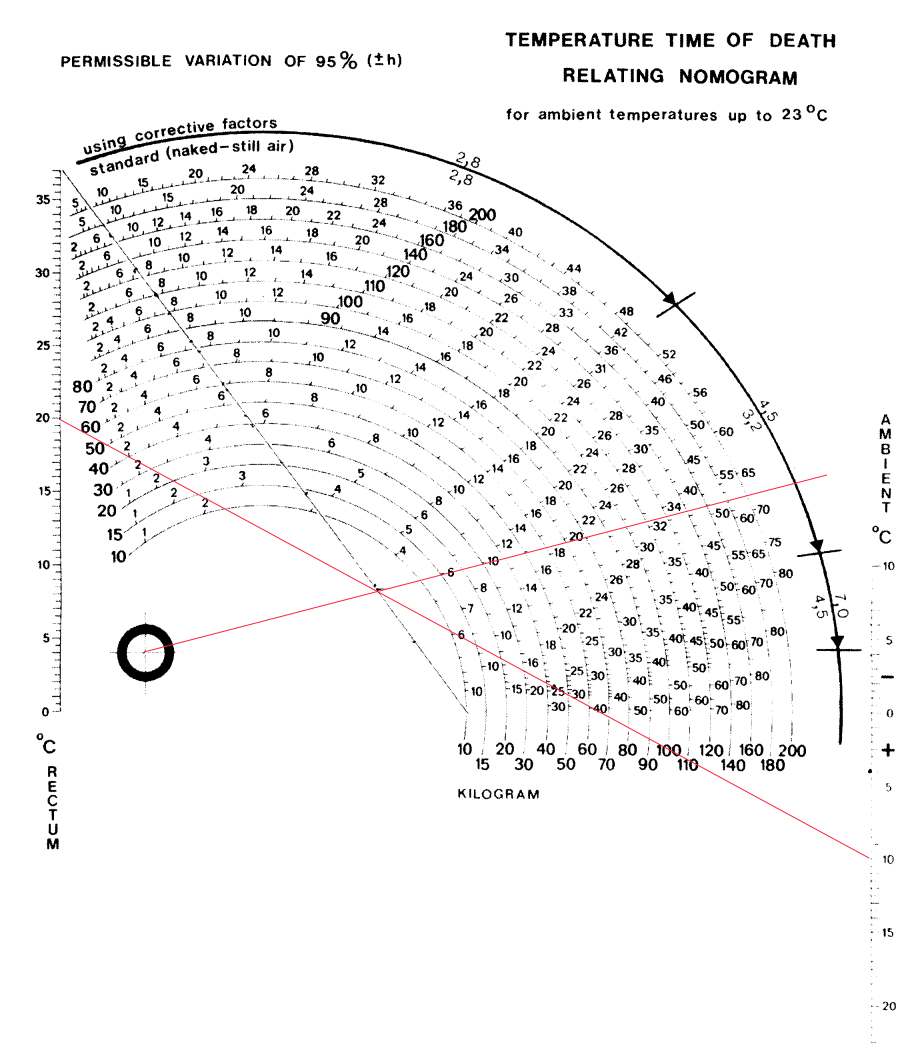
| Faster cooling | Slower cooling |
|---|---|
| Large temperature gradient (cold ambient) | Insulation: clothing, bedding |
| Well-ventilated or humid environment | Warm ambient temperature |
What is rigor mortis and what is its timeline?
Rigor mortis is post-mortem stiffening of muscle caused by ATP depletion. After death, loss of membrane integrity lets calcium into the fibres and actin and myosin bind. Relaxation needs ATP to pump calcium back into the sarcoplasmic reticulum and to detach the actin–myosin complex; without ATP the cross-bridges stay locked and the muscle stiffens. Primary relaxation comes first; secondary relaxation follows when putrefaction breaks down the contracted muscle, at roughly 36 hours.
| Phase | Time after death | Note |
|---|---|---|
| Onset | 1 to 2 hours | Begins in small muscles; eyelids first |
| Fully established | About 12 hours | Cephalocaudal spread: eyelids, neck, jaw, chest, arms, abdomen, legs, fingers and toes |
| Passing off | Over the next 24 to 48 hours | Resolves with secondary relaxation and putrefaction (about 36 hours) |
- Rapid onset and early resolution — children, the elderly, and deaths with severe exhaustion (for example cholera) or convulsions (for example strychnine).
- Cutis anserina (goose skin) — contraction of the erector pili.
- Cardiac rigor — ventricular contraction that can be misread as hypertrophy.
- Dartos contraction — wrinkled scrotal skin; with contraction of the seminal vesicles and vas deferens it can cause post-mortem seminal emission, which must not be taken as proof of ante-mortem sexual activity.
| Condition | Mechanism | Where / when |
|---|---|---|
| Heat stiffening | Coagulation and denaturation of muscle proteins | High-temperature exposure, high-voltage electrocution, scalds |
| Cold stiffening | Freezing of body fluids and subcutaneous fat | Sub-zero temperatures |
| Gas stiffening | Putrefactive gas accumulation | Decomposition |
| Cadaveric spasm (instantaneous rigor) | Muscle group in intense use at death stiffens instantly | Usually the hand: clenched on a weapon (suicide), clothing or hair (assault), weeds or mud (drowning) |
What is livor mortis (post-mortem staining) and when does it fix?
After circulation stops, blood settles under gravity into dependent areas, producing reddish-blue discolouration — livor mortis, lividity, hypostasis or post-mortem staining. In a supine body it appears over the back.
| Time after death | Finding |
|---|---|
| 1 to 3 hours | Patches appear in dependent areas |
| 4 to 6 hours | Patches expand and coalesce |
| 6 to 8 hours | Fully developed and fixed (blood coagulated in dependent vessels); shifting is no longer possible |
- Shifting: if the body is turned within the first hours, blood redistributes to the new dependent areas.
- Blanching test: press with the thumb for about 1 minute; pallor on release means lividity is not fixed, persistent colour means fixed.
- Contact pallor (contact flattening): areas pressed against the floor, bed or slab, or under tight clothing or bands, stay pale because compressed vessels cannot fill.
- Intensity: reduced after major blood loss or anaemia, increased in asphyxial deaths.
| Poison | Colour |
|---|---|
| Carbon monoxide | Cherry red |
| Cyanide | Pink |
| Nitrates (nitrites) | Brown |
What are autolysis and putrefaction, and what are the signs?
Autolysis is self-digestion by the body's own enzymes after cell membranes break down; it does not need bacteria. Its earliest external sign is a whitish cornea. Autolysis in the fetus within the amniotic cavity is maceration (skin slippage with blackish-brown discolouration). Putrefaction is microbial decomposition. The principal organism is *Clostridium perfringens*, a Gram-positive anaerobic rod whose lecithinase lyses red cell membranes; hydrogen sulphide from bacterial metabolism combines with haemoglobin to form sulphaemoglobin, giving the green colour.

| Feature | Detail |
|---|---|
| First external sign | Greenish discolouration over the right iliac fossa (over the caecum, rich in liquid and bacteria), visible at about 12 to 24 hours; spreads over the abdomen and then the whole body |
| Marbling | Greenish-blue outlining of superficial vessels |
| Gas | Hydrogen sulphide, ammonia, carbon dioxide, methane: abdominal distension, swelling of the face and genitalia, purging of fluid from mouth and nose |
| Skin | Slippage, fluid-filled blisters, loosening of hair and nails |
| Internal | Intestinal distension, 'Swiss-cheese' liver, liquefied brain; gas blisters under mucosa. Changes typically 18 to 36 hours |
| Insects | Blowfly eggs hatch about 12 to 24 hours; maggots established by 24 to 48 hours; adult flies in about 6 to 14 days. Used to estimate the minimum PMI |
| Later | Liquefaction of most internal organs by 5 to 10 days; abdominal rupture from gas pressure |
| Most resistant organ | Prostate |
| Faster | Slower |
|---|---|
| Hot, humid climate (optimum 25 to 38 degrees C; roughly twice as fast in summer as in winter) | Cold; refrigeration |
| Open air exposure | Burial or immersion in water |
| Obesity (fat holds heat and fluid) | Thin, dry body |
| Sepsis; open wounds (more microbial entry) | Tight or heavy clothing |
Casper's dictum — rate of decomposition: air : water : soil = 8 : 4 : 1
A body decomposes in air twice as fast as in water and 8 times as fast as in soil.
What are adipocere and mummification?
These are the two modifications of putrefaction, produced by very different conditions. Both preserve facial features and injuries, so identification and injury recognition remain possible.
| Feature | Adipocere (saponification) | Mummification |
|---|---|---|
| Process | Hydrolysis and hydrogenation of body fat into a yellowish, greasy, rancid, wax-like substance | Desiccation (dehydration) of tissues |
| Environment | Warm, moist, humid — water is needed for fat hydrolysis | Arid, with a constant warm breeze |
| Composition / look | Palmitic, oleic and stearic acids with glycerol; yellow and soft, becoming white and brittle | Brown, hard, brittle skin stretched over bony prominences (zygomatic bones, mandible); marked shrinkage |
| Where / how fast | Fatty areas: cheeks, chin, abdomen, buttocks; earliest about 3 weeks, usually about 3 months | Takes longer than adipocere |
| Can coexist with putrefaction? | Yes, in different regions | Yes, partial mummification |
How is time since death estimated across the first days?
| Period | Method |
|---|---|
| First few hours | Algor mortis (rectal temperature, Henssge nomogram); rigor and livor onset; gastric emptying (small light meals empty in 1 to 3 hours if the time of the meal is known) |
| Early (roughly 3 to 72 hours) | The classical triad: rigor mortis, livor mortis, algor mortis |
| After about 12 hours | Fixed lividity (traditionally taken to indicate more than 12 hours) |
| Days | Putrefaction stages, forensic entomology (succession and development methods) |
| Weeks and beyond | Adipocere (earliest about 3 weeks) and mummification |
What do exams ask about post-mortem changes?
- First sign of putrefaction — green discolouration over the right iliac fossa.
- Earliest sign of autolysis — whitish cornea.
- Rigor mortis mechanism — depletion of ATP, so actin and myosin cannot detach.
- Livor fixation — about 6 to 8 hours, with the blanching test.
- Cadaveric spasm — instantaneous, helps manner of death.
- Adipocere vs mummification — warm moist vs dry arid.
- Casper's dictum — decomposition is twice as fast in air as in water and 8 times as fast as in soil (8 : 4 : 1).
- Poison and lividity colour — cherry red (CO), pink (cyanide), brown (nitrate).