NEET-PG Psychiatry Previous Year Questions (2017–2026)

47 NEET-PG Psychiatry PYQs from 2017 to 2026, tagged by topic, with an explanation for every question. Psychiatry had 4 of the 180 questions in NEET-PG 2026.

Last verified: 24 September 2026 against Kinase question bank and NEET-PG 2026 recall paper. natboard.edu.in · nmc.org.in

Quick Answer

NEET-PG Psychiatry had 4 of 180 questions (2.2%) in the NEET-PG 2026 paper — up to 16 marks. Kinase has 47 NEET-PG Psychiatry PYQs from 2017 to 2026; the most-asked topic is Neurosis (7 questions).

Psychiatry in NEET-PG at a glance

Questions in NEET-PG 20264 of 180 (2.2%)
Maximum marks at stake16 of 720
NEET-PG Psychiatry PYQs on Kinase47 (2.8% of all NEET-PG PYQs)
Years covered2017–2026
INICET Psychiatry PYQs on Kinase70

Most-asked Psychiatry topics in NEET-PG PYQs

TopicNEET-PG PYQsShare of subject
Neurosis715%
Substance-Related Disorders715%
Clinical Psychiatry613%
Neurocognitive Disorders613%
Sexuality613%

Across NEET PG and INI-CET papers: Most repeated Psychiatry topics →

Sample NEET-PG Psychiatry PYQs with answers

Question 1 · NEET PG Aug 2026

A 25-year-old man from a rural area complains of fatigue, low energy, anxiety, irritability and dark circles under his eyes. He attributes his symptoms to loss of semen through frequent masturbation and nocturnal emissions, and is troubled by a whitish discharge he says he notices in his urine. Which culture-bound syndrome does this describe?

  1. A.Koro
  2. B.Latah
  3. C.Dhat
  4. D.Amok
Show answer and explanation

Answer: C. Dhat

Correct answer: C. Dhat.

Dhat syndrome is a South Asian culture-bound syndrome of distress attributed to perceived loss of semen (in urine or through emissions). Patients report fatigue, anxiety, weakness and somatic complaints without organic disease. Management is reassurance and cognitive behavioural approaches.
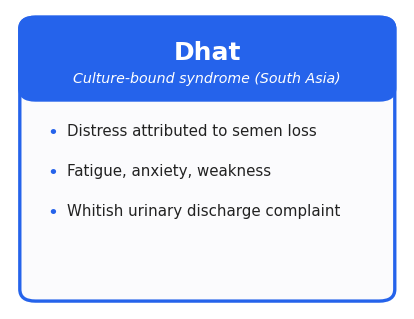
Dhat syndrome concept card
Dhat: distress attributed to semen loss with fatigue and anxiety.

Incorrect Options:

  • Koro is an acute anxiety state with the fear that the genitals are retracting into the body and may cause death. Koro concept card
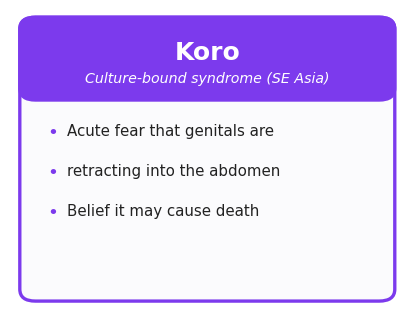
    Koro: fear of genital retraction.
  • Latah is an exaggerated startle response with echolalia, echopraxia and automatic obedience. Latah concept card
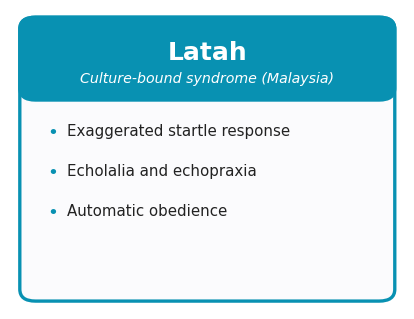
    Latah: exaggerated startle with echolalia.
  • Amok is a sudden dissociative episode of uncontrolled violent behaviour followed by amnesia. Amok concept card
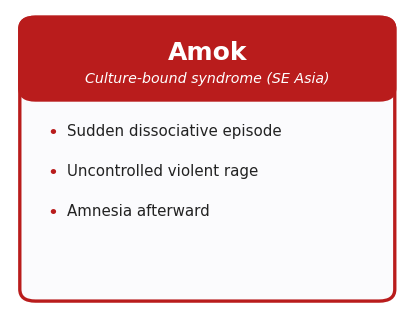
    Amok: sudden dissociative rage with amnesia.

High-Yield Facts:

  • Dhat is common in South Asia and centres on perceived semen loss.
  • Koro (SE Asia, China) = fear of genital retraction.
  • Latah (Malaysia) = startle with echolalia and echopraxia.
  • Amok (SE Asia) = sudden homicidal or violent outburst with later amnesia.
Question 2 · NEET PG Aug 2026

A 25-year-old man is socially withdrawn, has no close friends and prefers to live in isolation with little interest in forming relationships. He shows no odd beliefs, magical thinking or perceptual distortions. Which personality type does he most likely have?

  1. A.Schizotypal personality
  2. B.Schizoid personality
  3. C.Avoidant personality
  4. D.Antisocial personality
Show answer and explanation

Answer: B. Schizoid personality

Correct answer: B. Schizoid personality.

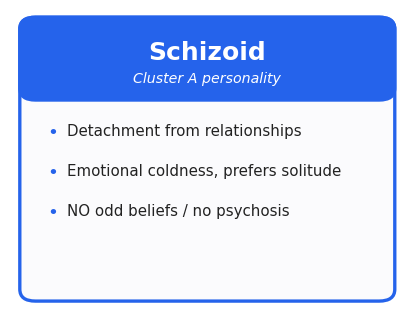
Schizoid personality is a Cluster A disorder marked by detachment from social relationships, emotional coldness and a preference for solitude. Crucially there is no odd belief, magical thinking or perceptual distortion, which distinguishes it from schizotypal personality.

Schizoid personality concept card
Schizoid: social detachment and emotional coldness without psychosis.

Incorrect Options:

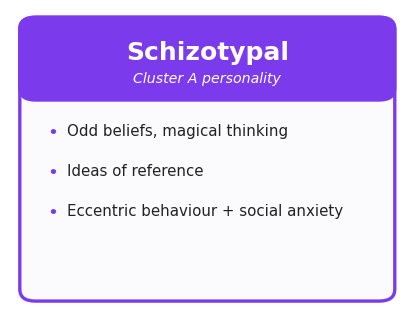
  • Schizotypal personality also has social discomfort but adds odd beliefs, magical thinking and ideas of reference. Schizotypal personality concept card
    Schizotypal: eccentricity with odd beliefs and magical thinking.
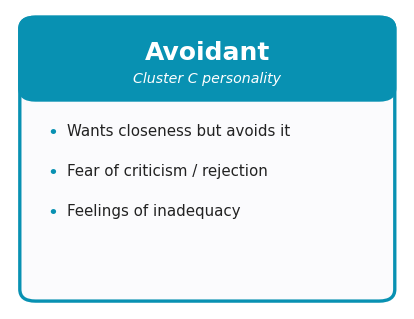
  • Avoidant personality patients desire relationships but avoid them because of fear of criticism and rejection. Avoidant personality concept card
    Avoidant: wants closeness but fears rejection.
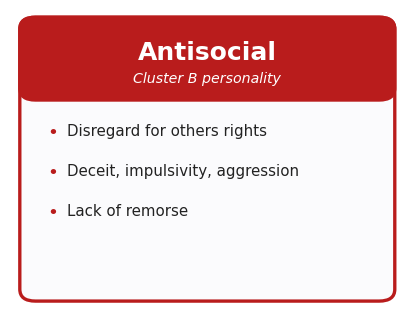
  • Antisocial personality shows disregard for the rights of others, deceit and lack of remorse. Antisocial personality concept card
    Antisocial: disregard for others, impulsivity and no remorse.

High-Yield Facts:

  • Schizoid = social detachment and emotional coldness, prefers solitude.
  • Schizoid lacks the odd beliefs and magical thinking of schizotypal personality.
  • Avoidant personality wants relationships but fears rejection (unlike schizoid).
  • Cluster A (odd or eccentric): paranoid, schizoid and schizotypal.
Question 3 · NEET PG Aug 2026

A 73-year-old man is alert and oriented on the first day after a hip replacement. By the next morning he is drowsy, tugging at his intravenous line and cannot hold his attention through a sentence, with symptoms that wax and wane through the day. Which bedside tool is best suited to confirm the diagnosis?

  1. A.Mini-Cog screen
  2. B.PHQ-9 questionnaire
  3. C.Confusion Assessment Method
  4. D.Mini-mental state exam
Show answer and explanation

Answer: C. Confusion Assessment Method

Correct answer: C. Confusion Assessment Method (CAM).

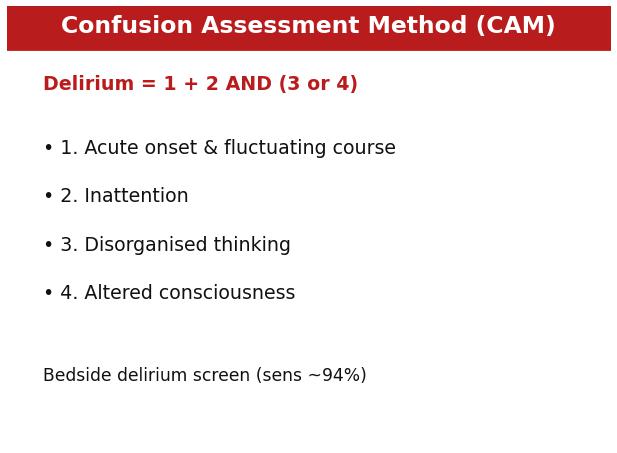
The acute onset, fluctuating course, inattention and altered consciousness describe delirium. The CAM diagnoses delirium at the bedside when features 1 (acute and fluctuating) AND 2 (inattention) are present, together with either 3 (disorganised thinking) OR 4 (altered level of consciousness).

CAM diagnostic algorithm for delirium

CAM: feature 1 + 2 and (3 or 4) confirms delirium.

Incorrect Options:

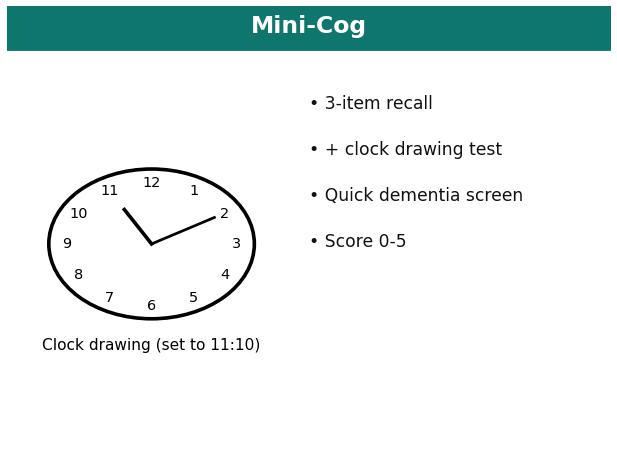
  • Mini-Cog: a rapid dementia screen (3-item recall plus clock drawing), not a delirium test.
  • Mini-Cog clock drawing dementia screen

    Mini-Cog screens chronic cognitive decline.

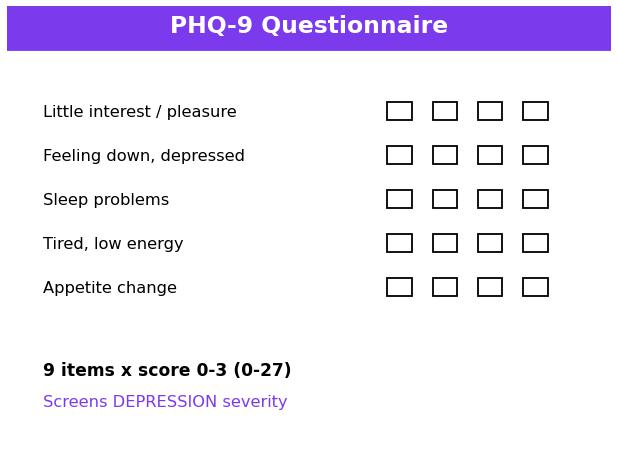
  • PHQ-9: a nine-item questionnaire that grades depression severity, not acute confusion.
  • PHQ-9 depression questionnaire

    PHQ-9 measures depression, not delirium.

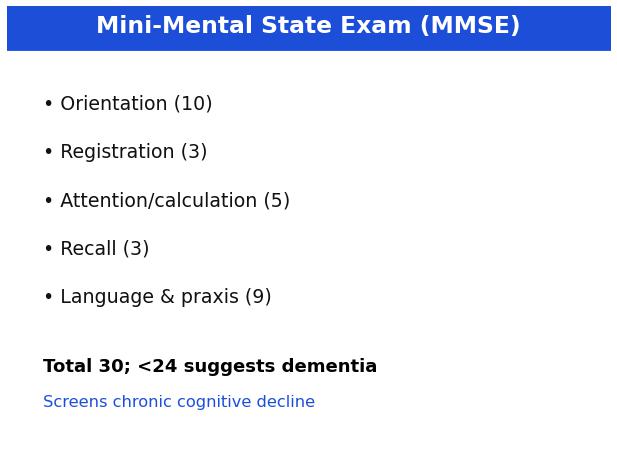
  • Mini-mental state exam: useful for chronic cognitive impairment but does not capture the fluctuation and inattention of delirium.
  • Mini-mental state examination domains

    MMSE grades dementia, not fluctuating delirium.

High-Yield Facts:

  • Delirium = acute, fluctuating, inattention, with disorganised thinking or altered consciousness.
  • Hypoactive (drowsy) delirium is easily missed but carries a worse prognosis.
  • Haloperidol is preferred for dangerous agitation once reversible causes are treated.
  • The CAM has high sensitivity and specificity and takes only a few minutes.

Psychiatry concept guides

Browse the full concept library and clinical image atlas.

Practise the rest: open the Kinase question bank, choose Psychiatry, set the exam to NEET-PG and switch on PYQs only. Questions you get wrong go into Fix My Weakness for targeted revision.

Frequently Asked Questions

How many Psychiatry questions were in NEET-PG 2026?▼
4 of the 180 questions in the NEET-PG 2026 paper (30 August 2026) were Psychiatry — 2.2% of the paper, worth up to 16 marks at +4 per correct answer. This is from the recall paper in the Kinase question bank.
How many NEET-PG Psychiatry PYQs does Kinase have?▼
Kinase has 47 NEET-PG Psychiatry previous year questions from 2017 to 2026, each with an explanation, plus 70 INICET Psychiatry PYQs for extra practice.
What are the most-asked Psychiatry topics in NEET-PG?▼
In Kinase's NEET-PG Psychiatry PYQs, the most-asked topics are Neurosis, Substance-Related Disorders, Clinical Psychiatry. Neurosis alone accounts for 7 of the 47 questions.
Are NEET-PG Psychiatry PYQs the same as INICET PYQs?▼
Both exams test the MBBS syllabus, so most Psychiatry concepts overlap. The marking differs: NEET-PG is +4 / −1 and INICET is +1 / −1/3. Kinase lets you practise either exam's PYQs, or both together.
How should I practise Psychiatry PYQs for NEET-PG?▼
Start with the most-asked topics above, do a daily set of Psychiatry PYQs, and read every explanation — including the ones you got right. Kinase's Fix My Weakness then builds practice sets from the topics you miss most.
47 Psychiatry PYQs
2017–2026 papers
Topic + year tagged

Ready to Start Practicing?

Psychiatry was 4 questions (up to 16 marks) in NEET-PG 2026.

Start Free Practice

No credit card required