What is pseudomembranous colitis?
Pseudomembranous colitis is the severe end of Clostridioides difficile infection (CDI). StatPearls describes it as a severe inflammation of the inner lining of the large intestine that appears as an antibiotic-associated colonic inflammatory complication. The organism — formerly called Clostridium difficile — is a gram-positive, anaerobic, spore-forming, toxin-producing bacillus and a major cause of antibiotic-associated colitis worldwide.
The clinical spectrum is wide: asymptomatic carriage → mild diarrhoea → pseudomembranous colitis → toxic megacolon with septic shock. Not every C. difficile infection shows pseudomembranes, but when they are seen on endoscopy in a patient with diarrhoea they are strongly suggestive of the diagnosis.
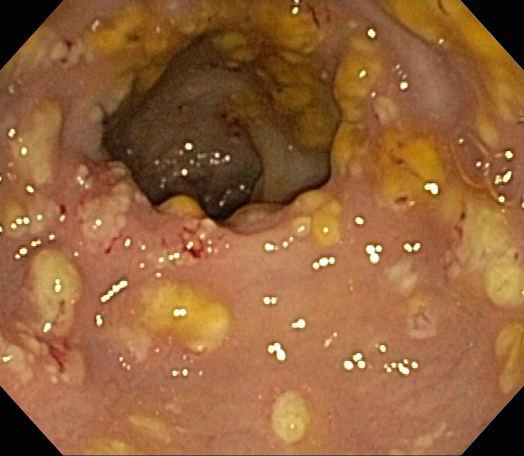
How do C. difficile toxins A and B cause colitis?
Diarrhoea and pseudomembranous colitis result from two clostridial glycosylating exotoxins: toxin A (TcdA), an enterotoxin, and toxin B (TcdB), a cytotoxin. The organism itself does not invade the mucosa; the damage is toxin-driven.
- Antibiotics disturb the normal colonic microbiota.
- Spores picked up from hands, surfaces or equipment reach the colon, where toxigenic strains multiply.
- Toxins A and B damage the colonic epithelium.
- The toxins over-stimulate the innate immune system and draw neutrophils into the colonic mucosa — the basis of the pseudomembrane.
On colonoscopy the mucosa is inflamed with raised yellowish, occasionally haemorrhagic nodules or plaques that join into pseudomembranes. These plaques are up to about 2 cm across and are scattered among areas of normal mucosa; in the most severe cases confluent pseudomembranes cover the whole colonic surface.
| Factor | Nature | Exam point |
|---|---|---|
| Toxin A (TcdA) | Enterotoxin | Fluid secretion, mucosal inflammation |
| Toxin B (TcdB) | Cytotoxin | Cytopathic effect — the basis of the old cell-culture cytotoxicity assay |
| Binary toxin (CDT) | Extra toxin of the hypervirulent strain | Seen with NAP1/BI/027 |
| Spores | Resistant resting form | Survive alcohol hand rubs and persist on surfaces |


Which antibiotics and risk factors cause C. difficile infection?
The most significant risk factor is antibiotic use, particularly broad-spectrum antibiotics. StatPearls names penicillins, cephalosporins, fluoroquinolones and clindamycin as the classes most associated with the disease — but any antibiotic can lead to CDI.
| Group | Examples |
|---|---|
| Antibiotics | Clindamycin, cephalosporins, fluoroquinolones, penicillins — any antibiotic possible |
| Acid suppression | Proton pump inhibitors |
| Host factors | Advanced age, immunosuppression, comorbidities, kidney or liver failure |
| Healthcare exposure | Recent hospitalisation, prolonged hospital stay |
| History | Previous C. difficile infection |
How does C. difficile colitis present and how is severity graded?
The usual picture is watery diarrhoea during or after a course of antibiotics, often with crampy abdominal pain, fever and leukocytosis. IDSA/SHEA 2017 defines the patients who should be tested as those with unexplained, new-onset ≥ 3 unformed stools in 24 hours.
| Severity | Supportive data |
|---|---|
| Non-severe | WBC ≤ 15,000 cells/µL and serum creatinine < 1.5 mg/dL |
| Severe | WBC ≥ 15,000 cells/µL or serum creatinine > 1.5 mg/dL |
| Fulminant | Hypotension or shock, ileus or megacolon (previously called 'severe, complicated') |
How is C. difficile infection diagnosed?
Diagnosis is made on stool from a patient with clinically significant diarrhoea. The available tests detect the organism (glutamate dehydrogenase [GDH] antigen, nucleic acid amplification tests [NAAT] for toxin genes) or the free toxin (toxin A/B enzyme immunoassay, cell cytotoxicity neutralisation assay).
| Test | Detects | Strength | Weakness |
|---|---|---|---|
| GDH antigen EIA | Conserved enzyme (common antigen) present in all isolates | Good screen | Present in toxigenic and non-toxigenic strains — must be paired with a toxin test |
| NAAT (PCR) | Toxin genes (e.g. tcdA, tcdB) | Most sensitive | Shows the gene, not toxin being made now |
| Toxin A/B EIA | Free toxin in stool | Specific for active disease | Less sensitive alone |
| Cell cytotoxicity neutralisation assay | Toxin activity on cultured cells | Detects active toxin | Laboratory-based, slower |
IDSA/SHEA 2017 recommends a multistep algorithm — GDH plus toxin; GDH plus toxin, arbitrated by NAAT; or NAAT plus toxin — rather than a toxin test alone. When there are agreed institutional criteria for which stools are sent, NAAT alone or a multistep algorithm can be used.
- Do not repeat testing within 7 days during the same episode of diarrhoea.
- Do not test asymptomatic patients and do not do a 'test of cure'.
- Do not routinely test neonates or infants ≤ 12 months — neonates have a high asymptomatic carrier rate.
- Colonoscopy/sigmoidoscopy showing pseudomembranes supports the diagnosis when tests are negative but suspicion remains, or treatment fails.

What is the treatment of C. difficile colitis?
First stop the inciting antibiotic if possible — continued use lowers response and raises recurrence (IDSA/SHEA 2017). Drug choice has changed over three guideline versions, which is a favourite trap:
| Guideline | Initial (non-fulminant) episode |
|---|---|
| 2010 | Metronidazole for mild–moderate disease; oral vancomycin for severe disease |
| 2017 | Oral vancomycin or fidaxomicin for non-severe and severe disease; metronidazole only if these are unavailable (non-severe) |
| 2021 focused update | Fidaxomicin preferred over a standard course of vancomycin; vancomycin remains an acceptable alternative |
| Situation | Regimen |
|---|---|
| Initial episode (non-severe or severe) | Fidaxomicin 200 mg twice daily for 10 days (preferred, 2021) or oral vancomycin 125 mg four times daily for 10 days |
| Non-severe, if the above are unavailable | Oral metronidazole 500 mg three times daily for 10 days |
| Fulminant | Oral (or nasogastric) vancomycin 500 mg four times daily + IV metronidazole 500 mg every 8 hours; add rectal vancomycin if ileus |
How is recurrent C. difficile infection managed?
Recurrence after initial cure is a major problem in CDI. The 2021 focused update addresses two agents for it:
- Fidaxomicin (standard 10-day or extended-pulsed regimen) is suggested over a standard vancomycin course for recurrent episodes. A tapered and pulsed vancomycin regimen or a standard vancomycin course are acceptable alternatives for a first recurrence.
- Bezlotoxumab — a human monoclonal antibody against toxin B — is suggested as a co-intervention with standard antibiotics for a recurrence within the last 6 months. Other recurrence risk factors are age ≥ 65 years, immunocompromise and severe CDI at presentation.
- The FDA warns that in patients with congestive heart failure, bezlotoxumab should be reserved for when benefit outweighs risk. Its maker discontinued it in January 2025, so it is now mainly an exam fact.
- Faecal microbiota transplantation (FMT) is recommended for multiple recurrences after appropriate antibiotic treatment has failed (IDSA/SHEA 2017; unchanged in 2021). Vancomycin followed by rifaximin is another option for multiple recurrences.
When does C. difficile cause toxic megacolon and need surgery?
C. difficile colitis is the most common infectious cause of toxic megacolon; inflammatory bowel disease is the other major cause. Toxic megacolon is dilatation of the colon accompanied by systemic toxicity.
| Requirement | Criteria |
|---|---|
| All patients | Radiographic colonic dilatation > 6 cm, especially transverse and ascending colon |
| At least 3 of | Fever > 38 °C; heart rate > 120/min; neutrophilic leukocytosis > 10,500/µL; anaemia |
| At least 1 of | Altered sensorium; hypotension; hypovolaemia; electrolyte abnormalities |
Fulminant CDI is treated with oral/nasogastric vancomycin plus IV metronidazole (rectal vancomycin if there is ileus). If surgery is needed for a severely ill patient, IDSA/SHEA 2017 recommends subtotal colectomy with preservation of the rectum.
How is the spread of C. difficile prevented in hospitals?
- Hand hygiene with soap and water rather than alcohol rubs when caring for CDI patients — soap and water removes spores better.
- Contact precautions and isolation continued for at least 48 hours after diarrhoea resolves; longer if ward CDI rates stay high.
- Sporicidal environmental cleaning of rooms and equipment — surfaces act as reservoirs for spores.
- Antibiotic stewardship — fewer high-risk antibiotics and shorter courses.
- Probiotics: IDSA/SHEA 2017 found insufficient data to recommend them for primary prevention outside trials.
How is pseudomembranous colitis asked in NEET PG and INI-CET?
- Drug that most commonly causes pseudomembranous colitis — clindamycin in the classic MCQ; cephalosporins and fluoroquinolones are also high-risk.
- Organism — Clostridioides (Clostridium) difficile: gram-positive, anaerobic, spore-forming bacillus.
- Toxins — A = enterotoxin, B = cytotoxin; binary toxin with ribotype 027.
- Investigation of choice — stool testing (GDH/NAAT + toxin); colonoscopy shows raised yellowish plaques.
- Drug of choice — current answer: fidaxomicin, or oral vancomycin; metronidazole only as a fallback for non-severe disease.
- Recurrence — bezlotoxumab (anti-toxin B) and faecal microbiota transplantation.