Which drug groups open the airways and which suppress cough?
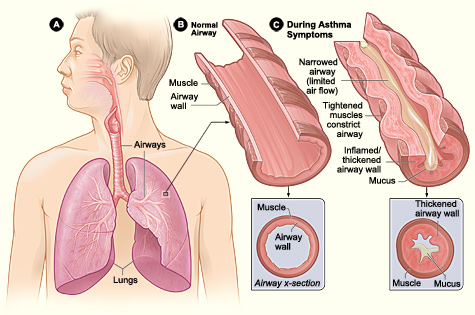
Respiratory pharmacology questions become easier when the therapeutic target is identified first. Bronchodilators act on airway smooth muscle and reduce bronchoconstriction. Anti-inflammatory controllers, particularly inhaled corticosteroids, address the inflammatory component of asthma. Antitussives reduce the cough reflex; an improvement in cough does not establish that airway obstruction or its underlying cause has been treated.
An asthma stem may describe wheeze, chest tightness or a need for rapid symptom relief. A cough-suppression stem may instead name dextromethorphan or codeine and ask about central action or toxicity. Keep these categories separate: a medicine that suppresses cough is not automatically a bronchodilator, and a medicine that dilates the bronchi does not automatically provide adequate asthma control.
| Family | Representative drugs | Core action |
|---|---|---|
| Beta-2 agonists | Salbutamol, formoterol, salmeterol | Relax bronchial smooth muscle through cyclic AMP |
| Antimuscarinics | Ipratropium, tiotropium | Block vagal muscarinic bronchoconstriction |
| Methylxanthines | Theophylline, aminophylline | Phosphodiesterase inhibition and adenosine antagonism |
| Central antitussives | Dextromethorphan, codeine | Reduce centrally mediated cough responses |
| Peripheral antitussive | Benzonatate | Anaesthetise respiratory stretch receptors |
How do beta-2 agonists produce bronchodilation?
Beta-2 receptor stimulation increases intracellular cyclic AMP in bronchial smooth muscle, producing relaxation and improving airflow. Salbutamol is also called albuterol; those names describe the same drug. The short-acting and long-acting labels describe the clinical duration of action, rather than different receptor targets.
Short-acting beta-2 agonists, such as salbutamol, are used for rapid relief of bronchospasm. Long-acting agents support sustained symptom control. Formoterol has a rapid onset despite being long-acting, while salmeterol has a slower onset. Therefore, the shortcut that every long-acting beta agonist is slow to start is wrong. Formoterol can function as a reliever when incorporated into an appropriate inhaled corticosteroid combination regimen.
| Drug | Class | Revision point |
|---|---|---|
| Salbutamol/albuterol | SABA | Rapid bronchodilator for acute symptoms |
| Levalbuterol | SABA | Short-acting beta-2 agonist |
| Formoterol | LABA | Rapid onset; used with ICS in appropriate reliever regimens |
| Salmeterol | LABA | Maintenance agent with slower onset |
A beta agonist provides bronchodilation without replacing the anti-inflammatory role of inhaled corticosteroids. In a question asking why symptoms recur despite frequent reliever use, do not assume that simply increasing bronchodilator exposure solves the whole problem. Disease control, adherence and inhaler technique must also be assessed.
Which adverse effects identify a beta-2 agonist?
The classic adverse-effect cluster is tremor, tachycardia, palpitations and hypokalaemia. Beta-2 agonists move potassium into cells, so the fall in serum potassium is a redistribution effect. This distinction explains why the drug class appears in both respiratory pharmacology and electrolyte questions.
Receptor selectivity reduces unwanted effects but does not mean that systemic effects are impossible. Higher exposure, excessive reliever use or repeated treatment can produce clinically important adverse effects. A stem describing an increasingly shaky patient with palpitations after bronchodilator treatment should prompt a medication review as well as assessment of the underlying respiratory illness.
Excess beta-agonist exposure can also cause hyperglycaemia and lactic acidosis. These findings need clinical interpretation: persistent distress after treatment is not always a reason to continue escalating the same medicine without reassessing airflow, oxygenation and the patient’s overall condition. The examination point is recognition of the adverse-effect pattern rather than a universal bedside treatment rule.
Repeated receptor stimulation can lead to desensitisation and reduced response. For an exam question on frequent reliever use, connect the pharmacology with poor control: the history is a reason to review the treatment plan. It should not be interpreted as evidence that a short-acting bronchodilator alone is adequate long-term therapy.
How do ipratropium and tiotropium differ?
Airway parasympathetic activity contributes to bronchoconstriction and secretion. Inhaled anticholinergic medicines block this muscarinic pathway, particularly the M3 receptor. They produce bronchodilation by opposing cholinergic constriction, rather than by stimulating beta receptors. This is why combining the classes can target different pathways.
| Feature | Ipratropium | Tiotropium |
|---|---|---|
| Class | Short-acting muscarinic antagonist, SAMA | Long-acting muscarinic antagonist, LAMA |
| Main revision role | COPD bronchodilation; acute severe asthma adjunct | Maintenance bronchodilation, particularly in COPD |
| Receptor pathway | Blocks muscarinic bronchoconstriction | Blocks muscarinic bronchoconstriction |
| Common adverse-effect clue | Dry mouth | Dry mouth |
| Role distinction | Can supplement a rapid beta agonist | Do not confuse maintenance treatment with immediate rescue |
Ipratropium and tiotropium are quaternary ammonium compounds with limited systemic absorption when inhaled. However, dry mouth, urinary retention and other anticholinergic effects remain relevant. In an adverse-effect stem, compare the dry-mouth or retention pattern with the tremor and hypokalaemia pattern of beta agonists.
COPD and asthma should not be treated as interchangeable indications. Long-acting bronchodilators have a central role in COPD maintenance treatment. In asthma, bronchodilator selection sits within an anti-inflammatory treatment plan. The exam often tests the class and role of a medicine rather than asking for a complete personalised regimen.
Why are theophylline and aminophylline important exam drugs?
Theophylline is a methylxanthine with bronchodilator activity. Its familiar mechanisms are nonselective phosphodiesterase inhibition, which raises intracellular cyclic AMP, and adenosine receptor antagonism. Compare this with beta-2 agonists: both can increase cyclic AMP signalling, but they reach that result through different pharmacological targets.
Aminophylline is a more soluble theophylline preparation with ethylenediamine. It belongs to the same pharmacological family; it is not an antimuscarinic or an inhaled corticosteroid. Recognition of this relationship is more useful than memorising a loading dose without knowing the formulation, patient factors and monitoring requirements.
The major limitation is a narrow therapeutic window. Nausea, vomiting, gastrointestinal discomfort, insomnia and tremor can occur. Severe toxicity may produce arrhythmias and seizures, making this adverse-effect combination a strong examination clue. A patient with new vomiting and palpitations while taking theophylline needs assessment for toxicity rather than an automatic increase in treatment.
Serum concentration monitoring is important when toxicity is suspected, the dose changes, or illness and other medicines may alter clearance. Theophylline use has become more limited because safer and more effective inhaled options are available. Older drug lists may place aminophylline prominently in acute asthma; the pharmacology remains examinable, but that does not establish it as routine preferred acute treatment.
How should reliever and controller drugs be separated?
A reliever reduces current symptoms; a controller reduces the inflammatory burden and helps prevent future symptoms and exacerbations. These are treatment roles rather than mutually exclusive drug labels. An ICS/formoterol combination can deliver anti-inflammatory treatment and rapid bronchodilation together in a regimen designed for that purpose.
The BTS/NICE/SIGN asthma guideline says not to prescribe a short-acting beta agonist without a concomitant inhaled corticosteroid prescription. It also recommends as-needed low-dose ICS/formoterol for newly diagnosed asthma in adults and adolescents within its specified age group. This page uses that guidance to explain the principle and does not reproduce age-specific dosing schedules.
- SABA identifies a short-acting bronchodilator; it does not prove that SABA-only long-term asthma treatment is appropriate.
- LABA monotherapy must be avoided in asthma: the anti-inflammatory component is essential.
- AIR means anti-inflammatory reliever therapy using an appropriate ICS/formoterol combination.
- MART means maintenance and reliever therapy with an appropriate ICS/formoterol combination.
- Before escalating treatment, check adherence, inhaler technique, comorbidities and whether the diagnosis is secure.
Salmeterol is not interchangeable with formoterol for a reliever regimen simply because both are LABAs. The product and prescribed plan matter. Likewise, COPD decisions about long-acting bronchodilators and inhaled corticosteroids should be made in the COPD context rather than borrowed automatically from asthma.
Why does inhaler technique change the apparent drug response?
An inhaled medicine must reach the airways to work. A poor response can reflect incorrect device use rather than failure of the receptor mechanism. Assessment should include whether the patient can use the chosen device, coordinate the required steps and demonstrate the technique correctly.

The NICE guideline recommends observing inhaler use when checking control, changing devices and reviewing treatment. Device suitability, dexterity and inspiratory ability should be considered. A spacer may help with a metered-dose inhaler when appropriate. Remember that a device change is not merely a different-looking prescription; it may require new technique teaching.
For a question asking the next step in apparently uncontrolled asthma, recognise the difference between drug selection and drug delivery. Medication history, adherence and a demonstration of inhaler use can reveal a correctable problem. These checks are part of rational pharmacology because they determine the exposure actually achieved.
How do central and peripheral antitussives compare?
Dextromethorphan is a centrally acting, nonopioid antitussive. It acts on brainstem cough pathways and has multiple neural targets, including sigma-1 and NMDA-related effects. Its cough-suppressing action should not be described as identical to the mu-opioid action of codeine.
| Drug | Site or mechanism | Important distinction |
|---|---|---|
| Dextromethorphan | Central cough pathways; nonopioid antitussive | Serotonergic interactions and misuse risk |
| Codeine | Central opioid antitussive action | Respiratory depression and dependence risk |
| Benzonatate | Peripheral anaesthesia of respiratory stretch receptors | Acts peripherally rather than through central opioid pathways |
Dextromethorphan is metabolised mainly through CYP2D6. Interactions with serotonergic medicines can increase the risk of serotonin syndrome. Combination with monoamine oxidase inhibitors is contraindicated. The common exam trap is assuming that a nonopioid cough medicine has no important central effects or interactions.
An antitussive treats a symptom and does not establish the diagnosis behind the cough. In a drug-classification question, separate cough suppression from mucus-directed treatment and bronchodilation. In a vignette with wheeze, dyspnoea or persistent symptoms, the underlying respiratory problem still requires assessment. Do not select a cough suppressant simply because cough appears in the stem.