What is syphilis and why is it called the great imitator?
Syphilis is a systemic infection caused by the spirochaete *Treponema pallidum*. Humans are its only host, and most cases spread by vaginal, anal or oral sex; it also crosses the placenta (congenital syphilis) and rarely spreads by blood. Because its signs can mimic disease in almost any organ, it is called the great imitator.
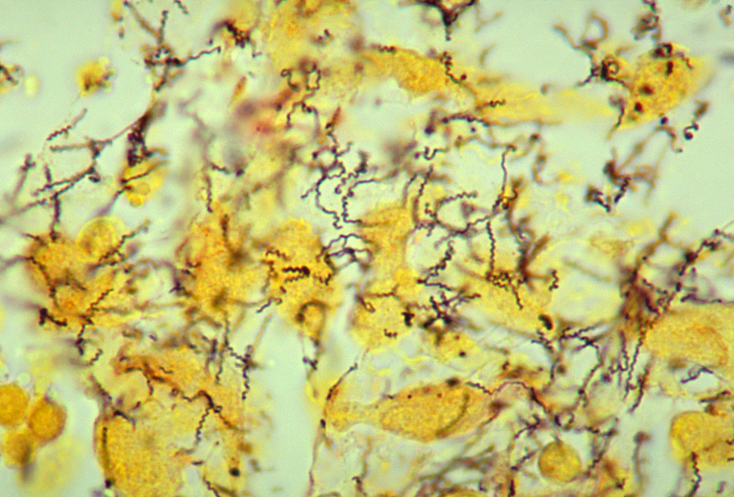
- Organism: thin spiral Gram-negative bacterium, too thin to see on routine light microscopy. It is seen moving on dark-field microscopy or with silver stains (Warthin–Starry, Levaditi).
- Slow growth: it divides only about once every 30 hours, which is why long-acting penicillin (benzathine) is used.
- Incubation: a chancre appears 10–90 days after exposure (median about 3 weeks).
- HIV link: syphilis and HIV travel together; every patient with one should be tested for the other.
What are the stages of syphilis?
Untreated syphilis passes through four stages: primary, secondary, latent and tertiary. The chancre and the secondary rash both heal on their own, which is why so many patients never seek care and reach the latent stage.
| Stage | When | Key features |
|---|---|---|
| Primary | 10–90 days after exposure | Single painless, indurated ulcer (chancre) with a clean base and raised edge, usually 1–2 cm; painless rubbery regional nodes in up to 80%; heals in 3–6 weeks |
| Secondary | About 2–8 weeks after the chancre heals | Non-itchy copper-coloured rash including palms and soles, mucous patches, condylomata lata, moth-eaten alopecia, generalised lymphadenopathy, fever, malaise |
| Latent | After secondary lesions settle | No symptoms; found only by serology. Divided into early latent and late latent (or unknown duration) for treatment |
| Tertiary | Years to decades later (often 20–30 years) | Cardiovascular (aortitis, ascending aortic aneurysm, aortic regurgitation), gummas, late neurosyphilis; develops in about 25–40% of untreated patients |
- Chancre site: usually genital, but can be on the lip, tongue, finger or nipple; on the cervix it is often missed because it is painless. HIV-positive patients often have several chancres.
- Secondary syphilis is the most infectious stage — condylomata lata and mucous patches teem with treponemes. Untreated, secondary lesions relapse in about a quarter of patients within a year.
- Lues maligna is a rare, aggressive ulcerating form of secondary syphilis, seen mainly with HIV.

What happens in tertiary syphilis and neurosyphilis?
Tertiary disease is caused by obliterative endarteritis and a delayed hypersensitivity response. Cardiovascular syphilis is the most common tertiary form, accounting for about 80–85% of tertiary cases.
- Cardiovascular syphilis: inflammation of the vasa vasorum of the aorta causes ascending aortic aneurysm and aortic regurgitation; the intima looks wrinkled like tree bark. It rarely dissects.
- Gummas: rubbery granulomatous nodules with necrotic centres, most often in skin, liver, bone, testes and brain. They contain very few organisms.
- Neurosyphilis can occur at any stage. Ocular and otic syphilis count as neurosyphilis.
| Form | Usual timing | What to remember |
|---|---|---|
| Asymptomatic | Any stage | Most common form; CSF abnormal, no symptoms |
| Meningeal | Under 1 year after infection | Headache, neck stiffness, cranial nerve palsies |
| Meningovascular | 5–12 years | Endarteritis causing stroke in a young adult |
| General paresis | More than 10 years | Chronic meningoencephalitis: personality change, dementia, psychosis |
| Tabes dorsalis | More than 10 years | Dorsal column and root degeneration: lightning pains, sensory ataxia, positive Romberg, Argyll Robertson pupils, Charcot joints |
What are the features of congenital syphilis?
Treponemes cross the placenta at any stage of pregnancy. Without treatment, up to 40% of pregnancies in women with syphilis end in stillbirth, and many more in preterm birth or low birth weight. About 70% of infected newborns look normal at birth, and most show signs within the first 3 months.
| Type | Onset | Typical findings |
|---|---|---|
| Early | Before 2 years (usually by 3 months) | Snuffles (rhinitis), bullous or desquamating rash, hepatosplenomegaly, jaundice, anaemia, pseudoparalysis from painful bone lesions; moth-eaten osteolytic long-bone lesions |
| Late | After 2 years | Hutchinson teeth, interstitial keratitis, eighth nerve deafness, saddle nose, frontal bossing, saber shins, Clutton joints (painless knee effusions), Higoumenakis sign (thickened medial clavicle) |

Newborn diagnosis is tricky because maternal IgG crosses the placenta, so a positive treponemal test in the baby may simply be the mother's antibody. The baby's non-treponemal titre is compared with the mother's, and lesions are tested by dark-field microscopy or PCR. Work-up includes long-bone X-rays, a blood count and CSF examination.
How do non-treponemal and treponemal tests differ?
Serology is the main way syphilis is diagnosed, because dark-field microscopy and PCR need a moist lesion and a skilled laboratory. Two families of tests are used together.
| Feature | Non-treponemal (VDRL, RPR) | Treponemal (FTA-ABS, TPHA, TPPA, EIA/CIA) |
|---|---|---|
| Detects | Antibodies (reagin) to cardiolipin–lecithin–cholesterol antigen; a flocculation test | Antibodies against T. pallidum itself |
| Specificity | Not specific — false positives in 1–2% | Specific |
| Result | Quantitative titre (1:2, 1:4, 1:8 …) | Qualitative (reactive / non-reactive) |
| After treatment | Titre falls; may become non-reactive | Usually positive for life |
| Main use | Screening and monitoring treatment | Confirmation |
| Late syphilis | Titre often low or negative | Remains positive |
- Titre changes: a 4-fold change (for example 1:32 to 1:8) is clinically significant. A 4-fold fall means response; a 4-fold rise means reinfection or treatment failure.
- RPR sensitivity: about 86% in primary, 100% in secondary and about 73% in latent syphilis — secondary syphilis is the stage where non-treponemal tests are always positive.
- VDRL vs RPR: the two are not interchangeable. CSF-VDRL is the test for CSF; RPR is preferred for following serum titres.
- False-positive non-treponemal tests: intravenous drug use, HIV, hepatitis B and autoimmune disease, usually at low titres (1:8 or less).
- Reverse sequence screening: many laboratories now screen with an automated treponemal test first, then use RPR to judge activity.
What is the prozone phenomenon in syphilis testing?
The prozone effect is a false-negative non-treponemal test caused by a very high concentration of antibody. Too much antibody relative to antigen prevents the lattice (immune complex) that produces visible flocculation, so an undiluted sample can look non-reactive.
- When to suspect it: secondary syphilis (very high titres), pregnancy, HIV co-infection — a patient with an obvious secondary rash but a 'non-reactive' VDRL.
- Fix: test serial dilutions of the serum. Laboratories already titrate reactive samples by dilution, and the endpoint titre is the highest dilution that still flocculates.
How is syphilis treated?
Penicillin is the drug of choice for every stage, and T. pallidum has stayed sensitive to it. Long-acting forms are used because the organism divides slowly; neurosyphilis needs aqueous penicillin to reach CSF levels.
| Stage | Regimen |
|---|---|
| Primary, secondary, early latent | Benzathine penicillin G 2.4 million units IM, single dose |
| Late latent, latent of unknown duration, tertiary (non-neuro) | Benzathine penicillin G 2.4 million units IM weekly for 3 weeks |
| Neurosyphilis, ocular or otic syphilis | Aqueous crystalline penicillin G 18–24 million units a day (3–4 million units IV every 4 hours) for 10–14 days |
| Congenital syphilis (proven or likely) | Aqueous crystalline penicillin G 50,000 units/kg IV every 12 hours for the first 7 days of life, then every 8 hours, for 10 days in total |
| Non-pregnant penicillin allergy (alternatives) | Doxycycline 100 mg twice daily for 14 days; ceftriaxone is another option |
- Follow-up: clinical review with non-treponemal titres at 6, 12 and 24 months; a 4-fold fall shows success.
- Azithromycin is no longer recommended because of resistance.
- Partners and HIV: test and treat partners; test every patient for HIV.
How is syphilis screened and treated in pregnancy?
- Screen everyone at the first antenatal visit (WHO). In high-risk women, repeat at about 28 weeks and at delivery; test any woman with a stillbirth after 20 weeks.
- Treat with penicillin only. No proven alternative cures the fetus — erythromycin and azithromycin do not reliably treat the fetus and tetracyclines are avoided. A penicillin-allergic pregnant woman is desensitised and then given penicillin.
- Benzathine penicillin given at least 30 days before delivery is about 98% effective in preventing congenital syphilis.
- In the weekly 3-dose regimen, a pregnant woman who misses a dose by 2 days or more must restart the whole course.
- Jarisch–Herxheimer reaction in pregnancy can trigger fetal distress or preterm labour, so the fetus is monitored — but treatment is never delayed.
- Where rapid point-of-care tests are used, a positive pregnant woman is treated immediately rather than waiting for confirmation.