On which day of fever does each rash appear?
The timing of the rash relative to the fever is the single most tested comparison. The table puts the six classic exanthems side by side.
| Disease (agent) | When the rash appears | Where it starts / spread | Signature clue |
|---|---|---|---|
| Varicella (VZV) | Day 1 — in children the rash is often the first sign; adults have a prodrome | Head, face and trunk, then limbs | Itchy 'dew drop on a rose petal' vesicles; all stages at once |
| Scarlet fever (GAS toxin) | Day 2 — 24–48 hours after sore throat begins | Trunk, underarms and groin, then limbs; spares palms and soles | Sandpaper rash, strawberry tongue, circumoral pallor, Pastia lines |
| Rubella (rubivirus) | Day 1–2 of a mild illness; in children the rash is often the first sign | Face, then quickly trunk and limbs | Postauricular and suboccipital nodes; rash fades in about 3 days |
| Measles (morbillivirus) | Day 3–5 of fever, cough, coryza and conjunctivitis | Hairline and face, then downward | Koplik spots 1–2 days before the rash |
| Roseola (HHV-6) | After 3–5 days of high fever — as the fever breaks | Trunk, then neck and limbs | Well-looking infant; febrile seizures possible |
| Erythema infectiosum (parvovirus B19) | After a mild flu-like phase; child already feels well | Cheeks, then a lacy rash on limbs | Slapped-cheek face; not infectious once the rash appears |
What are the stages and signs of measles?
Measles is caused by an enveloped, single-stranded, negative-sense RNA virus of the genus Morbillivirus (family Paramyxoviridae). It spreads by respiratory droplets and is one of the most contagious human infections — each case can infect 14 to 18 susceptible contacts.
- Incubation: 6 to 21 days (median about 13); the rash usually appears about 14 days after exposure.
- Prodrome: high fever with the three Cs — cough, coryza and conjunctivitis.
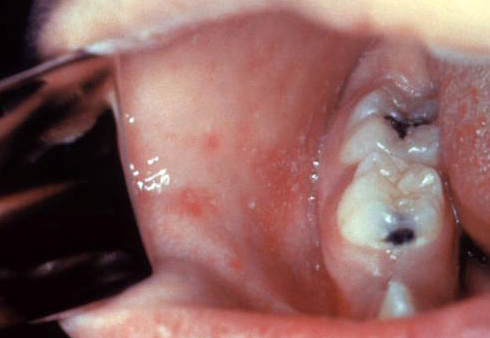
- Koplik spots: small white papules on the buccal mucosa, pathognomonic, appearing 1 to 2 days before the rash (they are not always seen).
- Rash: a maculopapular (morbilliform) rash appears 3 to 5 days after the first symptoms, starting at the hairline and face and spreading downward to the trunk and limbs.
- Recovery: the rash fades about a week after it appears, in the same order it came, often followed by fine peeling.
What are the complications of measles, including SSPE?
Measles suppresses immunity for weeks, so secondary infections are common. Unvaccinated young children, malnourished children (especially with vitamin A deficiency) and pregnant women are at highest risk.
| System | Complication | Key point |
|---|---|---|
| Respiratory | Pneumonia — viral (Hecht giant cell pneumonia) or secondary bacterial | Most common complication and leading cause of measles deaths |
| Ear and eye | Otitis media; keratoconjunctivitis | Keratoconjunctivitis with vitamin A deficiency can cause blindness |
| Gut | Diarrhoea | Dehydration and electrolyte problems |
| CNS (acute) | Acute disseminated encephalomyelitis (ADEM) | Post-infectious, within weeks |
| CNS (immunocompromised) | Measles inclusion body encephalitis (MIBE) | Seen in people with weak immunity |
| CNS (late) | Subacute sclerosing panencephalitis (SSPE) | Years later; progressive and fatal |
SSPE is a slowly progressive brain disease caused by persistent, mutated measles virus. It appears in about 5 to 10 per 100,000 children who had measles, with a latent period of about 7 to 10 years; infection before age 2 shortens the latency and raises the risk. It begins with personality and behaviour change and school decline, then myoclonus, motor decline and dementia.
- Diagnosis: raised anti-measles antibody in CSF (≥ 1:4) or serum (≥ 1:256), a raised CSF globulin fraction, and the EEG pattern of high-amplitude slow waves repeating at regular intervals (periodic complexes), seen in about 65–83% of cases.
- Treatment: no cure exists; care is supportive.
- Prevention: measles vaccination — SSPE is a strong argument for high two-dose coverage.
How is measles confirmed and prevented after exposure?
- Serology: measles IgM becomes detectable 3 to 4 days after the rash and lasts 6 to 8 weeks — a sample taken too early can be falsely negative.
- WHO clinical case definition: fever with a generalised maculopapular rash plus cough, coryza or conjunctivitis.
- Post-exposure prophylaxis: measles-containing vaccine within 72 hours of exposure; immune globulin for those who cannot receive a live vaccine (for example, immunocompromised contacts).
- Treatment: supportive care plus vitamin A; antibiotics only for proven bacterial complications.
How does rubella present and what is congenital rubella syndrome?
Rubella (German measles) is caused by the rubella virus (genus Rubivirus, classically grouped with the togaviruses). After an incubation of 14 to 21 days, children have a mild illness: low-grade fever, a pink maculopapular rash that starts on the face and spreads quickly to the trunk and limbs, and tender lymph nodes behind the ears and at the back of the head (postauricular and suboccipital). The rash lasts about 3 days. Petechiae on the soft palate (Forchheimer spots) appear in about 20%. Adolescents and adults may get arthralgia or arthritis.
The danger of rubella is to the fetus. Infection in the first trimester can cause miscarriage, stillbirth or congenital rubella syndrome (CRS). If the mother is infected before 10 weeks, up to 90% of fetuses develop defects; within the first 12 weeks, up to 85% of newborns are affected.
| Feature group | Findings |
|---|---|
| Classic triad | Cataract, congenital heart disease and sensorineural deafness |
| Heart | Patent ductus arteriosus, pulmonary artery hypoplasia |
| Eye | Cataract, retinopathy, glaucoma, chorioretinitis, microphthalmia |
| Brain | Microcephaly, developmental delay |
| Blood and skin | Thrombocytopenia, haemolytic anaemia, 'blueberry muffin' rash from dermal erythropoiesis |
How do roseola infantum and erythema infectiosum differ?
| Feature | Roseola infantum (sixth disease) | Erythema infectiosum (fifth disease) |
|---|---|---|
| Agent | Human herpesvirus 6 (less often HHV-7) | Parvovirus B19 |
| Typical age | 6 to 12 months; 90% under 2 years | Children; adults may get arthralgia |
| Fever | Sudden high fever, often above 40 °C, for 3–5 days | Mild flu-like illness before the rash |
| Rash | Pink, non-itchy papules on the trunk, spreading to neck and limbs, appearing as the fever falls | Bright red 'slapped cheek' face, then a lacy (reticular) rash on the limbs that fades and returns |
| Enanthem | Nagayama spots — red papules on soft palate and uvula (about two-thirds) | — |
| Infectivity | Benign, self-limiting course | Not contagious once the rash appears |
| Key complication | Febrile seizures during the fever | Transient aplastic crisis (haemolytic anaemias), hydrops fetalis in pregnancy, arthralgia |
Parvovirus B19 targets red-cell precursors. In a child with sickle cell disease or another haemolytic anaemia, this can cause a sudden aplastic crisis; in pregnancy, fetal anaemia can lead to hydrops fetalis, with the second trimester carrying the highest risk.
What are the features and complications of varicella?
Varicella (chickenpox) is caused by the varicella-zoster virus, which stays latent in sensory ganglia and can reactivate as herpes zoster. The incubation period is 10 to 21 days (average about 2 weeks). Lesions start as red macules and papules and within about 12 hours become 1–3 mm clear vesicles on a red base — 'dew drops on a rose petal'. Older vesicles turn into pustules and crusts.

- Polymorphic rash: macules, papules, vesicles, pustules and crusts are seen at the same time — the key difference from monkeypox, where lesions are all at one stage.
- Infectious period: from 1–2 days before the rash until all lesions have crusted.
- Complications: secondary bacterial skin infection, pneumonia (the most serious complication in adults), acute cerebellar ataxia, encephalitis and Guillain-Barré syndrome (CNS events under 1 per 1000).
- Reye syndrome: encephalopathy with fatty liver after aspirin — use paracetamol for fever.
- Congenital varicella syndrome: about 2% when the mother has varicella in the first 20 weeks; maternal zoster carries little risk.
- Lab: direct fluorescent antibody testing has largely replaced the Tzanck smear (multinucleated giant cells).
How is scarlet fever recognised and treated?
Scarlet fever is the exanthem of group A *Streptococcus* pharyngitis, caused by streptococcal pyrogenic exotoxins that act as superantigens. The incubation period is 1 to 5 days, and the rash appears 24 to 48 hours after the sore throat and fever begin.
- Sandpaper rash: fine red papules starting on the trunk, underarms and groin, spreading to the limbs and sparing the palms and soles.
- Strawberry tongue and circumoral pallor (a pale ring around the mouth in a flushed face).
- Pastia lines: linear red streaks in skin folds — neck, elbow creases, groin.
- Desquamation: peeling may follow for up to 2 weeks after the rash fades.
- Treatment: oral penicillin V or amoxicillin for 10 days; alternatives for penicillin allergy depend on local resistance.
- Why treat: antibiotics cut spread and reduce suppurative and non-suppurative complications such as rheumatic fever and post-streptococcal glomerulonephritis.
How are measles and rubella prevented in India?
India's Universal Immunization Programme replaced the single measles vaccine with the combined measles-rubella (MR) vaccine in 2017. A nationwide MR campaign (2017–2020) vaccinated all children aged 9 months to under 15 years. See the full schedule in National Immunisation Schedule.
| Item | Detail |
|---|---|
| Doses | MR-1 at 9–12 months and MR-2 at 16–24 months (given up to 5 years) |
| Dose and route | 0.5 ml subcutaneous, right upper arm |
| Diluent | Sterile water supplied by the manufacturer |
| Delayed first dose | If MR-1 is given after 12 months, keep at least 1 month between doses |
| Cold chain | Reconstituted MR is heat- and light-sensitive and must be used within 4 hours |