Which vitamin deficiency causes which disease?
Vitamins are grouped by solubility. The fat-soluble vitamins — A, D, E, K — need bile and pancreatic enzymes for absorption, so they fail together in cholestasis, pancreatic insufficiency, cystic fibrosis, short bowel and bariatric surgery. The water-soluble vitamins — the B group and C — are stored poorly (B12 is the exception, with large hepatic stores), so deficiency appears quickly when intake or absorption falls.
| Vitamin | Deficiency disease | Key signs | Key test | Treatment / prevention |
|---|---|---|---|---|
| A (retinol) | Xerophthalmia | Night blindness, Bitot spots, corneal xerosis → keratomalacia; frequent infections | Serum retinol | High-dose oral vitamin A (WHO schedule) |
| D (cholecalciferol) | Rickets (children), osteomalacia (adults) | Bone pain, myalgia, weakness, fractures; secondary hyperparathyroidism | Serum 25-hydroxyvitamin D | Vitamin D3 (preferred over D2) |
| E (α-tocopherol) | Neuromuscular syndrome | Ataxia, hyporeflexia, loss of vibration sense, limited upward gaze, retinopathy | Serum α-tocopherol (< 5 µg/mL) | Oral vitamin E; treat malabsorption |
| K (phylloquinone) | Vitamin K deficiency bleeding | Bruising, umbilical/GI bleeding, intracranial haemorrhage in infants | Prolonged PT, raised PIVKA-II | Vitamin K1 1 mg IM at birth; IM/SC vitamin K to treat |
| Vitamin | Deficiency disease | Key signs | Key test | Treatment |
|---|---|---|---|---|
| B1 (thiamine) | Beriberi, Wernicke–Korsakoff | Dry: neuropathy; wet: high-output heart failure; Wernicke triad | Mainly clinical — treat on suspicion | IV thiamine before glucose |
| B2 (riboflavin) | Ariboflavinosis | Cheilosis, angular stomatitis, glossitis, seborrhoeic dermatitis, anaemia | EGRac ≥ 1.40 | Oral riboflavin |
| B3 (niacin) | Pellagra | Dermatitis, diarrhoea, dementia → death | Urinary N1-methylnicotinamide; therapeutic response | Nicotinamide 250–500 mg/day |
| B6 (pyridoxine) | Pyridoxine deficiency | Cheilosis, glossitis, seborrhoeic dermatitis, microcytic anaemia, seizures, neuropathy | Plasma PLP (< 20 nmol/L insufficient) | Pyridoxine; prophylaxis with isoniazid |
| B7 (biotin) | Biotin deficiency | Alopecia, periorificial dermatitis, hypotonia, seizures | Urinary 3-hydroxyisovaleric acid | Biotin 5–10 mg/day |
| B9 (folate) | Megaloblastic anaemia; neural tube defects | Anaemia, glossitis — no neuropathy | Serum folate < 2 ng/mL; ↑ homocysteine, normal MMA | Folic acid 1–5 mg/day |
| B12 (cobalamin) | Megaloblastic anaemia, SACD | Anaemia plus neuropathy, ataxia, loss of proprioception, dementia | B12 < 200 pg/mL; ↑ MMA and homocysteine | IM B12 1000 µg |
| C (ascorbic acid) | Scurvy | Corkscrew hairs, perifollicular haemorrhages, bleeding gums, subperiosteal bleeds | Leukocyte vitamin C; clinical | Vitamin C 500–1000 mg/day (adults) |
What are the features of vitamin A deficiency?
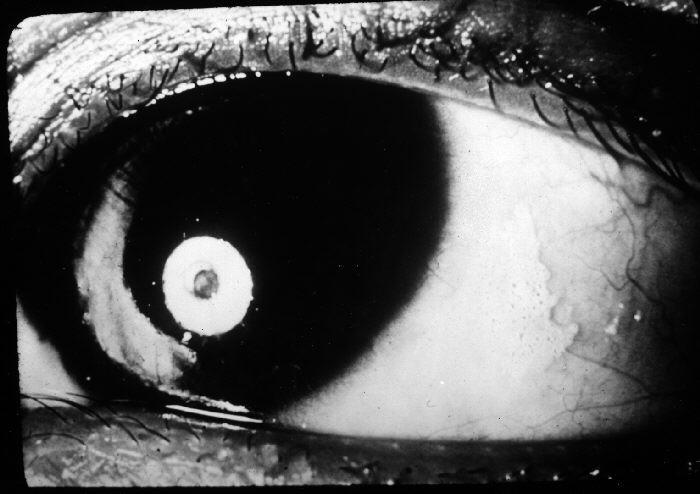
Chronic vitamin A deficiency presents first with night blindness (nyctalopia) and more frequent gastrointestinal, respiratory and urinary infections. As it progresses, xerophthalmia develops: conjunctival xerosis, Bitot spots (triangular or oval, foamy conjunctival lesions), corneal xerosis, ulceration and finally keratomalacia — corneal softening and necrosis. Measles can drop serum retinol by more than 30% and cause acute corneal ulceration without preceding night blindness. Serum retinol is the most widely used test. Staging is covered in xerophthalmia.
| Purpose | Age | Dose |
|---|---|---|
| Treatment of xerophthalmia (days 1, 2 and 15) | < 6 months | 50,000 IU per dose |
| 6–12 months | 100,000 IU per dose | |
| > 12 months and adults | 200,000 IU per dose | |
| Prevention (supplementation programmes) | 6–11 months | 100,000 IU once |
| 12 months – 5 years | 200,000 IU every 4–6 months |
What do vitamin D, E and K deficiencies look like?
Vitamin D: low vitamin D reduces calcium and phosphate absorption; the low calcium drives secondary hyperparathyroidism, phosphaturia and bone loss — rickets in children and osteomalacia in adults (full detail in rickets). Most patients are asymptomatic; severe deficiency causes bone pain, myalgia, fasciculations and weakness. Measure serum 25-hydroxyvitamin D (the storage form) — StatPearls describes < 20 ng/mL as deficiency and 20–30 ng/mL as insufficiency, while noting that cut-offs vary between societies. Vitamin D3 is preferred to D2 for correction.
Vitamin E deficiency is rare from diet alone and usually reflects fat malabsorption (cystic fibrosis, cholestasis, short bowel), abetalipoproteinaemia, isolated vitamin E deficiency (tocopherol transfer protein defect) or prematurity (little crosses the placenta). It is a neurological disease: ataxia (the commonest finding), hyporeflexia, loss of vibration sense, limited upward gaze and, in abetalipoproteinaemia, pigmented retinopathy — a picture that mimics Friedreich ataxia.
Why do newborns need vitamin K and what is VKDB?
Nearly all newborns are vitamin K deficient: poor placental transfer, immature hepatic synthesis of clotting factors, a sterile gut without vitamin K-producing bacteria, and low vitamin K in breast milk. Vitamin K is the cofactor for γ-glutamyl carboxylase, which activates factors II, VII, IX and X and proteins C, S and Z; without it, inactive 'PIVKA' proteins accumulate.
| Type | Timing | Typical cause | Typical bleeding |
|---|---|---|---|
| Early | Within 24 hours | Maternal drugs — anticonvulsants (phenytoin, carbamazepine, phenobarbital), rifampicin, isoniazid, warfarin | Often severe: intracranial, intrathoracic, intra-abdominal |
| Classic | Day 2 to 1 week | Exclusive breastfeeding without prophylaxis | Skin, umbilical, GI, post-circumcision |
| Late | 1 week – 6 months (peak 2–8 weeks) | Exclusive breastfeeding without prophylaxis; cholestasis (biliary atresia), malabsorption | Intracranial haemorrhage in a high proportion |
- Prophylaxis (AAP): vitamin K1 (phytonadione) 1 mg IM within 6 hours of birth for infants > 1500 g; 0.3–0.5 mg/kg IM for infants ≤ 1500 g. IM is preferred — oral regimens are less effective against late VKDB
- Labs: prolonged PT (± aPTT) with normal platelets and fibrinogen; raised PIVKA-II; PT corrects within 2–4 hours of vitamin K
- Treatment: vitamin K1 1 mg IM or SC; fresh frozen plasma 10–15 mL/kg or prothrombin complex concentrate for severe bleeding such as intracranial haemorrhage
What are beriberi and Wernicke encephalopathy?
Thiamine pyrophosphate is the coenzyme for pyruvate dehydrogenase, α-ketoglutarate dehydrogenase and transketolase. Deficiency starves high-energy tissues — nerves, heart and brain. Dry beriberi = symmetrical peripheral neuropathy; wet beriberi = high-output heart failure with oedema, a medical emergency that can kill within days.
Wernicke encephalopathy is the acute neurological form: the classic triad of ophthalmoparesis (often with nystagmus), gait ataxia and mental status change. Only about 16% show all three and about 19% show none at first, so suspect it in any malnourished or alcohol-dependent patient — and remember it also occurs without alcohol use. Lesions involve the mammillary bodies, medial thalami and periaqueductal grey. Untreated, it progresses to Korsakoff syndrome — anterograde amnesia with confabulation.
What are the signs of riboflavin and niacin (pellagra) deficiency?
Riboflavin (B2) forms FMN and FAD. Severe deficiency (ariboflavinosis) causes cheilosis, angular stomatitis, glossitis, seborrhoeic dermatitis and anaemia; it also impairs activation of niacin and pyridoxine. Neonatal phototherapy degrades the light-sensitive vitamin. The functional test is the erythrocyte glutathione reductase activation coefficient (EGRac) — ≥ 1.40 indicates deficiency.
Niacin (B3) forms NAD and NADP, and can also be made from tryptophan. Deficiency causes pellagra — the classic '3 Ds': dermatitis, diarrhoea and dementia, with death as the fourth D. The dermatitis is a symmetrical, burning, sunburn-like eruption on sun-exposed skin (dorsum of hands and feet, neck, malar area); the tongue is beefy red; neuropsychiatric change runs from apathy and depression to delirium.
| Cause | Mechanism |
|---|---|
| Maize (corn)-based diet | Niacin in corn is bound and poorly bioavailable |
| Hartnup disease | Impaired tryptophan absorption |
| Carcinoid syndrome | Tryptophan diverted to serotonin |
| Isoniazid | Reduces B6-dependent conversion of tryptophan to niacin |
| 5-fluorouracil, 6-mercaptopurine, azathioprine | Inhibit conversion of tryptophan to niacin |
| Chronic alcohol use, malabsorption | Poor intake and absorption |
What do pyridoxine and biotin deficiencies cause?
Pyridoxine (B6) — active form pyridoxal 5′-phosphate — is a cofactor in over 100 reactions, including transamination and the first step of haem (porphyrin) synthesis. Deficiency causes stomatitis, glossitis, cheilosis, irritability, peripheral neuropathy, seborrhoeic dermatitis, microcytic anaemia and seizures. Isoniazid competitively inhibits pyridoxine, so patients on INH are supplemented; penicillamine, levodopa and some anticonvulsants also interfere.
- Pyridoxine-dependent seizures in neonates do not respond to usual anticonvulsants — give pyridoxine 100 mg IV
- Isoniazid overdose seizures: pyridoxine in a dose equal to the INH ingested (up to 5 g) is life-saving
- Toxicity: chronic high doses (usually > 250 mg/day) cause sensory neuropathy that may be irreversible — B6 is one of the few toxic water-soluble vitamins
Biotin (B7) is the cofactor for the carboxylases — pyruvate, acetyl-CoA, propionyl-CoA and 3-methylcrotonyl-CoA carboxylase. Deficiency causes alopecia, a scaly periorificial dermatitis, conjunctivitis, hypotonia and seizures, with lactic acidosis and organic aciduria. Classic causes are excess raw egg white (avidin binds biotin), long-term anticonvulsants or antibiotics, biotin-free parenteral nutrition, and inherited biotinidase or holocarboxylase synthetase deficiency. The best marker is raised urinary 3-hydroxyisovaleric acid.
How do you tell folate from vitamin B12 deficiency?
Both cause megaloblastic anaemia — MCV > 100 fL with hypersegmented neutrophils — because both are needed for DNA synthesis. B12 is the cofactor for methionine synthase (homocysteine → methionine) and methylmalonyl-CoA mutase (methylmalonyl-CoA → succinyl-CoA). B12 deficiency also traps folate as methyl-THF (the folate trap). See megaloblastic anaemia.
| Feature | Folate (B9) | Cobalamin (B12) |
|---|---|---|
| Neurology | Absent (mood change possible) | Present — SACD: dorsal columns, lateral corticospinal and spinocerebellar tracts; neuropathy, dementia |
| Homocysteine | Raised | Raised |
| Methylmalonic acid | Normal | Raised |
| Onset | Weeks (stores ~8–16 weeks) | Years (large liver stores; ~3 years of strict vegan diet) |
| Causes | Poor diet, alcohol, pregnancy, haemolysis, methotrexate, phenytoin, trimethoprim, sprue | Pernicious anaemia, gastrectomy/bariatric surgery, ileal resection, Crohn, D. latum, vegan diet, metformin, nitrous oxide |
| Treatment | Folic acid 1–5 mg/day orally | 1000 µg IM weekly × 4, then monthly (oral high-dose also works) |

What are the signs of scurvy?
Vitamin C is the cofactor for prolyl and lysyl hydroxylases, which stabilise collagen. Without it, vessels, skin, gums and bone become fragile. Humans cannot synthesise ascorbic acid (they lack L-gulonolactone oxidase). Non-specific symptoms appear 4–12 weeks after intake stops; risk groups include alcohol use, 'tea and toast' diets in older adults, infants fed cow's milk instead of breast milk or formula, smokers and dialysis patients.
- Skin: corkscrew hairs (considered pathognomonic), swan-neck hairs, perifollicular haemorrhages on the legs, petechiae, ecchymoses, poor wound healing
- Gums: swollen, bleeding gingivae, periodontal disease, loss of teeth
- Bone and joint: subperiosteal haematomas, haemarthroses, painful limp or refusal to bear weight in children (knee most often)
- Scorbutic rosary: tender, angular costochondral swellings — unlike the rounded, non-tender rachitic rosary

Diagnosis is clinical, supported by a rapid response to vitamin C. Plasma levels reflect recent intake; leukocyte vitamin C is a better measure of stores. Treat with 500–1000 mg/day in adults (up to 300 mg/day in children) for 1–3 months; fatigue improves within 24 hours, bleeding within 1–2 weeks, and corkscrew hairs within a month.