What is asthma and what happens in the airway?
Asthma is a heterogeneous chronic inflammatory disease of the airways defined by a history of wheeze, shortness of breath, chest tightness and cough that vary over time and in intensity, together with variable expiratory airflow limitation (GINA). It usually begins in childhood, is influenced by genes and the environment, and is strongly linked with atopy.
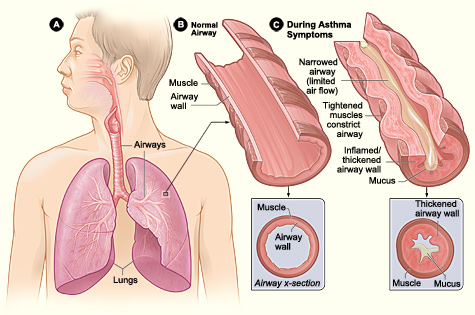
In atopic asthma, allergen-specific IgE on mast cells and basophils is cross-linked on re-exposure, releasing histamine, prostaglandin D2 and cysteinyl leukotrienes (LTC4, LTD4, LTE4). These cause bronchial smooth-muscle contraction within minutes; a late phase hours later brings eosinophils, T cells and neutrophils. The Th2 cytokines IL-4, IL-5 and IL-13 promote IgE and eosinophilic inflammation. Airflow limitation comes from smooth-muscle contraction, airway-wall oedema, mucus plugging and remodelling (basement-membrane thickening, collagen deposition), which in long-standing disease may become fixed.
- Allergens — house-dust mite, animal dander, pollen, moulds, cockroach.
- Exercise, cold air and viral respiratory infections.
- Drugs — aspirin and other NSAIDs in sensitive patients, sulfite sensitivity, and beta-blockers, including ophthalmic preparations.
- Irritants — tobacco smoke, household sprays, paint fumes; occupational sensitisers (see occupational lung diseases).
- Comorbid conditions that worsen control — gastro-oesophageal reflux, chronic sinusitis, hyperventilation, obesity.
How is asthma diagnosed — which spirometry criteria matter?
Diagnosis needs typical symptoms plus confirmed variable expiratory airflow limitation. Spirometry in asthma shows an obstructive pattern (reduced FEV1/FVC ratio). GINA accepts any one of the following as evidence of excessive variability (the more often it is seen, the more confident the diagnosis).
| Test | Adults | Children |
|---|---|---|
| Bronchodilator reversibility (10–15 min after 200–400 mcg salbutamol) | FEV1 or FVC rises by ≥ 12% and ≥ 200 mL (more confident if ≥ 15% and ≥ 400 mL); PEF rise ≥ 20% if no spirometry | FEV1 rises by ≥ 12% of predicted (or PEF ≥ 15%) |
| Diurnal PEF variability over 2 weeks | Average daily variability > 10% | Average daily variability > 13% |
| Improvement after 4 weeks of anti-inflammatory treatment | FEV1 rise ≥ 12% and ≥ 200 mL (or PEF ≥ 20%) from baseline | Documented improvement as per criteria |

Extrapulmonary clues include pale boggy nasal mucosa, nasal polyps, posterior pharyngeal cobblestoning and atopic dermatitis. Clinical signs of a severe attack are tripod posture, use of accessory muscles and pulsus paradoxus. Revise FEV1/FVC ratio patterns for the spirometry basics.
How is asthma classified — control, severity and phenotype?
Three different axes are tested; keep them apart. Control is how well symptoms are suppressed now. Severity is retrospective, judged by the treatment needed. Phenotype describes the biology (allergic, eosinophilic, non-Type 2 and so on). Older textbooks also grade asthma at presentation by symptom frequency into intermittent, mild persistent, moderate persistent and severe persistent; GINA no longer drives treatment from that label and instead steps treatment up or down according to control and risk.
| Question — in the past 4 weeks, has the patient had… | Count of 'yes' answers |
|---|---|
| Daytime symptoms more than twice a week? | — |
| Any night waking due to asthma? | — |
| SABA reliever needed more than twice a week? | — |
| Any activity limitation due to asthma? | — |
| Interpretation | None = well controlled; 1–2 = partly controlled; 3–4 = uncontrolled |
| Term | Definition (GINA) |
|---|---|
| Mild asthma | Well controlled with low-intensity treatment: as-needed low-dose ICS-formoterol, or low-dose ICS plus as-needed SABA |
| Moderate asthma | Well controlled with Step 3 or Step 4 treatment (low- or medium-dose ICS-LABA) |
| Difficult-to-treat asthma | Uncontrolled despite medium- or high-dose ICS-LABA, or needs high-dose ICS-LABA to stay controlled |
| Severe asthma | Uncontrolled despite adherence with optimised high-dose ICS-LABA and treatment of contributory factors, or worsens when high-dose treatment is reduced; about 3–10% of people with asthma |
Risk factors for future exacerbations include uncontrolled symptoms, previous ICU admission or exacerbation, obesity, poor adherence, chronic rhinosinusitis and a low FEV1. Allergic phenotypes frequently coexist with allergic rhinitis — treating one helps the other.
What are the GINA treatment steps in adults and adolescents?
GINA presents two tracks. Track 1 (preferred) uses low-dose ICS-formoterol as the reliever (anti-inflammatory reliever, AIR) because it gives lower exacerbation risk with similar symptom control and a simpler regimen. Track 2 (alternative) uses a SABA as reliever and is chosen where the preferred option is not feasible.
| Step | Track 1 (preferred): reliever = low-dose ICS-formoterol | Track 2 (alternative): reliever = SABA |
|---|---|---|
| 1 | As-needed-only low-dose ICS-formoterol | Low-dose ICS taken whenever SABA is taken |
| 2 | As-needed-only low-dose ICS-formoterol | Daily low-dose ICS plus as-needed SABA |
| 3 | Low-dose maintenance ICS-formoterol (MART) | Low-dose maintenance ICS-LABA plus as-needed SABA |
| 4 | Medium-dose maintenance ICS-formoterol (MART) | Medium- or high-dose maintenance ICS-LABA plus as-needed SABA |
| 5 | Refer for expert assessment, phenotyping and add-on therapy (for example LAMA, biologics) | Same — refer; add-on options as for Track 1 |
- MART = maintenance and reliever therapy with a single ICS-formoterol inhaler. Formoterol is a fast-onset LABA, which is why it can also act as the reliever.
- Before any step-up: confirm the diagnosis, check inhaler technique and adherence, and remove modifiable triggers.
- Step down once good control is sustained, to the lowest dose that keeps asthma controlled (the retrospective severity label depends on this minimum effective dose).
- Regular follow-up every 1–6 months is advised; measure FEV1 at the start, after 3–6 months of ICS to record the personal best, and then periodically.
How does therapy differ in children and at Step 5 (biologics)?
For children aged 6–11 years, GINA's preferred Step 1 is taking ICS whenever SABA is taken and preferred Step 2 is regular low-dose ICS plus as-needed SABA. Higher steps escalate ICS dose or add a LABA; children with persistent symptoms despite correct technique and adherence at the top steps are referred for specialist assessment. Children aged 5 years and younger have their own treatment steps in a separate GINA chapter.
At Step 5 the patient is referred for phenotypic assessment. Add-on options include LAMA (tiotropium) and, for severe Type 2-high asthma, biologics:
| Drug | Target | Typical patient |
|---|---|---|
| Omalizumab | Anti-IgE | Severe allergic asthma with perennial allergen sensitisation and IgE in range (StatPearls quotes 30–700 IU/mL) |
| Mepolizumab, reslizumab | Anti-IL-5 | Severe eosinophilic asthma |
| Benralizumab | Anti-IL-5 receptor α | Severe eosinophilic asthma |
| Dupilumab | Anti-IL-4 receptor α (IL-4 and IL-13) | Type 2-high asthma, including oral-steroid-dependent disease |
| Tezepelumab | Anti-TSLP | Severe asthma, age 12 years and above |
How is an acute asthma exacerbation managed?
- Oxygen to keep saturation in the target range, and assess severity (speech, pulse, respiratory rate, PEF).
- Rapid-acting bronchodilator — SABA (albuterol/salbutamol) 2–4 puffs by metered-dose inhaler at home, 4–8 puffs with a spacer in the office every 20 minutes for the first hour, or nebulised. GINA also accepts ICS-formoterol 1–2 puffs every 20 minutes for 1 hour in Track 1 patients (StatPearls quotes a maximum of 8 puffs per day).
- Ipratropium added in moderate-to-severe attacks.
- Systemic corticosteroids early — oral prednisone-equivalent 40–60 mg daily for 5–7 days in adults (StatPearls); they shorten recovery and reduce relapse.
- Intravenous magnesium sulfate for severe attacks not responding to bronchodilators, ipratropium and steroids. NAEPP-based pediatric guidance gives 25–75 mg/kg (maximum 2 g) over 20 minutes in children aged 4 years or older.
- Home management can continue if symptoms improve and PEF returns to 80% of baseline or better.
For the drug classes tested in pharmacology, see respiratory pharmacology — bronchodilators, adrenergic drugs and corticosteroids.
What are the common traps in asthma questions?
- Reversibility cut-off — ≥ 12% and ≥ 200 mL in adults (both conditions).
- Control is defined by four questions over the past 4 weeks; zero yes = well controlled.
- Severe asthma is a retrospective label after optimised high-dose ICS-LABA, not simply 'a bad attack'.
- In Track 1 the reliever is ICS-formoterol, not SABA; formoterol's fast onset makes this possible. Salmeterol is slow and is not used as a reliever.
- LABA alone is not given as monotherapy in asthma; it is always paired with an inhaled corticosteroid.
- Biologic matching: IgE → omalizumab; IL-5 → mepolizumab/reslizumab; IL-5Rα → benralizumab; IL-4Rα → dupilumab; TSLP → tezepelumab.