What are the perineal pouches?
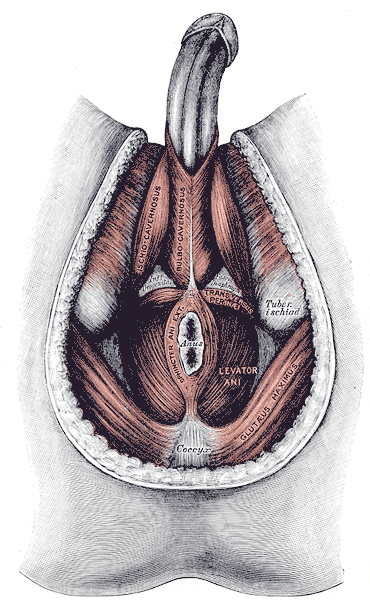
The perineum is the diamond-shaped region below the pelvic diaphragm. An imaginary line joining the two ischial tuberosities (the inter-ischial line) divides it into an anterior urogenital triangle and a posterior anal triangle. The urogenital triangle is then split by a dense fascial sheet, the perineal membrane (older name: inferior fascia of the urogenital diaphragm), into two compartments.
| Feature | Superficial perineal pouch | Deep perineal pouch |
|---|---|---|
| Position | Below the perineal membrane | Above the perineal membrane |
| Boundaries | Perineal membrane above; Colles' fascia (membranous layer of the superficial perineal fascia) superficially | Perineal membrane below; inferior fascia of the pelvic diaphragm above, with no distinct upper fascial layer |
| Closed or open? | Well-defined fascial boundaries — a closed compartment | Not a closed compartment — communicates with the pelvis through the urogenital hiatus |
| Main contents (male) | Root of the penis (bulb and crura), 3 muscles, vessels and nerves | Membranous urethra, sphincter urethrae, deep transverse perineal muscle, bulbourethral glands |

What is in the superficial perineal pouch?
The superficial perineal space lies between the perineal membrane and the perineal skin. Its fascial layers are the superficial perineal fascia (Colles' fascia), the deep perineal fascia and the perineal membrane. StatPearls describes a thin subcutaneous pouch (between Colles' fascia and the deep perineal fascia) and the true superficial perineal pouch (between the deep perineal fascia and the perineal membrane); classical textbooks simply describe the superficial pouch as lying between Colles' fascia and the perineal membrane, and examinations follow that description.
| Male | Female | |
|---|---|---|
| Erectile tissue | Bulb of the penis (corpus spongiosum, containing the bulbar urethra) and the two crura with the corpora cavernosa | Bulbs of the vestibule and the crura of the clitoris |
| Muscles (both sexes) | Ischiocavernosus, bulbospongiosus, superficial transverse perineal | Ischiocavernosus, bulbospongiosus, superficial transverse perineal |
| Glands | — | Greater vestibular (Bartholin's) glands |
| Vessels and nerves | Perineal branches of the internal pudendal artery and nerve; posterior scrotal vessels | Perineal branches; posterior labial vessels |
Colles' fascia is the key boundary. Its attachments, as described in the urological literature, are:
- Laterally — the margins of the ischiopubic rami, and beyond them it fuses with the fascia lata of the thigh along the line of the inguinal ligament.
- Posteriorly — the posterior margin of the perineal membrane and the perineal body, passing over the superficial transverse perineal muscles.
- Anteriorly — it becomes continuous with the dartos of the scrotum and penis and with Scarpa's fascia (the membranous layer of the anterior abdominal wall); the space communicates with the potential plane deep to Scarpa's fascia.
What is in the deep perineal pouch?
The deep perineal space is bounded inferiorly by the perineal membrane, superiorly by the inferior fascia of the pelvic diaphragm and laterally by the obturator fascia over obturator internus. In both sexes it holds the urethra, the external urethral sphincter complex and the neurovascular structures of the external genitalia. Because there is no distinct upper fascial layer, it is not a closed compartment.
| Male | Female | |
|---|---|---|
| Urethra | Membranous urethra | Proximal urethra |
| Muscles | Sphincter urethrae, deep transverse perineal | Sphincter urethrae, compressor urethrae, sphincter urethrovaginalis |
| Glands | Bulbourethral (Cowper's) glands — ducts pierce the perineal membrane and open into the bulbar urethra | — |
| Other | Anterior recesses of the ischioanal fossa; dorsal nerve and artery of the penis in the pudendal canal | Vagina (passes through the membrane); anterior recesses of the ischioanal fossa; dorsal nerve of the clitoris |
Modern anatomy has dropped the older idea of a sheet-like urogenital diaphragm with a superior and an inferior fascia. The perineal membrane is the real structure; the sphincter muscles sit above it without a fascial roof. This is why current urology texts talk about the perineal membrane and about injury at the bulbomembranous junction, even though exam books still use the older terms.
Which parts of the male urethra are injured, and how?
Urethral injuries are classified as anterior (bulbar and penile urethra) or posterior (prostatic and membranous urethra). The posterior urethra is more vulnerable to blunt trauma, mainly pelvic fracture, whereas anterior and posterior injuries are equally common in penetrating trauma. The bulbar urethra is fixed in place, so it is vulnerable to crush injury: in a straddle injury it is compressed between the object and the pubic bone.
| Part of urethra | Pouch / relation | Typical cause | Where urine goes |
|---|---|---|---|
| Prostatic | Above the deep pouch | Pelvic fracture (posterior urethral injury) | Pelvic space around the prostate |
| Membranous | Deep perineal pouch | Pelvic fracture (avulsion at the bulbomembranous junction) | Deep pouch and extraperitoneal pelvis; not confined |
| Bulbar | Superficial perineal pouch (in the bulb) | Straddle injury, fall astride | Superficial pouch → scrotum, penis, abdominal wall |
| Penile (pendulous) | Within the penis, deep to Buck's fascia | Instrumentation, penile trauma | Penile shaft; spreads if Buck's fascia tears |
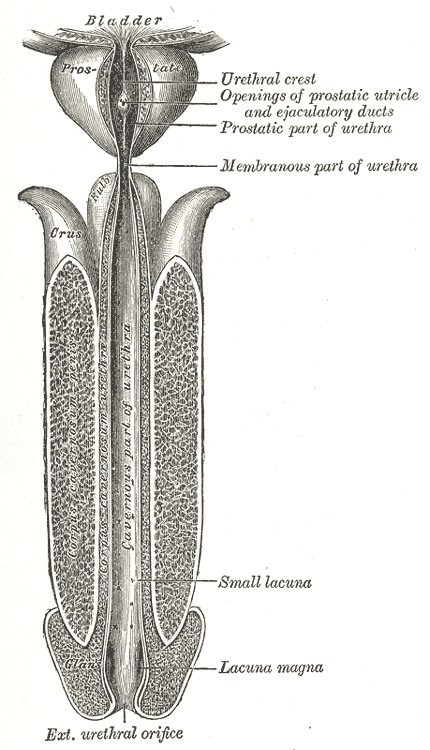
In pelvic fracture urethral injury (PFUI) the older theory blamed shearing at the urogenital diaphragm. That concept has been rejected; the current view is avulsion of the membranous urethra from the bulbar urethra at the point where they meet at the perineal membrane. It is a partial or complete disruption, and combined bladder and urethral injuries are found in up to 20% of cases.
Where does urine go when the bulbar urethra ruptures?
This is the classic examination question. A straddle injury ruptures the bulbar urethra, which lies below the perineal membrane. Urine escapes into the superficial perineal pouch, which is closed by Colles' fascia. Because Colles' fascia is continuous with the dartos of the scrotum and penis and with Scarpa's fascia, the urine spreads forwards — not outwards or backwards.
| Direction | Does urine go there? | Reason |
|---|---|---|
| Scrotum | Yes | Colles' fascia continues as the dartos |
| Penis (shaft) | Yes | Continuity with the dartos of the penis, once Buck's fascia is breached |
| Lower anterior abdominal wall (deep to Scarpa's fascia) | Yes | Colles' fascia is continuous with Scarpa's fascia |
| Thigh | No | Colles' fascia fuses with the fascia lata along the line of the inguinal ligament |
| Anal triangle / ischioanal fossa | No | Colles' fascia is attached to the posterior border of the perineal membrane and perineal body |
| Pelvis (extraperitoneal) | No | The perineal membrane forms the roof of the superficial pouch |
The urological literature adds a refinement based on Buck's fascia, the deep fascia of the penis. If Buck's fascia stays intact, blood or urine stays within the penile shaft (the eggplant deformity). If Buck's fascia is torn, Colles' fascia contains the leak in the superficial pouch and produces a butterfly-shaped perineal haematoma. If Colles' fascia is also breached, urine, blood or infection can spread to the scrotum and abdominal wall.
What happens when the membranous urethra ruptures?
The membranous urethra lies in the deep perineal pouch. It is usually torn in a pelvic fracture. Because the deep pouch is open above through the urogenital hiatus, urine and blood are not confined by a fascial wall. They track upwards into the extraperitoneal pelvic space around the prostate and bladder, giving a pelvic haematoma that lifts the prostate (the so-called high-riding prostate, although this sign is often unreliable because of the haematoma).
A butterfly bruise of the perineum from blood confined by Colles' fascia is a late finding after pelvic fracture and indicates that the perineal membrane itself has ruptured. If the urine and blood become infected, an abscess can extend along fascial planes across compartment barriers into the abdomen, chest, perineum and medial thighs, causing necrotising fasciitis, urethrocutaneous fistula, peri-urethral diverticula and even death.
| Feature | Bulbar urethra | Membranous urethra |
|---|---|---|
| Typical injury | Straddle / fall astride | Pelvic fracture |
| Pouch involved | Superficial perineal | Deep perineal |
| Spread | Scrotum, penis, lower abdominal wall (not thigh, not anal triangle) | Extraperitoneal pelvis; not confined |
| Clinical clue | Perineal ecchymosis or haematoma, scrotal swelling | Pelvic fracture, retention, high-riding prostate, blood at meatus |
How is a urethral injury diagnosed and managed?
Suspect a urethral injury when there is blood at the urethral meatus, urinary retention or suprapubic fullness, perineal ecchymosis or scrotal haematoma, a superiorly displaced prostate, or an inability to pass a Foley catheter. Classical findings are absent in many patients, so a high index of suspicion is needed.
- Retrograde urethrogram (RUG) is performed in all suspected urethral injuries, in a fluoroscopy suite, after life-threatening vascular or visceral injuries have been dealt with. A 6–8 French Foley catheter is placed in the fossa navicularis for the ascending study.
- AAST grading (urethrogram-based): grade I contusion with blood at the meatus and a normal urethrogram; II stretch injury, no extravasation; III partial disruption with extravasation but contrast also reaching the bladder; IV complete disruption with less than 2 cm separation.
- Urinary diversion — urethral injury with pelvic fracture is best treated with suprapubic cystostomy (or primary realignment in a stable patient with an experienced urologist); straddle injuries also get a suprapubic catheter.
- Delayed reconstruction — after 3 to 6 months of observation the anatomy stabilises; anastomotic urethroplasty is the usual repair for a short obliterated bulbar segment.
- Early drainage matters — it prevents infection of extravasated urine and its complications.