What is the normal sequence of puberty and Tanner staging?
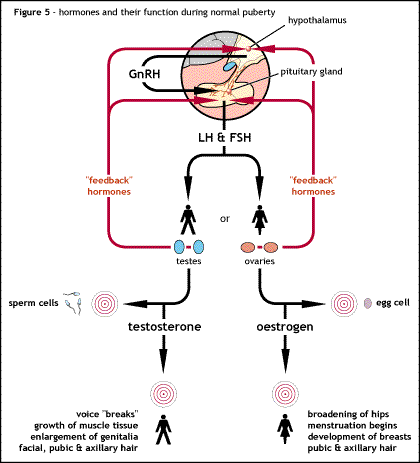
Puberty begins when increased kisspeptin and neurokinin B signalling makes hypothalamic neurons release GnRH in a pulsatile manner. Pulsatile GnRH drives pituitary LH and FSH, which stimulate the gonads to secrete testosterone or oestradiol. Normal onset ranges from about 8 to 13 years in girls and 9 to 14 years in boys.
In girls the first sign is thelarche — a breast bud under the areola, Tanner breast stage 2. Pubic and axillary hair (pubarche) follows 1 to 1.5 years later. Menarche averages 12.5 years and comes about 2.5 years after thelarche (range 0.5 to 3 years). Peak height velocity occurs between breast stages 2 and 3. In boys the first sign is testicular enlargement to 4 mL or more (long axis at least 2.5 cm), genital stage 2, and peak height velocity comes at genital stage 3.
| Stage | Breast (female) | Male genitalia (testicular volume) | Pubic hair (both sexes) |
|---|---|---|---|
| 1 | No palpable glandular tissue | Below 4 mL (long axis below 2.5 cm) | No hair |
| 2 | Breast bud under the areola — first sign of puberty | 4–8 mL — first sign of puberty | Downy hair |
| 3 | Breast tissue beyond the areola, no separate areolar contour | 9–12 mL | Scant terminal hair |
| 4 | Areola and papilla form a secondary mound ("double scoop") | 15–20 mL | Terminal hair filling the pubic triangle |
| 5 | Single adult contour; areola recedes, nipple projects | Above 20 mL | Hair extends beyond the inguinal crease onto the thigh |
What age cut-offs define precocious and delayed puberty?
Precocious puberty is the onset of secondary sexual characteristics before age 8 in girls and before age 9 in boys — the threshold endorsed by major paediatric and endocrine societies for starting evaluation. About 3% of children fall below this statistical threshold, but most have benign, non-progressive variants rather than true central puberty.
Delayed puberty is the absence of expected signs at an age at least 2 standard deviations later than the population mean. The traditional cut-offs are 13 years in girls (no breast development) and 14 years in boys (testicular volume below 4 mL).
| Measure | Girls | Boys |
|---|---|---|
| Normal onset range | 8–13 years | 9–14 years |
| First pubertal sign | Thelarche (breast stage 2) | Testicular volume 4 mL or more (genital stage 2) |
| Precocious puberty | Signs before 8 years | Signs before 9 years |
| Delayed puberty | No breast development by 13 years | Testicular volume below 4 mL at 14 years |
| Sex ratio of precocity | About 10 girls | for every 1 boy |
How does central differ from peripheral precocious puberty?
Central precocious puberty (CPP) — also called true, complete or gonadotropin-dependent — is premature activation of the hypothalamic–pituitary–gonadal axis. It produces progressive secondary sexual development with accelerated linear growth and advanced bone age. Peripheral precocious puberty (PPP) — pseudo, incomplete or gonadotropin-independent — is driven by sex steroids from the gonads, adrenals or exogenous sources while LH is suppressed.

| Central (gonadotropin-dependent) | Peripheral (gonadotropin-independent) |
|---|---|
| Idiopathic — the commonest, especially in girls | Congenital adrenal hyperplasia |
| Hypothalamic hamartoma — the commonest brain lesion | McCune–Albright syndrome |
| Other CNS tumours: optic glioma, astrocytoma, ependymoma, pineal tumours | Ovarian cysts and sex cord-stromal or germ cell tumours |
| Hydrocephalus, cerebral palsy, septo-optic dysplasia | Adrenocortical tumours |
| Head trauma, cranial irradiation, CNS infection | Familial male-limited precocity (testotoxicosis), Leydig cell and hCG-secreting tumours in boys |
| Secondary CPP after prolonged peripheral sex-steroid exposure | Exogenous sex steroids; Van Wyk–Grumbach syndrome (severe hypothyroidism) |
A hypothalamic hamartoma contains ectopic neural cells that act as an accessory GnRH pulse generator, so affected children may present in infancy, sometimes as early as 12 months. Secondary CPP can follow treatment of a long-standing peripheral cause: once bone age has advanced to about 10–12 years, removing the excess sex steroid releases feedback inhibition and the axis switches on.
Which special causes of peripheral precocity are exam favourites?
- McCune–Albright syndrome: an activating mutation of the gene encoding the alpha subunit of the stimulatory G protein (GNAS) raises cAMP and causes autonomous hyperfunction of cAMP-dependent receptors. Classic triad: "coast of Maine" café-au-lait macules, polyostotic fibrous dysplasia and peripheral precocious puberty. Other endocrine features include hyperthyroidism, Cushing syndrome and growth hormone excess.
- Van Wyk–Grumbach syndrome: severe primary hypothyroidism with ovarian cysts, precocious puberty and — unusually — delayed bone age; very high TSH is thought to stimulate FSH receptors ("specificity spillover").
- Congenital adrenal hyperplasia: adrenal androgen excess, treated with glucocorticoids.
- Familial male-limited precocious puberty (testotoxicosis): gonadotropin-independent testicular activation in boys.
- hCG-secreting tumours: cause precocity in boys only.
Benign variants must be separated from true precocity. Premature thelarche — isolated breast development between birth and 24 months or between 6 and 8 years — is the most common benign variant; bone age, growth velocity and hormone tests are normal. Premature adrenarche gives pubic or axillary hair and body odour from adrenal androgens without gonadal activation. Both are self-limited and need reassurance and follow-up rather than treatment.
How is precocious puberty evaluated and treated?
- Clinical staging and growth: Tanner stage, height velocity and testicular size; asymmetric or unilateral testicular enlargement suggests a tumour, while menarche with minimal breast development points to a peripheral cause.
- Bone age (hand and wrist radiograph): advanced in progressive CPP.
- LH: a pubertal stimulated LH after a GnRH or GnRH-analogue test confirms central activation; reported cut-offs range from above 3.3 to 9.2 IU/L depending on stimulus, timing and assay. Very high oestradiol or testosterone with suppressed LH suggests a peripheral source.
- MRI of the hypothalamic–pituitary region for CPP, with the highest yield in children under 6 years, those with neurological signs and boys of any age.
- Pelvic ultrasound in girls for uterine and ovarian maturity and ovarian cysts or tumours.
GnRH agonists are the standard treatment of progressive CPP, particularly when onset is before about 6 to 7 years, the tempo is rapid or bone age is significantly advanced. These long-acting super-agonists bind the pituitary GnRH receptor and down-regulate it, so gonadotropin and sex-steroid secretion fall even though the drug is an agonist. Treatment halts or reverses pubertal signs and slows growth velocity and skeletal maturation.
Peripheral precocity is treated at its source: removal of a tumour or exogenous steroid, glucocorticoids for CAH, and for McCune–Albright syndrome in girls aromatase inhibitors (anastrozole, letrozole) or tamoxifen have shown some benefit. Untreated precocious puberty causes psychosocial distress and reduced adult height from early epiphyseal closure, and can delay recognition of a serious underlying lesion.
What causes delayed puberty?
| Group | Gonadotropins | Key examples |
|---|---|---|
| Constitutional delay of growth and puberty (CDGP) | Low for age, axis intact | Healthy late bloomer; family history; delayed bone age |
| Functional hypogonadotropic hypogonadism | Low (temporary) | Chronic illness, undernutrition, hypothyroidism, hyperprolactinaemia |
| Permanent hypogonadotropic hypogonadism | Low | Kallmann syndrome (with anosmia), isolated GnRH deficiency, pituitary or hypothalamic tumours, surgery or radiation |
| Hypergonadotropic hypogonadism (primary gonadal failure) | High | Turner syndrome (45,X), Klinefelter syndrome (47,XXY), steroidogenic enzyme defects, gonadal injury |
CDGP is the most common cause. In one academic-centre study of 232 adolescents, CDGP accounted for 53% of delayed puberty and was more frequent in males (63%) than females (30%); functional hypogonadotropic hypogonadism accounted for 19%. Children with CDGP grow slowly, their bone age is delayed by 2 years or more in line with their height, and a parent or sibling often matured late. Puberty eventually starts and catch-up growth continues to target height.
Kallmann syndrome is hypogonadotropic hypogonadism with anosmia, linked to genes such as ANOS1 (KAL1) and FGFR1; GnRH neurons and olfactory neurons share a developmental migration path. Turner syndrome should be considered whenever hypergonadotropic hypogonadism comes with short stature, and Klinefelter syndrome is the most common cause of primary hypogonadism in males — see chromosomal syndromes.
How is delayed puberty investigated and managed?
- History and examination: growth pattern, chronic illness, nutrition, sense of smell, family timing of puberty; documented Tanner stage and height, weight and BMI on age-appropriate charts.
- Bone age (non-dominant hand and wrist radiograph) to judge remaining growth.
- LH, FSH and sex steroids: high gonadotropins point to gonadal failure; low values fit CDGP or hypogonadotropic hypogonadism.
- Karyotype or genetic testing when a syndrome is suspected, and imaging of the hypothalamic–pituitary region or olfactory bulbs when a central cause is suspected.
Management of CDGP is guided by the adolescent and family: observation and reassurance are appropriate when there is no significant distress, and a short course of low-dose testosterone in boys or oestrogen in girls is used when delay causes substantial psychosocial stress. Permanent hypogonadism needs lifelong replacement — testosterone started low and increased over about 3 years in males, and low-dose 17-beta oestradiol (oral or transdermal) increased gradually in females.