How does the body control sodium and water, and what are the cut-offs?
Sodium is the main solute of extracellular fluid, potassium of intracellular fluid. Serum sodium is really a measure of water relative to solute, not of total body sodium. Hyponatraemia is serum sodium below 135 mEq/L; StatPearls grades it as mild 130–135, moderate 125–130 and severe below 125 mEq/L. Hypernatraemia is serum sodium above 145 mEq/L.
Water balance is held by thirst (hypothalamic osmoreceptors trigger it at about 295 mOsm/kg) and by arginine vasopressin (ADH), made in hypothalamic magnocellular neurons and stored in the posterior pituitary. ADH binds V2 receptors on the collecting duct and inserts aquaporin-2 channels into the apical membrane; V1 receptors cause vasoconstriction. Baroreceptors (carotid sinus, renal arteries) can also release ADH when effective circulating volume falls, and so can nausea, pain, stress and some drugs — but they are less sensitive than osmoreceptors.

| Parameter | Value |
|---|---|
| Hyponatraemia | Serum Na below 135 mEq/L (severe: below 125) |
| Hypernatraemia | Serum Na above 145 mEq/L |
| Effective serum osmolality (tonicity) | 2 × Na + glucose/18; reference 285–295 mOsm/kg (urea excluded — it crosses cell membranes) |
| Total serum osmolality | 2 × Na + glucose/18 + urea (BUN)/2.8 |
| Urine osmolality below 100 mOsm/kg | ADH is suppressed (primary polydipsia, low solute intake) |
| Urine sodium | Below 20 mmol/L suggests low renal perfusion; above 40 suggests SIADH |
How is hyponatraemia classified and what are the causes?
| Type | Serum osmolality | Causes |
|---|---|---|
| Hypertonic | Above 295 mOsm/kg | Hyperglycaemia; exogenous osmoles such as mannitol, maltose, radiocontrast, sucrose |
| Isotonic (pseudohyponatraemia) | 275–295 mOsm/kg | Laboratory artefact from hypertriglyceridaemia, lipoprotein X (cholestasis) or hyperproteinaemia (monoclonal gammopathy, IV immunoglobulin) — less aqueous plasma, so indirect ion-selective methods read low |
| Hypotonic (true) | Below 275–285 mOsm/kg | Excess water relative to sodium — the vast majority of cases |
| Volume status | Mechanism | Examples |
|---|---|---|
| Hypovolaemic | Water falls less than sodium | GI loss (vomiting, diarrhoea), third-spacing (pancreatitis, hypoalbuminaemia, small-bowel obstruction), thiazide diuretics, osmotic diuresis, salt-wasting nephropathy, cerebral salt wasting, mineralocorticoid deficiency |
| Hypervolaemic | Water rises more than sodium; low effective volume drives ADH | Heart failure, cirrhosis, nephrotic syndrome, acute or chronic renal failure |
| Euvolaemic | Water excess with stable total sodium | SIADH, hypothyroidism, adrenal insufficiency (Addison disease), primary polydipsia and potomania (low solute, high fluid intake) |
The thiazide site of action is the sodium-chloride cotransporter of the distal convoluted tubule, and thiazides impair urinary dilution — a classic drug cause. Other common drugs: desmopressin and oxytocin (vasopressin analogues), SSRIs and other antidepressants, opioids, carbamazepine, vincristine, antipsychotics, chlorpropamide, cyclophosphamide, NSAIDs and MDMA (ecstasy). In hospital practice the commonest causes are SIADH, diuretics, polydipsia, adrenal insufficiency and heart or liver failure.
What is SIADH and how is it diagnosed?
SIADH is non-physiological ADH release that causes water retention and a euvolaemic hypotonic hyponatraemia. Solute loss (natriuresis) accompanies the water retention, and is more prominent in chronic SIADH. The 1967 Schwartz–Bartter criteria remain valid:
- Serum sodium below 135 mEq/L and serum osmolality below 275 mOsm/kg.
- Urine osmolality above 100 mOsm/kg (inappropriately concentrated) and urine sodium above 40 mEq/L.
- No clinical volume depletion — normal skin turgor and blood pressure.
- Exclusion of adrenal insufficiency, hypothyroidism, cardiac, renal or hepatic disease and drugs that impair water excretion.
- Correction of hyponatraemia with fluid restriction.
| Group | Examples |
|---|---|
| CNS | Stroke, haemorrhage, infection, trauma, psychosis |
| Malignancy | Small-cell lung cancer (commonest ectopic ADH source); head and neck cancers; olfactory neuroblastoma |
| Drugs | Carbamazepine, oxcarbazepine (increase ADH sensitivity), chlorpropamide (more V2 receptors), cyclophosphamide, SSRIs, MDMA; less often NSAIDs, opiates, vincristine, haloperidol |
| Pulmonary | Pneumonia (viral, bacterial, tuberculous), asthma, atelectasis |
| Surgery | Post-operative pain-mediated ADH release |
| Genetic | Nephrogenic syndrome of inappropriate antidiuresis — gain-of-function V2 receptor mutation |
How is hyponatraemia treated and how fast can sodium be corrected?
Treatment depends on symptoms, duration (acute is under 48 hours; chronic over 48 hours) and volume status. Acute hyponatraemia causes cerebral oedema because brain cells have no time to adapt. In chronic hyponatraemia the brain has already expelled osmoles to protect its volume, so rapid correction risks osmotic demyelination. If duration is unknown and there are no worrying neurological signs, use the slower correction targets.
| Presentation | Treatment |
|---|---|
| Severe symptoms — seizures, obtundation, delirium | 3% sodium chloride 100 mL boluses over about 10 minutes, repeated as needed; aim to raise Na by 4–6 mEq/L in the first hours (this is enough to reduce neurological severity) and by no more than 10 mEq/L in 24 hours (European limit) |
| Mild to moderate symptoms — fatigue, somnolence, nausea, weakness | Slow 3% saline infusion using the sodium deficit formula, with frequent sodium checks (hourly to every 4–6 hours) |
| Chronic, asymptomatic — hypovolaemic | Isotonic saline; treat vomiting; stop diuretics |
| Chronic, asymptomatic — hypervolaemic | Treat the cause; restrict salt and fluid; loop diuretic |
| Chronic, asymptomatic — euvolaemic (SIADH) | Fluid restriction (below 1 L/day; below 800 mL/day in some SIADH advice); then oral salt, loop diuretic, urea, or a vaptan |
- Sodium deficit (mEq) = total body water × (desired Na − current Na). Total body water = weight × 0.6 for men and children, 0.5 for women and older adults.
- Traditional limit: no more than 10–12 mEq/L in 24 hours. SIADH teaching: 8 mEq/L per 24 hours, or 0.5–1 mEq/L per hour.
- Isotonic saline can worsen SIADH when urine osmolality exceeds that of the saline — the solute is excreted in a small volume of urine and free water is retained. Use hypertonic saline in severe symptoms.
- Vaptans (tolvaptan oral, conivaptan IV) block V2 receptors and cause aquaresis (free water excretion) without sodium loss; they carry a risk of overcorrection. US guidance allows them in SIADH if fluid restriction fails; European guidance does not recommend them.
- Oral urea (15–60 g/day) is an inexpensive solute load that increases urine volume; it is avoided in hypovolaemic hyponatraemia, drug-induced SIADH, adrenal insufficiency and cirrhosis (hyperammonaemia).
- Rescue from overcorrection: give desmopressin and/or free water to bring sodium back down.
What is osmotic demyelination syndrome?
Osmotic demyelination syndrome (ODS), formerly central pontine myelinolysis, is a complication of rapid correction of chronic hyponatraemia. Brain cells that have adapted to low sodium by expelling osmoles cannot cope with the rapid rise in tonicity, and the damage falls classically in the pons. StatPearls lists the clinical outcomes as parkinsonian features, quadriparesis or death; severe cases cause the 'locked-in' state with quadriplegia.
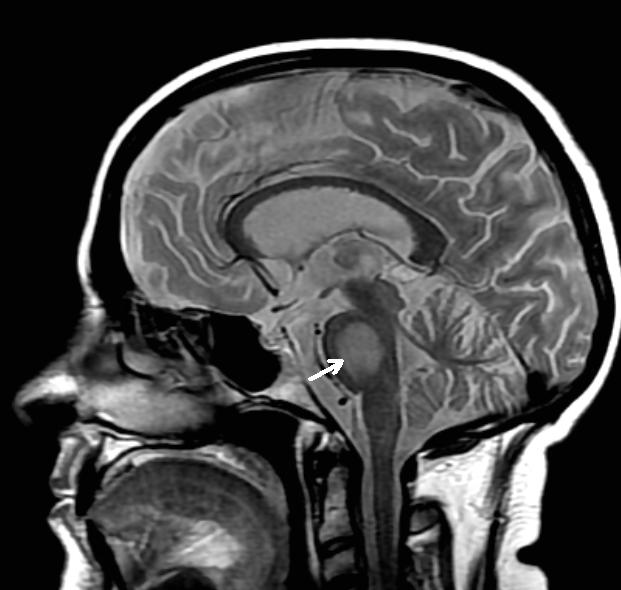
| Feature | Detail |
|---|---|
| Setting | Chronic hyponatraemia (over 48 hours) corrected too fast |
| Risk factors | Hypokalaemia, liver disease, malnutrition, alcohol use |
| Clinical picture | Quadriparesis, parkinsonian features, locked-in state, death |
| Imaging | MRI: abnormal signal in the central pons (T2 hyperintensity) |
| Prevention | Respect correction limits, monitor sodium frequently, identify acute vs chronic onset, treat the cause |
| Rescue | Desmopressin and/or free water if the correction rate is exceeded |
What causes hypernatraemia?
Hypernatraemia (serum sodium above 145 mEq/L) is caused by net water loss or, less often, by excess sodium intake. Because thirst is so powerful, it occurs mainly in people who cannot drink or ask for water — infants, the elderly and the neurologically impaired — or when ADH action fails. The commonest mechanism is water loss exceeding solute loss, so most patients are hypovolaemic.
| Mechanism | Examples |
|---|---|
| Combined water + sodium loss (hypovolaemic) | Gastroenteritis, vomiting, prolonged nasogastric drainage, burns, excessive sweating; renal loss with osmotic diuresis (hyperglycaemia, mannitol), loop diuretics, post-obstructive diuresis |
| Pure water loss — diabetes insipidus | Central DI: idiopathic, head trauma, cranial neoplasm, pituitary infiltration (sarcoidosis, histiocytosis). Nephrogenic DI: X-linked inherited form, lithium, foscarnet, demeclocycline |
| Inadequate intake | Breastfed babies with poor feeding, abuse, impaired thirst, adipsia |
| Sodium excess (usually iatrogenic) | Hypertonic saline or sodium bicarbonate, improper infant formula mixing, salt tablet poisoning, hyperaldosteronism, seawater drowning |
Symptoms are neurological and usually appear when sodium rises rapidly or above about 160 mEq/L: irritability and a high-pitched cry in infants, lethargy, coma, thirst in alert patients, and brisk reflexes or myoclonus. The skin can feel doughy or velvety. Children's dehydration may be underestimated because water shifts from the intracellular space, preserving circulating volume. The most serious complication is subarachnoid or subdural haemorrhage from rupture of bridging veins, and dural sinus thrombosis.
How do you separate central from nephrogenic diabetes insipidus?
In diabetes insipidus the patient passes large volumes of inappropriately dilute urine (urine osmolality lower than serum osmolality) with polyuria and polydipsia. In extrarenal water loss, by contrast, the kidney conserves water: low urine volume, high specific gravity and urine osmolality above serum osmolality.
| Diagnosis | Response to desmopressin | Treatment |
|---|---|---|
| Central DI (no ADH) | Urine osmolality rises | Desmopressin (intranasal or oral); watch for water intoxication and hyponatraemia |
| Nephrogenic DI (kidney unresponsive) | No response | Treat or remove the cause (for example the offending drug); desmopressin is ineffective |
How is hypernatraemia corrected?
- Identify and treat the cause and restore intravascular volume. In shock or severe dehydration, give isotonic saline first, then correct free water.
- Give fluids orally or by feeding tube whenever possible.
- Calculate the free water deficit = total body water × (plasma Na / 140 − 1), with TBW = weight × 0.6 (men) or 0.5 (women). A rule of thumb is about 4 mL per kg for every 1 mEq/L of desired fall.
- Lower the sodium no faster than 10–12 mEq/L in 24 hours (about 0.5 mEq/L per hour); correct the deficit over 48 to 72 hours; check sodium every 2–4 hours in the acute phase.
- Seizures during correction signal cerebral oedema from too-rapid osmolar shifts — stop hypotonic fluids.
- Sodium overload may need loop diuretics and occasionally dialysis; central DI needs desmopressin.
More Medicine and Physiology questions on fluid and electrolyte topics are in NEET PG Medicine PYQs and NEET PG Physiology PYQs; see also most repeated topics.