How are anticoagulants classified?
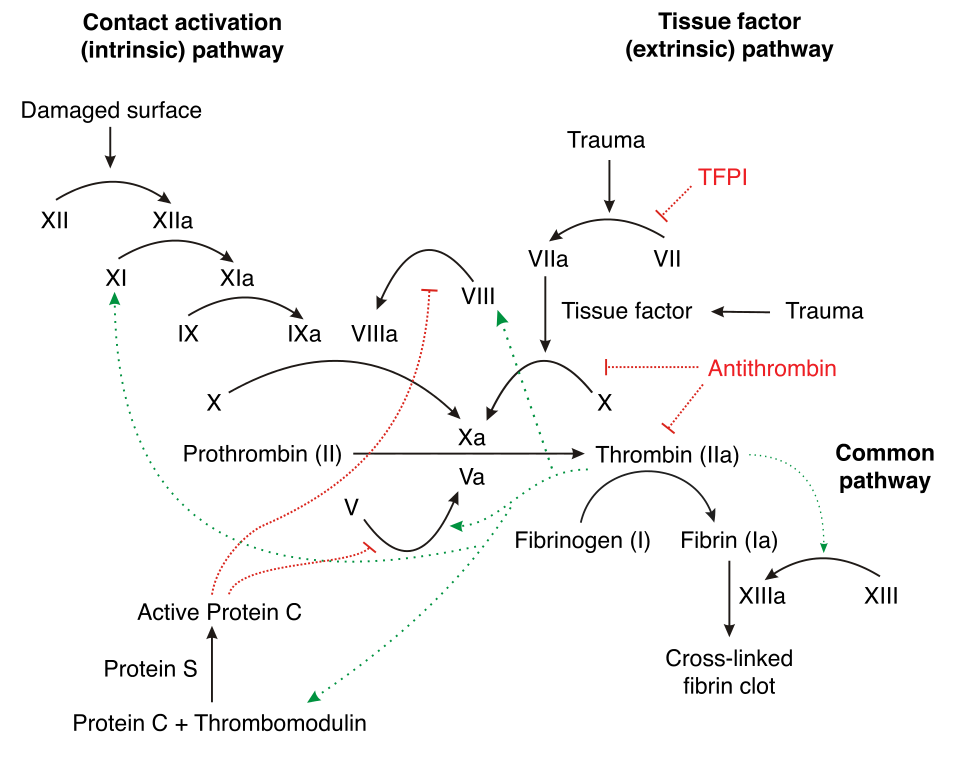
Anticoagulants prevent fibrin formation by acting on the coagulation cascade. They are easiest to learn in four groups: indirect inhibitors that need antithrombin (heparins, fondaparinux), vitamin K antagonists (warfarin), direct factor Xa inhibitors (apixaban, rivaroxaban, edoxaban) and direct thrombin inhibitors (dabigatran orally; argatroban and bivalirudin parenterally). They treat and prevent venous thrombosis — the clot that Virchow's triad explains — and prevent embolism in atrial fibrillation and with heart valves.
| Group | Drugs | Target | Route | Monitoring |
|---|---|---|---|---|
| Unfractionated heparin (UFH) | Heparin | Antithrombin → thrombin (IIa) and Xa | IV or SC | aPTT (or anti-Xa) |
| Low-molecular-weight heparin | Enoxaparin, dalteparin | Antithrombin → mainly Xa | SC | Usually none; anti-Xa in special cases |
| Synthetic pentasaccharide | Fondaparinux | Antithrombin → Xa only (indirect Xa inhibitor) | SC | None routinely |
| Vitamin K antagonist | Warfarin | Vitamin K epoxide reductase → factors II, VII, IX, X; proteins C and S | Oral | INR |
| Direct Xa inhibitors | Apixaban, rivaroxaban, edoxaban | Free and clot-bound Xa | Oral | None routinely |
| Direct thrombin inhibitors | Dabigatran (oral); argatroban, bivalirudin (IV) | Thrombin | Oral / IV | None routinely for dabigatran |

How does unfractionated heparin work and how is it monitored?
Heparin binds antithrombin III and changes its shape, greatly increasing its ability to inactivate thrombin (IIa) and factor Xa. Long heparin chains can bind thrombin and antithrombin at the same time, which is why UFH inhibits both — and why it has a fast onset. Its half-life is short and dose-dependent, typically 0.5–2 hours, so its effect wears off quickly once the infusion stops.
- Monitoring: aPTT (and ACT). Therapeutic aPTT is generally 1.5–2 times control, checked every 6 hours until two consecutive values are therapeutic.
- Heparin resistance (inflammation, thrombosis, MI, malignancy, antithrombin deficiency) makes aPTT unreliable — use anti-factor Xa levels.
- Adverse effects: bleeding, heparin-induced thrombocytopenia, hyperkalaemia (heparin suppresses aldosterone synthesis), alopecia, injection-site reactions, and osteoporosis with long-term use.
- Pregnancy: UFH does not cross the placenta.
How do LMWH and fondaparinux differ from heparin?
LMWH is a fragment of heparin. Its short chains activate antithrombin against factor Xa but are mostly too short to bridge thrombin, so the effect is mainly anti-Xa. Fondaparinux is a synthetic pentasaccharide — just the five sugars that bind antithrombin — and works as a pure indirect factor Xa inhibitor.
| Feature | UFH | LMWH (enoxaparin) | Fondaparinux |
|---|---|---|---|
| Main action | IIa and Xa | Mainly Xa | Xa only |
| Route / dosing | IV infusion or SC | SC once or twice daily | SC |
| Half-life | 0.5–2 h | About 4.5 h (enoxaparin, single dose) | — |
| Monitoring | aPTT | Not routine; anti-Xa if needed | Not routine |
| Severe renal impairment | — | Exposure rises when CrCl below 30 mL/min | — |
| HIT risk | Highest | Lower | Does not cause HIT |
| Reversal | Protamine — complete | Protamine — partial only | No specific antidote |
- Enoxaparin treatment dose for DVT: 1 mg/kg every 12 hours, or 1.5 mg/kg once daily in hospital, continued at least 5 days and until the INR is 2–3 when warfarin is started alongside.
- Protamine for LMWH: 1 mg per 1 mg enoxaparin within 8 hours, or 0.5 mg per 1 mg if 8–12 hours have passed — reversal is incomplete.
- Fondaparinux bleeding: supportive care; recombinant factor VIIa may be considered in life-threatening bleeding.
How does warfarin work and what INR is targeted?
Warfarin inhibits vitamin K epoxide reductase (VKORC1), so the liver runs out of active vitamin K and cannot carboxylate the vitamin K-dependent proteins: factors II, VII, IX and X and the natural anticoagulants protein C and protein S. Its onset is 24–72 hours and its half-life is variable, about 20–60 hours. It is a racemic mixture; the S-enantiomer is 2.7–3.8 times more potent and is metabolised mainly by CYP2C9 — which is why CYP2C9 and VKORC1 gene variants change the dose a patient needs.
| Indication | Target INR |
|---|---|
| Venous thromboembolism | 2.5 (range 2.0–3.0) |
| Non-valvular atrial fibrillation | 2.5 (range 2.0–3.0) |
| Bileaflet mechanical aortic valve, sinus rhythm, no extra risk | 2.5 |
| Mechanical mitral valve; caged-ball or caged-disc valves | 3.0 (range 2.5–3.5) |
| Bioprosthetic mitral valve, first 3 months | 2.5 (range 2.0–3.0) |
Warfarin in pregnancy: it crosses the placenta and causes embryopathy, mainly with first-trimester exposure. Daily doses above 5 mg carry more than a 30% risk of fetal loss or embryopathy; doses of 5 mg or less lower embryopathy to under 3%.
Which drugs and foods interact with warfarin?
Most interactions act through CYP2C9, the enzyme that clears the potent S-enantiomer. Enzyme inhibitors raise the INR; enzyme inducers lower it. Drugs that affect platelets raise bleeding risk even when the INR does not change.
| Effect | Examples | Mechanism |
|---|---|---|
| INR up (bleeding risk) | Metronidazole, co-trimoxazole, ciprofloxacin, amiodarone | CYP inhibition (amiodarone by two mechanisms) |
| INR down (clot risk) | Rifampicin, long-term phenytoin | CYP induction |
| Bleeding without INR change | Antiplatelets, NSAIDs, SSRIs, other anticoagulants | Additive effect on haemostasis |
| INR down | Vitamin K-rich food — kale, spinach, Brussels sprouts, green tea leaves | Replaces the vitamin K warfarin depletes |
What are DOACs and when are they avoided?
Direct oral anticoagulants (DOACs) inhibit a single clotting factor without needing antithrombin or vitamin K. Apixaban, rivaroxaban and edoxaban block both free and clot-bound factor Xa; dabigatran is the only oral direct thrombin inhibitor. Current US cardiology guidance (2023) recommends DOACs over warfarin as first-line for atrial fibrillation, and they have become the preferred choice for most venous thromboembolism.
| Drug | Target | Renal elimination | Exam point |
|---|---|---|---|
| Dabigatran | Thrombin | About 80% | Avoid if CrCl below 30 mL/min; removed by haemodialysis |
| Rivaroxaban | Xa | About 35% | Treatment and AF doses taken with food (evening meal for AF) |
| Apixaban | Xa | About 27% | Half-life about 12 h; twice daily; least renal clearance |
| Edoxaban | Xa | About 50% | Also reversed with PCC |
What are the antidotes for each anticoagulant?
| Anticoagulant | Reversal | Notes |
|---|---|---|
| Unfractionated heparin | Protamine sulfate | 1 mg per 100 units given in the past 2–3 h; max 50 mg; slow infusion |
| LMWH | Protamine (partial) | 1 mg per 1 mg enoxaparin within 8 h; 0.5 mg per mg after 8–12 h |
| Fondaparinux | None specific | Supportive; recombinant VIIa may be considered |
| Warfarin with major bleeding | 4-factor PCC 50 U/kg IV + IV vitamin K 5–10 mg | FFP only if PCC unavailable; subcutaneous vitamin K is unreliable |
| Dabigatran | Idarucizumab 5 g IV (two 2.5 g boluses) | Haemodialysis removes about 60% in 2–3 h |
| Apixaban, rivaroxaban, edoxaban | 4-factor PCC 50 U/kg IV | Andexanet alfa reversed Xa inhibitors but was withdrawn in the US — higher thrombotic risk, no mortality benefit |
Prothrombin complex concentrate (PCC) contains the vitamin K-dependent factors — 4-factor PCC has II, VII, IX and X; 3-factor PCC lacks VII. Its only FDA-approved indication is urgent reversal of warfarin-induced anticoagulation. Guidelines combine it with IV vitamin K to achieve rapid and sustained reversal.
What is heparin-induced thrombocytopenia (HIT)?
Type I HIT is a mild, non-immune fall in platelets that can start on day 1 and is harmless. Type II HIT is the dangerous one: IgG antibodies against the heparin–platelet factor 4 (PF4) complex bind platelet Fc receptors and activate platelets. The result is thrombocytopenia with thrombosis — up to 50% of patients develop thromboembolic complications, with mortality up to 30%.
- Timing: usually 5–14 days after starting heparin; from day 1 if heparin was given in the previous 100 days.
- More common with UFH than LMWH; fondaparinux does not cause it.
- Complications: DVT, PE, arterial thrombosis and skin necrosis — the last especially if warfarin is given in the acute phase.
- Diagnosis: 4T score first. A score of 0–3 makes HIT unlikely; 4 or more → stop all heparin and start an alternative. Confirm with PF4 ELISA (sensitive, not specific) and the serotonin release assay (gold standard).
- Treatment: stop all heparin, including flushes and heparin-coated catheters; use argatroban, bivalirudin, danaparoid, fondaparinux or a DOAC.