How is postpartum haemorrhage defined?
Postpartum haemorrhage (PPH) is excessive bleeding after childbirth. WHO estimates that it causes nearly 45 000 deaths a year, and it remains one of the leading causes of maternal mortality worldwide, with about 80% of PPH deaths in low- and middle-income countries, particularly sub-Saharan Africa and South Asia.
| Definition | Threshold | Source |
|---|---|---|
| Traditional | > 500 mL after vaginal birth or > 1000 mL after caesarean birth (estimated) | StatPearls |
| ACOG 2017 (reVITALize) | Cumulative loss ≥ 1000 mL with signs or symptoms of hypovolaemia within 24 h, any mode of birth | StatPearls |
| WHO 2025 — act-on criteria | Objectively measured loss ≥ 300 mL + any abnormal haemodynamic sign, or ≥ 500 mL, whichever comes first within 24 h | WHO consolidated guideline, Rec. 22 |
| Severe PPH | ≥ 1000 mL | WHO (outcome definition) |
The abnormal haemodynamic signs in the WHO 2025 criteria are pulse > 100 bpm, shock index > 1, systolic BP < 100 mmHg or diastolic BP < 60 mmHg. WHO asks for particular vigilance in the first 2 hours after birth, because most bleeding events meeting the criteria occur in that window.
What is the difference between primary and secondary PPH?
| Type | Timing | Typical causes to think of |
|---|---|---|
| Primary (early) | Within 24 hours of birth | Atony, genital tract trauma, retained placenta, coagulopathy |
| Secondary (late) | After 24 hours, up to 12 weeks postpartum | Evaluate for the same 4 Ts; coagulation studies and fibrinogen help when DIC is suspected |
The WHO 2025 diagnostic criteria and first-response bundle are written for bleeding within 24 hours of birth, i.e. primary PPH. StatPearls lists secondary PPH among the situations — with placental abruption and pre-eclampsia — in which coagulation studies and fibrinogen are useful because DIC may be present.
What are the 4 Ts of postpartum haemorrhage?
WHO describes four primary causes — uterine atony, genital tract trauma, retained placental tissue and coagulation abnormalities — remembered as the 4 Ts: Tone, Trauma, Tissue and Thrombin. A structured approach that checks each one rapidly is the basis of first-response care.
| T | Problem | Clue at the bedside | First fix |
|---|---|---|---|
| Tone | Uterine atony — the commonest cause (about 70%, StatPearls) | Soft, boggy, enlarged uterus | Uterine massage + uterotonic |
| Trauma | Lacerations of cervix, vagina, perineum; haematoma; uterine rupture or inversion | Bleeding with a well-contracted uterus | Examine genital tract, repair |
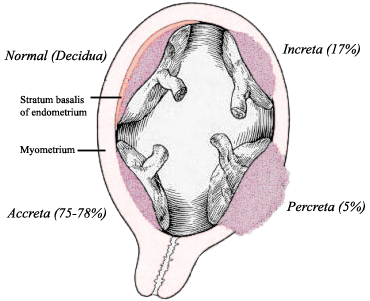
| Tissue | Retained placenta, cotyledon or membranes; abnormally adherent placenta | Incomplete placenta on inspection | Remove (manual removal under cover of antibiotics) |
| Thrombin | Coagulopathy — DIC (abruption, pre-eclampsia, sepsis), inherited disorders, anticoagulants | Oozing from puncture sites, non-clotting blood | Blood products guided by clinical and laboratory assessment |
Most women who have PPH have no identifiable risk factor, which is why WHO insists on prophylactic uterotonics and blood-loss measurement for every birth. Anaemia does not cause PPH but makes the same blood loss far more dangerous.
How is PPH prevented — what is active management of the third stage?
The third stage of labour — from the birth of the baby to complete delivery of the placenta — is the critical window. WHO 2025 recommends a quality-assured uterotonic for every birth, using only one of oxytocin, carbetocin or misoprostol.
| Component | Recommendation |
|---|---|
| Oxytocin | 10 IU IM or IV for all births — the agent of choice where several options exist. If IV access is already in place at vaginal birth, 10 IU IV diluted and given slowly over 1–2 minutes is preferred to IM |
| Carbetocin | 100 µg IM or IV; heat-stable carbetocin is the choice where the oxytocin cold chain cannot be maintained |
| Misoprostol | 400 µg or 600 µg orally — alternative when injectables or heat-stable carbetocin are unavailable; can be given by community health workers |
| Controlled cord traction | Recommended where skilled birth attendants are available; not recommended without them; cord traction is the method for placental removal at caesarean |
| Cord clamping | Early clamping (< 1 minute) is not recommended unless the baby needs immediate resuscitation |
| Uterine massage | Sustained massage is not recommended as prevention once prophylactic oxytocin has been given; abdominal tone assessment is recommended for all women |
Which uterotonics are used and what are their contraindications?
| Drug | Class | Dose (source) | Key caution |
|---|---|---|---|
| Oxytocin | Oxytocin receptor agonist | Prevention 10 IU IM/IV (WHO); IV oxytocin is first-line treatment (WHO) | Minimal adverse events; slow IV injection |
| Carbetocin | Oxytocin analogue | 100 µg IM/IV (WHO, prevention) | Heat-stable form avoids the cold chain |
| Ergometrine / methylergometrine | Ergot alkaloid — sustained contraction | Methylergonovine 200 µg IM/IV (StatPearls) | Hypertension / pre-eclampsia — relative contraindication |
| Carboprost (15-methyl PGF2α) | Prostaglandin F2α analogue | 250 µg IM or intramyometrial every 15–90 min, max 8 doses (StatPearls) | Asthma (bronchospasm); severe hepatic, renal or cardiac disease |
| Misoprostol | Prostaglandin E1 analogue | Prevention 400–600 µg oral; treatment 800 µg sublingual (WHO) | Slower onset; shivering, fever and diarrhoea (WHO) |
WHO's treatment sequence: IV oxytocin first; if it is unavailable or bleeding does not respond, give IV ergometrine, the oxytocin–ergometrine combination, or a prostaglandin (including sublingual misoprostol 800 µg).
When and how is tranexamic acid given in PPH?
WHO recommends early IV tranexamic acid (TXA), within 3 hours of birth, in addition to standard care, for all women with PPH after vaginal or caesarean birth — regardless of whether the bleeding comes from trauma or atony.
- Dose: 1 g IV (100 mg/mL) at 1 mL per minute, i.e. over 10 minutes.
- Second dose: another 1 g if bleeding continues after 30 minutes, or restarts within 24 hours of the first dose.
- Clock starts at birth, not at diagnosis. If the time of birth is unknown, use the best estimate.
- Not after 3 hours: pooled data from 40 138 bleeding patients showed no benefit beyond 3 hours, with point estimates in the direction of harm — WHO does not support TXA more than 3 hours after birth.
- Avoid with a clear contraindication to antifibrinolytics (e.g. a known thromboembolic event in pregnancy).
TXA is an antifibrinolytic. The WOMAN trial was designed because early TXA had already been shown to reduce deaths from bleeding in trauma patients. Note the exam distinction: TXA is for treatment of PPH (within 3 h), not for routine prevention.
What is the WHO MOTIVE first-response bundle?
WHO recommends a standardized, timely approach for every vaginal birth: objective measurement of blood loss (for example with a calibrated drape) plus a first-response treatment bundle started as soon as PPH is diagnosed, rather than one intervention at a time.
- Massage of the uterus.
- Oxytocic drugs to make the uterus contract.
- Tranexamic acid to reduce bleeding.
- Intravenous fluids — isotonic crystalloids in preference to colloids.
- Vaginal and genital tract examination.
- Escalation of care if bleeding persists.
For retained placenta, WHO recommends a uterotonic only if PPH is present, antibiotic prophylaxis for manual removal, and preparing for manual removal if the placenta is still undelivered after 30 minutes without PPH.
How is refractory PPH managed step by step?
About 10–20% of women do not respond to the first-response bundle (WHO). Uterine atony remains the leading cause in these refractory cases. Management moves from temporizing measures that buy time, to conservative surgery, to hysterectomy.
| Step | Intervention | Point to remember |
|---|---|---|
| Temporizing | Bimanual uterine compression, external aortic compression, non-pneumatic anti-shock garment (NASG) | Holds bleeding until surgery, blood or transfer are available |
| Balloon tamponade | Intrauterine balloon (StatPearls: filled with 250–500 mL saline) | WHO: for atony after vaginal birth not responding to first-line care, with surgery and blood available and trauma/retained tissue excluded |
| Not recommended | Uterine packing with plain or haemostatic gauze | WHO 2025 |
| Radiology | Uterine artery embolization | If other measures fail and resources exist; stable patient |
| Compression sutures | B-Lynch brace suture and its variants | Often the first surgical step; preserves the uterus |
| Vessel ligation | Uterine (O'Leary), utero-ovarian, then hypogastric (internal iliac) artery ligation | Internal iliac ligation needs a retroperitoneal approach, so it is rarely used |
| Hysterectomy | Subtotal (supracervical) or total | Definitive treatment and last resort; subtotal is faster |
The B-Lynch suture, a brace-like suture placed over the uterus, has been used since 1989 for bleeding from uterine atony that has failed conservative management, and it allows the uterus to be conserved for future menstruation and pregnancy. WHO's sequence: compression sutures first; if they fail, uterine, utero-ovarian and hypogastric vessel ligation; if life-threatening bleeding continues, subtotal or total hysterectomy.


What is the shock index and how is blood replaced?
Shock index = Pulse rate ÷ Systolic blood pressure
WHO 2025 treats a shock index > 1 (pulse higher than systolic BP) as an abnormal haemodynamic sign.
A shock index above 1 simply means the pulse rate is higher than the systolic BP. Combined with objectively measured blood loss of ≥ 300 mL, a shock index > 1 (or pulse > 100, SBP < 100 or DBP < 60) already meets the WHO 2025 criteria for starting the first-response bundle — the woman does not have to reach 500 mL first.
- Fluids: isotonic crystalloids rather than colloids for initial resuscitation (WHO).
- Blood products: the decision to transfuse should rest on the underlying risk, continuous clinical and haematological assessment and clear protocols (WHO 2025); early activation of massive-transfusion protocols is emphasised in StatPearls.
- Cell salvage: only in the context of rigorous research (WHO 2025).
- After PPH: oral iron with or without folic acid for 6–12 weeks where anaemia is common; IV iron when oral iron is not tolerated or rapid correction is needed.
How is postpartum haemorrhage asked in NEET PG and INI-CET?
- Definition — 500 mL vaginal / 1000 mL caesarean; primary < 24 h, secondary 24 h to 12 weeks.
- Most common cause — uterine atony (Tone).
- Drug of choice for prevention and treatment — oxytocin; dose 10 IU IM/IV.
- Contraindications — ergometrine in hypertension; carboprost in asthma.
- Tranexamic acid — 1 g IV over 10 min within 3 h of birth; repeat after 30 min if needed.
- Surgical sequence — B-Lynch, uterine artery ligation, internal iliac ligation, hysterectomy.
- Bleeding with a contracted uterus — genital tract trauma.