NEET-PG Orthopedics Previous Year Questions (2017–2026)

50 NEET-PG Orthopedics PYQs from 2017 to 2026, tagged by topic, with an explanation for every question. Orthopedics had 4 of the 180 questions in NEET-PG 2026.

Last verified: 24 September 2026 against Kinase question bank and NEET-PG 2026 recall paper. natboard.edu.in · nmc.org.in

Quick Answer

NEET-PG Orthopedics had 4 of 180 questions (2.2%) in the NEET-PG 2026 paper — up to 16 marks. Kinase has 50 NEET-PG Orthopedics PYQs from 2017 to 2026; the most-asked topic is Bone Tumors (6 questions).

Orthopedics in NEET-PG at a glance

Questions in NEET-PG 20264 of 180 (2.2%)
Maximum marks at stake16 of 720
NEET-PG Orthopedics PYQs on Kinase50 (3.0% of all NEET-PG PYQs)
Years covered2017–2026
INICET Orthopedics PYQs on Kinase109

Most-asked Orthopedics topics in NEET-PG PYQs

TopicNEET-PG PYQsShare of subject
Bone Tumors612%
Upper Limb Disorders612%
Lower Limb Disorders510%
Arthritis and Connective Tissue Disorders48%
Bone and Joint Disorders48%

Across NEET PG and INI-CET papers: Most repeated Orthopedics topics →

Sample NEET-PG Orthopedics PYQs with answers

Question 1 · NEET PG Aug 2026

A 3-year-old girl is brought in crying after her father lifted her by the wrist to stop her stepping onto a road. She now holds the arm slightly bent with the forearm turned palm-down and will not move it, yet there is no swelling or deformity and plain radiographs of the elbow are reported as normal. What is the most likely diagnosis?

  1. A.Supracondylar fracture
  2. B.Elbow dislocation
  3. C.Radial head subluxation
  4. D.Monteggia fracture-dislocation
Show answer and explanation

Answer: C. Radial head subluxation

Correct answer: C. Radial head subluxation. The history of a sudden longitudinal pull on a young child with a pronated, guarded arm and normal films is classic for a pulled elbow.

This is radial head subluxation (pulled elbow, nursemaid elbow). A quick axial traction on the extended, pronated forearm lets the annular ligament slip up over the radial head and become trapped in the radiocapitellar joint. Because it is a soft-tissue slip and not a fracture, plain radiographs are typically normal. Reduction is achieved by supination with elbow flexion or by hyperpronation, after which the child rapidly uses the arm again.
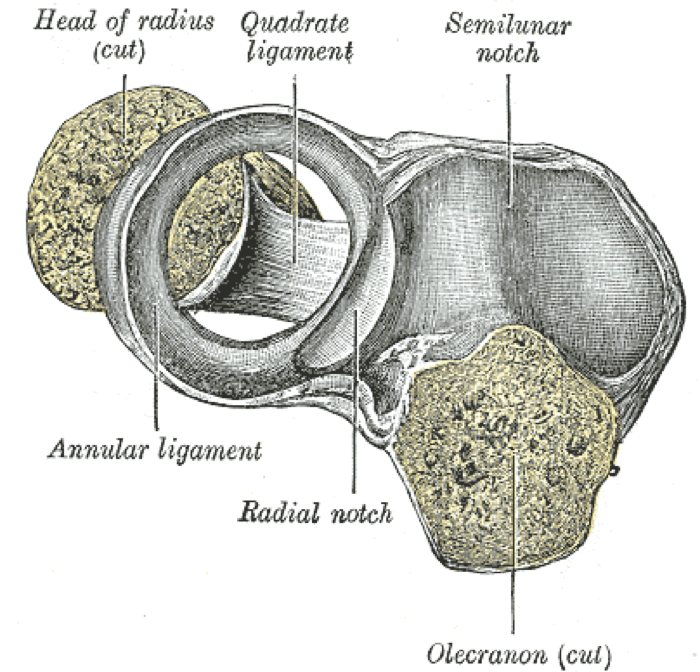
Anatomical diagram of the annular ligament encircling the radial head

The annular ligament encircles the radial head; a sudden axial pull lets it slip over the head.

Incorrect Options:

  • A. Supracondylar fracture: a distal humeral fracture that typically follows a fall on an outstretched hand and shows a fracture line, an effusion or a displaced fat pad on radiographs, none of which are present here. Paediatric elbow radiograph showing a supracondylar humeral fracture
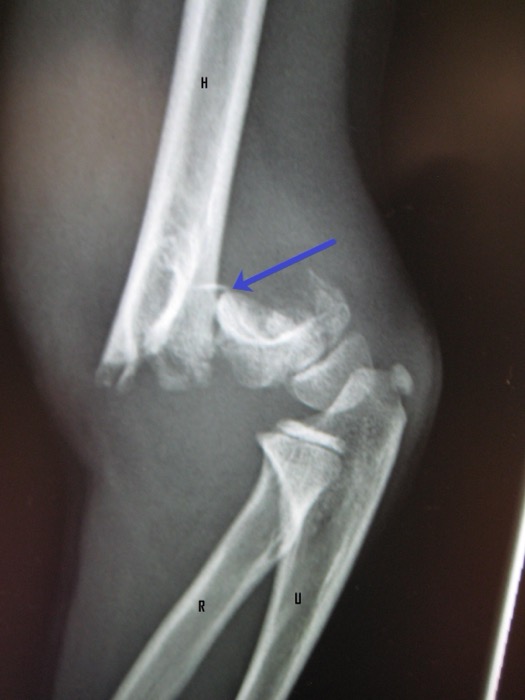
    Supracondylar fracture: a distal humeral break usually visible on radiographs.

  • B. Elbow dislocation: produces obvious deformity, marked swelling and clear radiographic malalignment, which is not the picture in a well-looking child with normal films. Elbow radiograph with an abnormal radiocapitellar line indicating dislocation
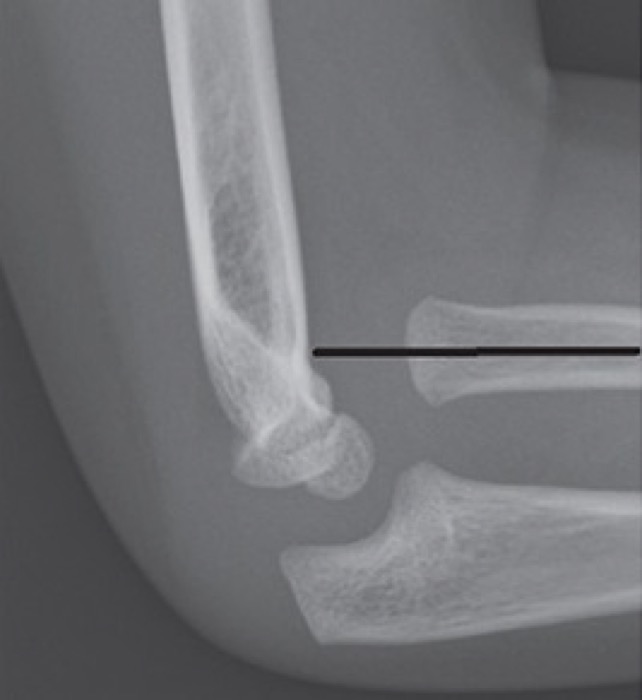
    Elbow dislocation: gross loss of joint alignment on the radiograph.

  • D. Monteggia fracture-dislocation: combines a proximal ulnar fracture with dislocation of the radial head and is clearly abnormal on radiographs, unlike this benign presentation. Forearm radiograph showing an ulnar fracture with radial head dislocation
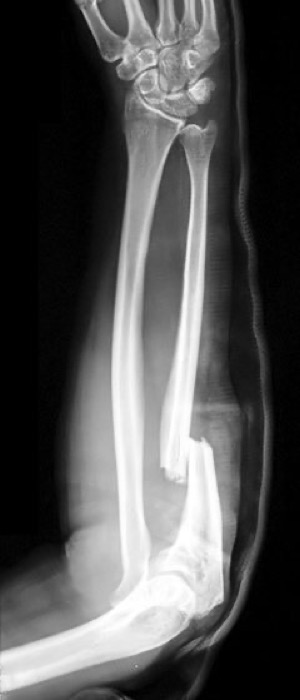
    Monteggia injury: proximal ulnar fracture with radial head dislocation.

High-Yield Facts:

  • Peak age is roughly 1 to 4 years; the annular ligament is thin and lax at this age.
  • The arm is held pronated and slightly flexed, with pain but no swelling or deformity.
  • Radiographs are usually normal; imaging is mainly to exclude fracture when the story is atypical.
  • Hyperpronation is often more successful and less painful than supination-flexion for reduction.
Question 2 · NEET PG 2023

A 45-year-old office worker presents to the orthopedic outpatient department reporting nocturnal awakenings caused by a "pins and needles" sensation involving the lateral three and a half digits of his right hand. He notes that hanging his arm over the edge of the bed or vigorously shaking his hand provides temporary relief from the discomfort. Which of the following options correctly identifies his underlying diagnosis and the most specific clinical provocative test used to evaluate it?

  1. A.Carpal tunnel syndrome; evaluated by Durkan's compression test
  2. B.Ulnar tunnel syndrome; evaluated by Froment's sign
  3. C.Carpal tunnel syndrome; evaluated by Froment's sign
  4. D.Ulnar tunnel syndrome; evaluated by Durkan's compression test
Show answer and explanation

Answer: A. Carpal tunnel syndrome; evaluated by Durkan's compression test

Correct Answer: A. Carpal tunnel syndrome; evaluated by Durkan's compression test

Nocturnal pins-and-needles in the lateral three and a half digits, relieved by hanging or shaking the hand (the flick sign), is carpal tunnel syndrome from median nerve compression beneath the flexor retinaculum -- the most common entrapment neuropathy. Durkan's compression test, applying steady pressure over the carpal ligament for about 30 seconds to reproduce the symptoms, is the most sensitive and specific provocative test for it.

Why the other options fail

  • B. Ulnar tunnel syndrome; evaluated by Froment's sign: wrong nerve for both parts -- ulnar tunnel syndrome causes numbness in the medial one and a half digits, and Froment's tests ulnar motor weakness, not sensory carpal tunnel symptoms.
  • C. Carpal tunnel syndrome; evaluated by Froment's sign: the diagnosis is right but Froment's sign tests adductor pollicis (ulnar-innervated) weakness, not the median nerve.
  • D. Ulnar tunnel syndrome; evaluated by Durkan's compression test: Durkan's test is specific to the median nerve at the carpal tunnel, not the ulnar nerve at Guyon's canal.

Pearl: nocturnal paresthesia in the radial three and a half fingers relieved by shaking the hand is carpal tunnel syndrome, confirmed at the bedside with Durkan's compression test.

Question 3 · NEET PG 2021

A 22-year-old man visits the outpatient clinic complaining of chronic lower back pain and significant morning stiffness that has progressively worsened over the past two years. The stiffness typically improves with physical activity and worsens with rest. Additionally, he reports developing bilateral heel pain over the last six months. What is the most likely diagnosis for this patient's condition?

  1. A.Ankylosing spondylitis
  2. B.Spinal tuberculosis (Pott's disease)
  3. C.Intervertebral disc herniation
  4. D.Mechanical back pain
Show answer and explanation

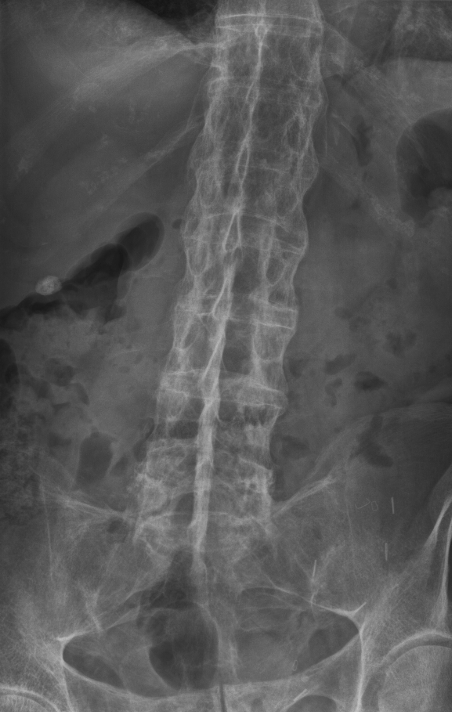
Answer: A. Ankylosing spondylitis

Correct Answer: A. Ankylosing spondylitis

AP abdomen/spine radiograph showing a rigid bamboo spine with bridging syndesmophytes

Bamboo spine: bridging marginal syndesmophytes fusing the vertebral column, classic for ankylosing spondylitis.

Inflammatory back pain (morning stiffness improving with activity) plus bilateral heel pain (Achilles/plantar enthesitis) in a young man is ankylosing spondylitis -- a seronegative spondyloarthropathy strongly linked to HLA-B27, starting at the sacroiliac joints and progressing to syndesmophyte-driven spinal fusion.

Why the other options fail

  • B. Pott disease: presents with constitutional symptoms and localized progressive pain, not generalized morning stiffness or enthesitis.
  • C. Disc herniation: gives acute radicular pain worsened by loading, with focal neurological signs, not chronic systemic stiffness.
  • D. Mechanical back pain: worsens with activity and improves with rest, the opposite pattern, and lacks enthesitis.

Pearl: extra-articular features include acute anterior uveitis, aortic regurgitation, and apical pulmonary fibrosis, and the modified Schober test quantifies restricted lumbar flexion in progressive disease.

Orthopedics concept guides

Browse the full concept library and clinical image atlas.

Practise the rest: open the Kinase question bank, choose Orthopedics, set the exam to NEET-PG and switch on PYQs only. Questions you get wrong go into Fix My Weakness for targeted revision.

Frequently Asked Questions

How many Orthopedics questions were in NEET-PG 2026?▼
4 of the 180 questions in the NEET-PG 2026 paper (30 August 2026) were Orthopedics — 2.2% of the paper, worth up to 16 marks at +4 per correct answer. This is from the recall paper in the Kinase question bank.
How many NEET-PG Orthopedics PYQs does Kinase have?▼
Kinase has 50 NEET-PG Orthopedics previous year questions from 2017 to 2026, each with an explanation, plus 109 INICET Orthopedics PYQs for extra practice.
What are the most-asked Orthopedics topics in NEET-PG?▼
In Kinase's NEET-PG Orthopedics PYQs, the most-asked topics are Bone Tumors, Upper Limb Disorders, Lower Limb Disorders. Bone Tumors alone accounts for 6 of the 50 questions.
Are NEET-PG Orthopedics PYQs the same as INICET PYQs?▼
Both exams test the MBBS syllabus, so most Orthopedics concepts overlap. The marking differs: NEET-PG is +4 / −1 and INICET is +1 / −1/3. Kinase lets you practise either exam's PYQs, or both together.
How should I practise Orthopedics PYQs for NEET-PG?▼
Start with the most-asked topics above, do a daily set of Orthopedics PYQs, and read every explanation — including the ones you got right. Kinase's Fix My Weakness then builds practice sets from the topics you miss most.
50 Orthopedics PYQs
2017–2026 papers
Topic + year tagged

Ready to Start Practicing?

Orthopedics was 4 questions (up to 16 marks) in NEET-PG 2026.

Start Free Practice

No credit card required