Match each condition with its investigation of choice:
1. Pancreatic pseudocyst
2. Obstructive jaundice
3. Thyroid nodule
4. Prostate carcinoma
a. PSMA-PET
b. FNAC
c. MRCP
d. CT
- A.1-c, 2-d, 3-a, 4-b
- B.1-d, 2-c, 3-b, 4-a
- C.1-d, 2-b, 3-a, 4-c
- D.1-c, 2-b, 3-a, 4-d
Show answer and explanation
Answer: B. 1-d, 2-c, 3-b, 4-a
The correct answer is 1-d, 2-c, 3-b, 4-a.
Each condition has a characteristic investigation of choice. A pancreatic pseudocyst is best shown by contrast-enhanced CT (d), defining the cyst wall, size and relations. Obstructive jaundice is mapped non-invasively by MRCP (c), the best test for the level and cause of biliary obstruction. A thyroid nodule is evaluated by FNAC (b), the single best test to separate benign from malignant nodules. Prostate carcinoma is staged with PSMA-PET (a), which detects nodal and metastatic disease with high sensitivity. This gives 1-d, 2-c, 3-b, 4-a.
The discriminators: CT for the pseudocyst, MRCP for the biliary tree, FNAC (tissue) for the thyroid, and the molecular PSMA-PET for prostate cancer.
Incorrect Options:
- 1-c, 2-d, 3-a, 4-b: wrongly gives MRCP to the pseudocyst and PSMA-PET to the thyroid nodule.
- 1-d, 2-b, 3-a, 4-c: FNAC does not assess obstructive jaundice and MRCP is not used for prostate cancer.
- 1-c, 2-b, 3-a, 4-d: mismatches nearly every pair, including CT for prostate carcinoma.
High-Yield Facts:
- CT is the investigation of choice for a pancreatic pseudocyst.
- MRCP is best for obstructive jaundice.
- FNAC is the test for a thyroid nodule.
- PSMA-PET stages prostate carcinoma.
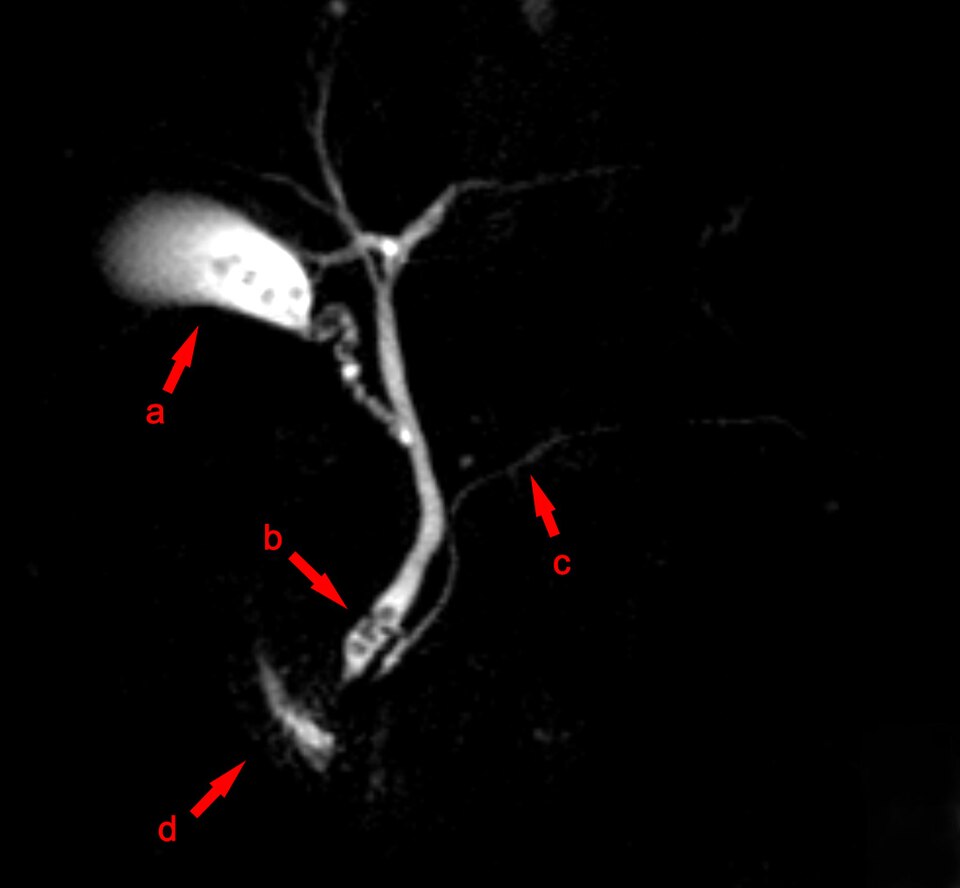
Figure: MRCP showing biliary calculi - MRCP is the non-invasive investigation of choice for obstructive jaundice.