INICET Surgery Previous Year Questions (2018–2026)

279 INICET Surgery PYQs from 2018 to 2026, tagged by topic, with an explanation for every question. Practise AIIMS-pattern Surgery questions before INICET November 2026.

Last verified: 24 September 2026 against AIIMS New Delhi notices and aiimsexams.ac.in.

Quick Answer

Kinase has 279 INICET Surgery PYQs from 2018 to 2026 — 8.3% of all INICET PYQs in the bank. The most-asked topic is Gastrointestinal and Abdominal Surgery (90 questions). INICET is marked +1 / −1/3, so a blind guess is worth nothing on average.

Surgery in INICET at a glance

INICET Surgery PYQs on Kinase279 (8.3% of all INICET PYQs)
Years covered2018–2026
Marking+1 correct, −1/3 wrong
NEET-PG Surgery PYQs on Kinase146

Most-asked Surgery topics in INICET PYQs

TopicINICET PYQsShare of subject
Gastrointestinal and Abdominal Surgery9032%
General Surgery7427%
Breast Surgery249%
Urology238%
Cardiothoracic and Vascular Surgery (CTVS)218%

Across NEET PG and INI-CET papers: Most repeated Surgery topics →

Sample INICET Surgery PYQs with answers

Question 1 · INICET May 2026

Consider the following two statements:

A) The inguinal region must be examined in every patient presenting with a scrotal swelling.
B) The lymphatic drainage of the testis is to the superficial inguinal lymph nodes.

Which of the following is correct?

  1. A.Both are correct
  2. B.A is correct and B is incorrect
  3. C.A is incorrect and B is correct
  4. D.Both are incorrect
Show answer and explanation

Answer: B. A is correct and B is incorrect

The correct answer is A is correct and B is incorrect.

Statement A is true: for any scrotal swelling you must examine the inguinal region and confirm whether you can get above the swelling. If you cannot, the lump is likely an inguinoscrotal hernia descending through the external ring rather than a primary scrotal lesion. Statement B is false: the testis develops as a retroperitoneal organ and then descends, so its lymphatics follow the testicular vessels up to the para-aortic (lumbar) lymph nodes at the level of L2. It is the skin of the scrotum, not the testis, that drains to the superficial inguinal lymph nodes.

This distinction is clinically vital: a testicular tumour spreads first to para-aortic nodes, so a normal groin examination does not exclude nodal metastasis, whereas a carcinoma of the scrotal skin does spread to the inguinal nodes.

Incorrect Options:

  • Both are correct: wrong, because the testis drains to para-aortic, not superficial inguinal, nodes.
  • A is incorrect and B is correct: reverses the truth - A is true and B is false.
  • Both are incorrect: wrong, because examining the inguinal region for a scrotal swelling is mandatory.

High-Yield Facts:

  • The testis drains to para-aortic (lumbar) nodes at L2.
  • The scrotal skin drains to superficial inguinal nodes.
  • For any scrotal swelling, check whether you can get above it.
  • A testicular tumour spreads first to para-aortic nodes, not the groin.
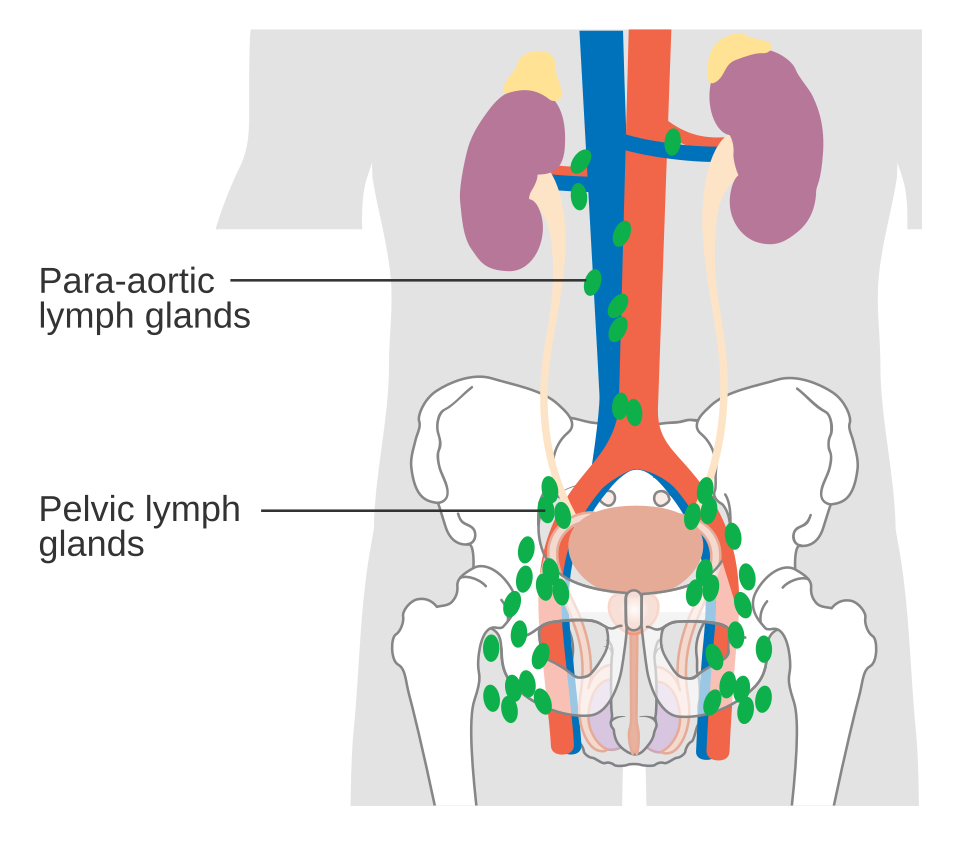
Diagram of the abdomen and pelvis labelling the para-aortic lymph glands along the aorta and the pelvic lymph glands

Figure: The testis drains to the para-aortic (lumbar) lymph glands shown along the aorta, reflecting its retroperitoneal origin - not to the inguinal nodes.
Question 2 · INICET May 2026

A 50-year-old man with lower urinary tract symptoms undergoes a fusion-guided prostate biopsy. Histopathology shows acinar adenocarcinoma of the prostate with a Gleason score of 8 (4+4). According to the ISUP (International Society of Urological Pathology) system, which prognostic grade group does this correspond to?

  1. A.Grade 2
  2. B.Grade 4
  3. C.Grade 3
  4. D.Grade 5
Show answer and explanation

Answer: B. Grade 4

The correct answer is Grade 4.

The ISUP/WHO prognostic grade group system maps the Gleason score onto five groups. Grade Group 1 is Gleason 6 or less, Grade Group 2 is 3+4=7, Grade Group 3 is 4+3=7, Grade Group 4 is Gleason 8 (whether 4+4, 3+5 or 5+3), and Grade Group 5 is Gleason 9 to 10. A Gleason score of 8 (4+4) therefore corresponds to Grade Group 4, a high-risk, poorly differentiated cancer.

Note the deliberate split of Gleason 7: a primary pattern 4 (4+3) carries a worse prognosis than 3+4, so the two are separated into Grade Groups 3 and 2 respectively. This prognostic separation is the main reason the grade group system was introduced.

Incorrect Options:

  • Grade 2: corresponds to Gleason 3+4=7, not 8.
  • Grade 3: corresponds to Gleason 4+3=7, a different score.
  • Grade 5: reserved for Gleason 9 and 10, the most aggressive tumours.

High-Yield Facts:

  • Grade Group 4 = Gleason 8 (4+4, 3+5 or 5+3).
  • Grade Group 1 = Gleason 6 or less, and Grade Group 5 = Gleason 9 to 10.
  • Gleason 7 splits into GG2 (3+4) and GG3 (4+3).
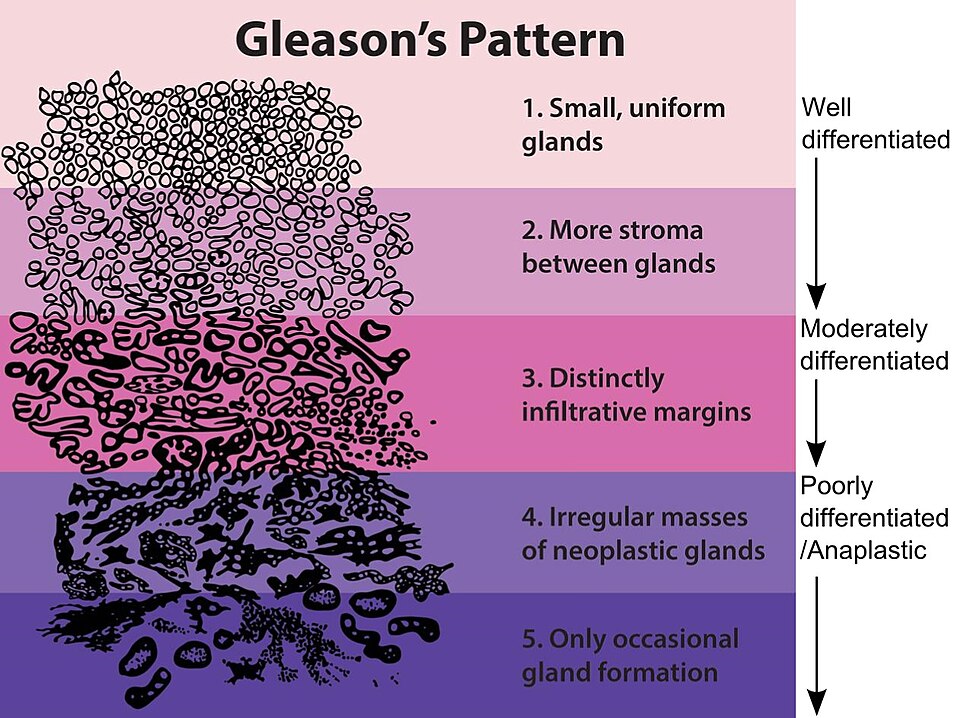
  • Gleason patterns run from 1 (well differentiated) to 5 (anaplastic).
Schematic of Gleason patterns 1 to 5 showing progressive loss of glandular differentiation in prostate cancer

Figure: Gleason patterns 1 to 5. A score of 8 means two pattern-4 components (4+4), placing the tumour in Grade Group 4.

Question 3 · INICET May 2026

Match each condition with its investigation of choice:

1. Pancreatic pseudocyst
2. Obstructive jaundice
3. Solitary thyroid nodule
4. Prostate carcinoma

a. PSMA-PET
b. FNAC
c. MRCP
d. CT

  1. A.1-c, 2-d, 3-a, 4-b
  2. B.1-d, 2-c, 3-b, 4-a
  3. C.1-d, 2-b, 3-a, 4-c
  4. D.1-c, 2-b, 3-a, 4-d
Show answer and explanation

Answer: B. 1-d, 2-c, 3-b, 4-a

The correct answer is 1-d, 2-c, 3-b, 4-a.

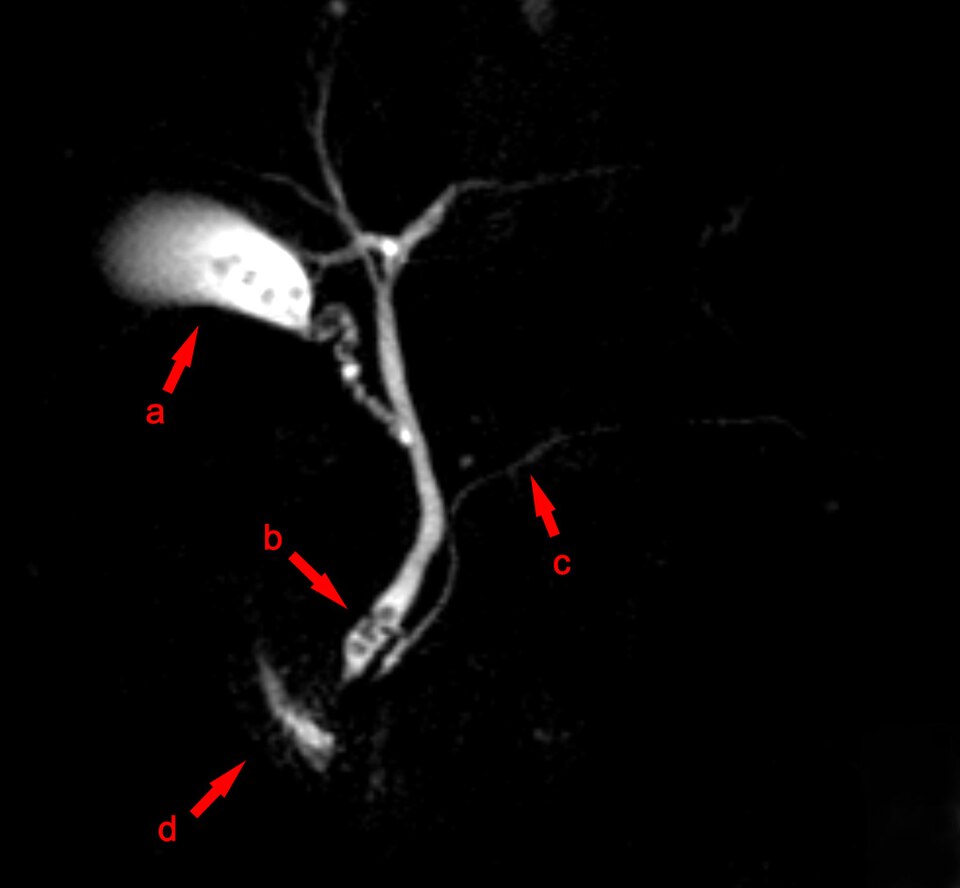
Each condition has a classic investigation of choice. A pancreatic pseudocyst is best assessed by contrast-enhanced CT (d), which shows the cyst wall, size, ductal communication and surrounding anatomy. Obstructive jaundice is mapped non-invasively by MRCP (c), the preferred test for the level and cause of biliary obstruction. A solitary thyroid nodule is evaluated by FNAC (b), the single best test to separate benign from malignant nodules. Prostate carcinoma is increasingly staged with PSMA-PET (a), which detects nodal and metastatic disease with high sensitivity.

Only the combination 1-d, 2-c, 3-b, 4-a links every condition to its correct modality. The other combinations swap at least one pair, for example assigning CT to the thyroid nodule or FNAC to the pseudocyst.

Incorrect Options:

  • 1-c, 2-d, 3-a, 4-b: wrongly gives MRCP to the pseudocyst and PSMA-PET to the thyroid nodule.
  • 1-d, 2-b, 3-a, 4-c: FNAC does not assess obstructive jaundice, and MRCP is not used for prostate cancer.
  • 1-c, 2-b, 3-a, 4-d: mismatches nearly every pair, including CT for prostate carcinoma.

High-Yield Facts:

  • CT is the investigation of choice for a pancreatic pseudocyst.
  • MRCP is the non-invasive test of choice for obstructive jaundice.
  • FNAC is the best test for a solitary thyroid nodule.
  • PSMA-PET is used to stage prostate carcinoma.
MRCP image of the biliary tree showing gallbladder and common bile duct calculi causing obstruction

Figure: MRCP showing biliary calculi - MRCP is the non-invasive investigation of choice for obstructive jaundice, defining the level and cause of obstruction.

Surgery concept guides

Browse the full concept library and clinical image atlas.

Practise the rest: open the Kinase question bank, choose Surgery, set the exam to INICET and switch on PYQs only. Build 50-question custom tests to rehearse one 45-minute INICET section.

Frequently Asked Questions

How many INICET Surgery PYQs does Kinase have?▼
Kinase has 279 INICET Surgery previous year questions from 2018 to 2026, each with an explanation — 8.3% of all INICET PYQs in the bank. There are also 146 NEET-PG Surgery PYQs for extra practice.
What are the most-asked Surgery topics in INICET?▼
In Kinase's INICET Surgery PYQs, the most-asked topics are Gastrointestinal and Abdominal Surgery, General Surgery, Breast Surgery. Gastrointestinal and Abdominal Surgery alone accounts for 90 of the 279 questions.
How is INICET Surgery marked?▼
Like every INICET subject, Surgery questions are +1 for a correct answer and −1/3 for a wrong one. INICET has 200 MCQs in four 45-minute sections of 50, for 200 marks.
Are INICET Surgery PYQs different from NEET-PG?▼
Both exams test the MBBS syllabus, so most Surgery concepts overlap. INICET is conducted by AIIMS New Delhi twice a year and marked +1 / −1/3; NEET-PG is conducted by NBEMS once a year and marked +4 / −1.
When is the next INICET?▼
INICET November 2026 is on 1 November 2026, with registration from 16 September to 13 October 2026 on aiimsexams.ac.in.
279 Surgery PYQs
2018–2026 papers
Topic + year tagged

Ready to Start Practicing?

INICET November 2026 is on 1 November — registration closes 13 October.

Start Free Practice

No credit card required