INICET Physiology Previous Year Questions (2017–2026)

212 INICET Physiology PYQs from 2017 to 2026, tagged by topic, with an explanation for every question. Practise AIIMS-pattern Physiology questions before INICET November 2026.

Last verified: 24 September 2026 against AIIMS New Delhi notices and aiimsexams.ac.in.

Quick Answer

Kinase has 212 INICET Physiology PYQs from 2017 to 2026 — 6.3% of all INICET PYQs in the bank. The most-asked topic is General Physiology (40 questions). INICET is marked +1 / −1/3, so a blind guess is worth nothing on average.

Physiology in INICET at a glance

INICET Physiology PYQs on Kinase212 (6.3% of all INICET PYQs)
Years covered2017–2026
Marking+1 correct, −1/3 wrong
NEET-PG Physiology PYQs on Kinase66

Most-asked Physiology topics in INICET PYQs

TopicINICET PYQsShare of subject
General Physiology4019%
Cardiovascular System3215%
Renal Physiology (Kidney)2813%
Central Nervous System2713%
Nerve and Muscle Physiology2612%

Across NEET PG and INI-CET papers: Most repeated Physiology topics →

Sample INICET Physiology PYQs with answers

Question 1 · INICET May 2026

One day after a meal of cooked rice, a 12-year-old boy develops acute watery diarrhoea and treatment is begun. Increasing the activity of which transport protein would be most effective?

  1. A.CFTR
  2. B.SGLT-1
  3. C.Na+/K+ ATPase pump
  4. D.Na+/H+ exchanger
Show answer and explanation

Answer: B. SGLT-1

The correct answer is B. SGLT-1.

Acute watery diarrhoea (here likely Bacillus cereus from reheated rice) is managed with oral rehydration solution (ORS). ORS works through SGLT-1, the sodium-glucose cotransporter on the apical membrane of enterocytes, which carries 2 sodium ions with 1 glucose molecule into the cell so that water follows by osmosis. This glucose-coupled sodium absorption is preserved even in secretory diarrhoea, so raising SGLT-1 activity maximises sodium and water uptake despite ongoing losses. The tempting distractor is the Na+/K+ ATPase, which does sustain the basolateral sodium gradient that powers SGLT-1, but it is not the glucose-coupled absorptive step ORS exploits, so it is not the answer. This coupling is exactly why ORS pairs glucose with salt.

Why the other options are incorrect:

  • A. CFTR: The apical chloride channel that drives secretory diarrhoea. Increasing it would push more chloride and water into the lumen, worsening fluid loss.
  • C. Na+/K+ ATPase pump: Maintains the sodium gradient that powers SGLT-1 but is not itself the glucose-coupled absorptive step targeted by ORS.
  • D. Na+/H+ exchanger: Nutrient-independent sodium absorption that is actually impaired during diarrhoea, so it cannot be relied on for rehydration.

High-Yield Facts:

  • SGLT-1 couples sodium with glucose absorption and is the basis of ORS.
  • Sodium-glucose cotransport is preserved in secretory diarrhoea.
  • Water follows the absorbed sodium and glucose by osmosis.
  • CFTR drives secretory diarrhoea, the opposite of absorption.
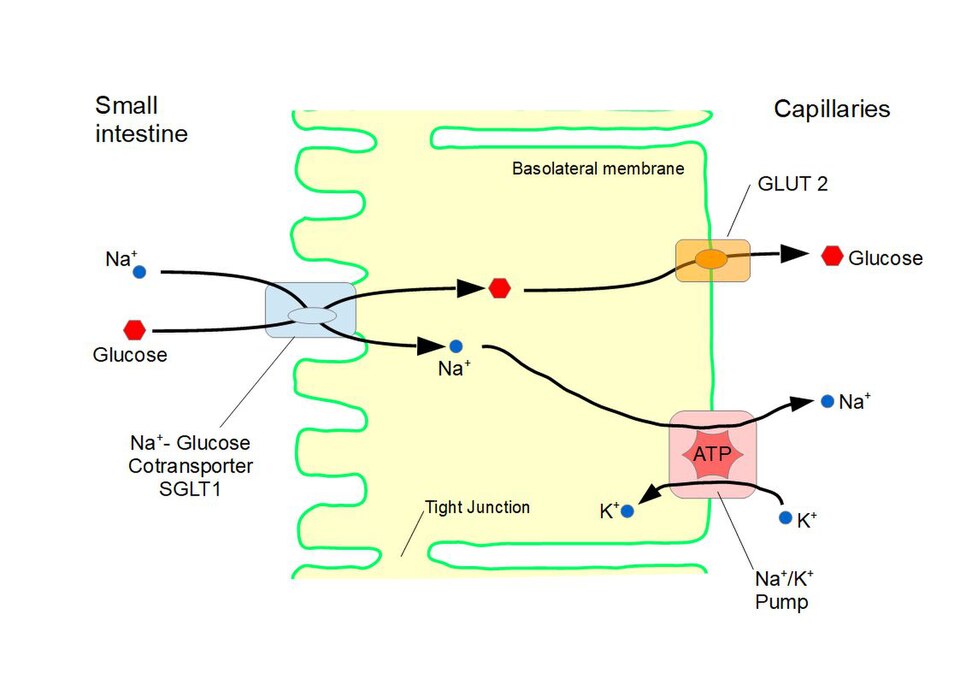
Diagram of an intestinal enterocyte showing the apical Na-glucose cotransporter SGLT1, basolateral GLUT2, and the Na-K ATPase pump

The intestinal Na-glucose cotransporter SGLT1 carries sodium with glucose into the enterocyte, with water following by osmosis - the molecular basis of ORS. GLUT2 exports glucose basolaterally, and the Na+/K+ ATPase maintains the sodium gradient.
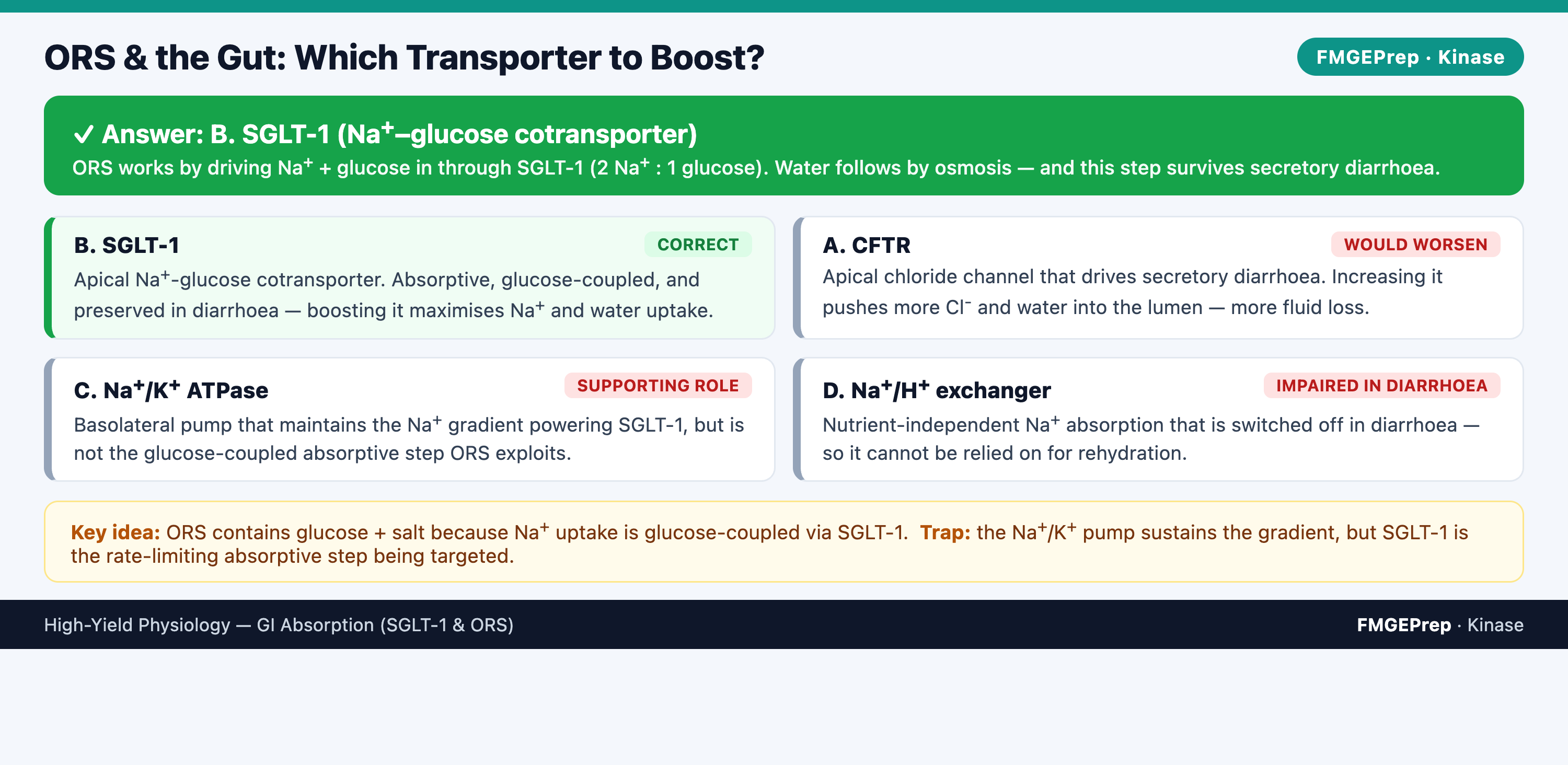
Infographic comparing CFTR, SGLT-1, Na-K ATPase and Na-H exchanger and why SGLT-1 should be boosted to treat diarrhoeal dehydration

Summary: boosting SGLT-1 (glucose-coupled, absorptive, diarrhoea-resistant) best aids rehydration. CFTR would worsen secretory loss, the Na+/K+ ATPase only supports the gradient, and the Na+/H+ exchanger is impaired in diarrhoea.
Question 2 · INICET May 2026

Which of the following explains the difference in biphasic blood flow between the right and left coronary arteries?

  1. A.High pressure developed during right ventricular systole
  2. B.Low pressure developed during right ventricular systole
  3. C.Thick right ventricular wall
  4. D.Reversal of flow during end of atrial systole
Show answer and explanation

Answer: B. Low pressure developed during right ventricular systole

The correct answer is Low pressure developed during right ventricular systole.

Coronary flow is phasic because the contracting myocardium compresses the intramural vessels during systole. The left ventricle generates a high systolic pressure (about 120 mmHg) that strongly compresses the left coronary vessels, so left coronary flow occurs mainly in diastole. The right ventricle develops a much lower systolic pressure (about 25 mmHg) and has a thin wall, so its vessels are barely compressed - therefore right coronary flow continues during both systole and diastole and follows the aortic pressure curve. The difference is thus explained by the low pressure developed during right ventricular systole.

Option C is a trap - the right ventricular wall is in fact thin, not thick, which is exactly why compression is minimal. The dominant, testable explanation among the options is the low systolic pressure of the right ventricle.

Incorrect Options:

  • High pressure developed during right ventricular systole: the right ventricle generates low, not high, systolic pressure.
  • Thick right ventricular wall: the right ventricular wall is thin - a thick wall would increase, not reduce, compression.
  • Reversal of flow during end of atrial systole: not the mechanism of the right-versus-left phasic difference.

High-Yield Facts:

  • Left coronary flow is mainly diastolic due to high LV systolic compression.
  • Right coronary flow occurs in both systole and diastole (low RV pressure, thin wall).
  • Right coronary flow follows the aortic pressure curve.
  • Diastolic dependence makes the left heart vulnerable to ischaemia in tachycardia.
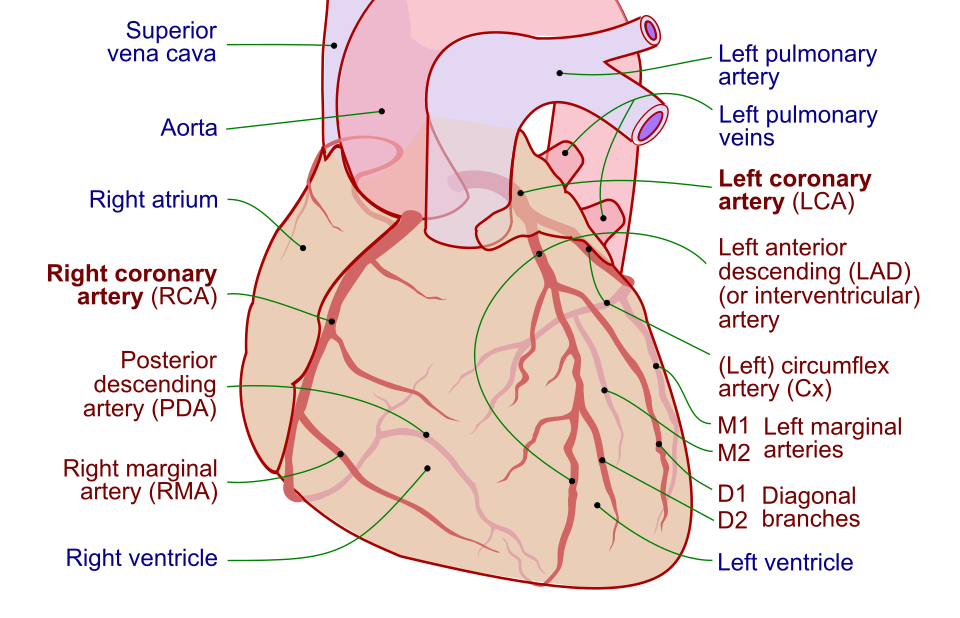
Labeled diagram of the heart showing the right coronary artery and left coronary artery with their branches

Figure: The right (RCA) and left (LCA) coronary arteries. The low-pressure right ventricle compresses the RCA little, so right coronary flow persists in systole, while left coronary flow is mainly diastolic.

Question 3 · INICET May 2026

A patient with severe hyperglycemia is started on insulin therapy. Which of the following effects is expected?

  1. A.Increased glucose uptake by liver via GLUT2
  2. B.Increased glucose uptake by skeletal muscle via GLUT4
  3. C.Increased glucose uptake by skeletal muscle via GLUT2
  4. D.Increased glucose uptake by liver via GLUT4
Show answer and explanation

Answer: B. Increased glucose uptake by skeletal muscle via GLUT4

The correct answer is Increased glucose uptake by skeletal muscle via GLUT4.

Insulin binds its receptor and triggers the PI3K-Akt pathway, which translocates GLUT4 from intracellular vesicles to the plasma membrane. GLUT4 is the insulin-responsive glucose transporter found in skeletal muscle, cardiac muscle and adipose tissue, so insulin therapy increases glucose uptake into skeletal muscle through GLUT4, lowering blood glucose. The liver instead uses GLUT2, a high-capacity insulin-independent transporter, so hepatic glucose handling is not driven by GLUT4.

The key pairing is GLUT4 with insulin-sensitive muscle and fat, not the liver. Muscle GLUT4 can also be recruited insulin-independently by exercise via the AMP-activated kinase pathway.

Incorrect Options:

  • Increased glucose uptake by skeletal muscle via GLUT2: muscle uses GLUT4, not GLUT2, for insulin-stimulated uptake.
  • Increased glucose uptake by liver via GLUT4: the liver expresses GLUT2, not GLUT4.
  • Increased glucose uptake by liver via GLUT2: GLUT2 is insulin-independent, so insulin does not directly raise hepatic uptake through it.

High-Yield Facts:

  • GLUT4 is the insulin-responsive transporter in muscle, heart and adipose tissue.
  • Insulin recruits GLUT4 to the membrane via the PI3K-Akt pathway.
  • The liver uses insulin-independent GLUT2.
  • Exercise recruits GLUT4 independently of insulin via AMP-kinase.
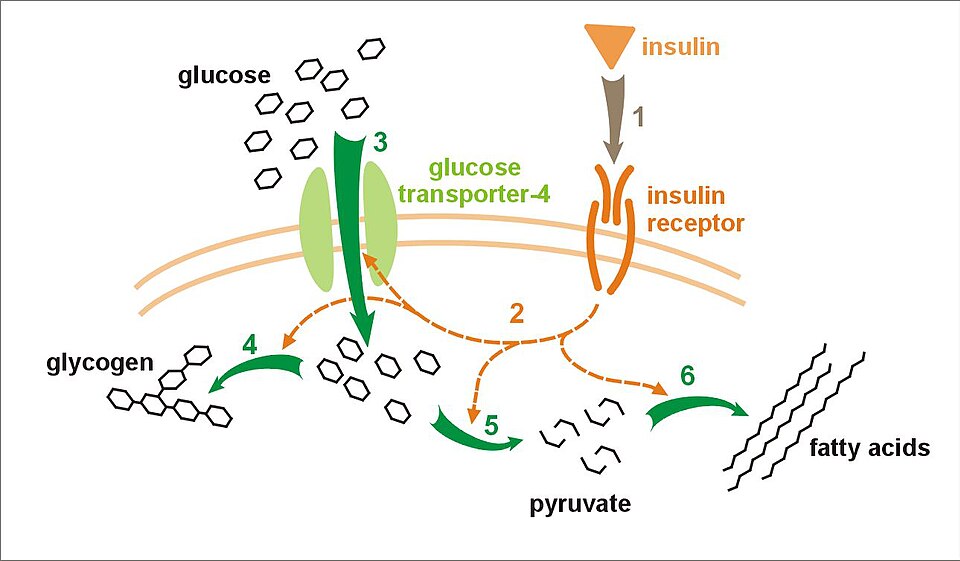
Diagram of insulin binding its receptor and recruiting GLUT4 to bring glucose into the cell, forming glycogen, pyruvate and fatty acids

Figure: Insulin binds its receptor and recruits GLUT4 to the membrane, increasing glucose uptake into the cell - the insulin-responsive transporter of muscle and adipose tissue.

Physiology concept guides

Browse the full concept library and clinical image atlas.

Practise the rest: open the Kinase question bank, choose Physiology, set the exam to INICET and switch on PYQs only. Build 50-question custom tests to rehearse one 45-minute INICET section.

Frequently Asked Questions

How many INICET Physiology PYQs does Kinase have?▼
Kinase has 212 INICET Physiology previous year questions from 2017 to 2026, each with an explanation — 6.3% of all INICET PYQs in the bank. There are also 66 NEET-PG Physiology PYQs for extra practice.
What are the most-asked Physiology topics in INICET?▼
In Kinase's INICET Physiology PYQs, the most-asked topics are General Physiology, Cardiovascular System, Renal Physiology (Kidney). General Physiology alone accounts for 40 of the 212 questions.
How is INICET Physiology marked?▼
Like every INICET subject, Physiology questions are +1 for a correct answer and −1/3 for a wrong one. INICET has 200 MCQs in four 45-minute sections of 50, for 200 marks.
Are INICET Physiology PYQs different from NEET-PG?▼
Both exams test the MBBS syllabus, so most Physiology concepts overlap. INICET is conducted by AIIMS New Delhi twice a year and marked +1 / −1/3; NEET-PG is conducted by NBEMS once a year and marked +4 / −1.
When is the next INICET?▼
INICET November 2026 is on 1 November 2026, with registration from 16 September to 13 October 2026 on aiimsexams.ac.in.
212 Physiology PYQs
2017–2026 papers
Topic + year tagged

Ready to Start Practicing?

INICET November 2026 is on 1 November — registration closes 13 October.

Start Free Practice

No credit card required