INICET Dermatology Previous Year Questions (2018–2026)

91 INICET Dermatology PYQs from 2018 to 2026, tagged by topic, with an explanation for every question. Practise AIIMS-pattern Dermatology questions before INICET November 2026.

Last verified: 24 September 2026 against AIIMS New Delhi notices and aiimsexams.ac.in.

Quick Answer

Kinase has 91 INICET Dermatology PYQs from 2018 to 2026 — 2.7% of all INICET PYQs in the bank. The most-asked topic is Skin Infections & Infestations (20 questions). INICET is marked +1 / −1/3, so a blind guess is worth nothing on average.

Dermatology in INICET at a glance

INICET Dermatology PYQs on Kinase91 (2.7% of all INICET PYQs)
Years covered2018–2026
Marking+1 correct, −1/3 wrong
NEET-PG Dermatology PYQs on Kinase41

Most-asked Dermatology topics in INICET PYQs

TopicINICET PYQsShare of subject
Skin Infections & Infestations2022%
Clinical Dermatology1516%
Papulosquamous Disorders89%
Vesiculobullous Disorders89%
Allergic Disorders & Dermatitis67%

Across NEET PG and INI-CET papers: Most repeated Dermatology topics →

Sample INICET Dermatology PYQs with answers

Question 1 · INICET May 2026

Match each sign with its associated condition:

Signs:
1. Positive Nikolsky sign
2. Pseudo-Nikolsky sign
3. False (negative) Nikolsky sign
4. Cerebriform tongue

Conditions:
a. Pemphigus vulgaris
b. Stevens-Johnson syndrome
c. Bullous pemphigoid
d. Pemphigus vegetans

  1. A.1-a, 2-b, 3-c, 4-d
  2. B.1-c, 2-b, 3-a, 4-d
  3. C.1-a, 2-b, 3-d, 4-c
  4. D.1-d, 2-c, 3-b, 4-a
Show answer and explanation

Answer: A. 1-a, 2-b, 3-c, 4-d

The correct answer is 1-a, 2-b, 3-c, 4-d.

The Nikolsky sign (skin shears off with lateral pressure) reflects loss of epidermal cohesion. A true positive Nikolsky sign occurs in pemphigus vulgaris, where intraepidermal acantholysis splits the epidermis (1-a). The pseudo-Nikolsky sign is seen in Stevens-Johnson syndrome / TEN, where full-thickness epidermal necrosis lets a shearing force extend the blister (2-b). A false (negative) Nikolsky is characteristic of bullous pemphigoid, a subepidermal blister with an intact epidermis (3-c). The cerebriform tongue (sulci-and-gyri pattern from papillary hyperplasia) is a clue to pemphigus vegetans (4-d).

Why the other options are wrong:

  • 1-c, 2-b, 3-a, 4-d: swaps pemphigus vulgaris and bullous pemphigoid - pemphigoid is Nikolsky-negative, not positive.
  • 1-a, 2-b, 3-d, 4-c: wrongly links false Nikolsky to pemphigus vegetans and cerebriform tongue to bullous pemphigoid.
  • 1-d, 2-c, 3-b, 4-a: mismatches almost every pair (e.g., positive Nikolsky is not pemphigus vegetans).

High-Yield Facts:

  • Positive Nikolsky = intraepidermal acantholysis (pemphigus vulgaris).
  • Pseudo-Nikolsky = full-thickness necrosis (SJS/TEN).
  • Bullous pemphigoid is Nikolsky-negative (subepidermal blister).
  • Cerebriform tongue points to pemphigus vegetans.
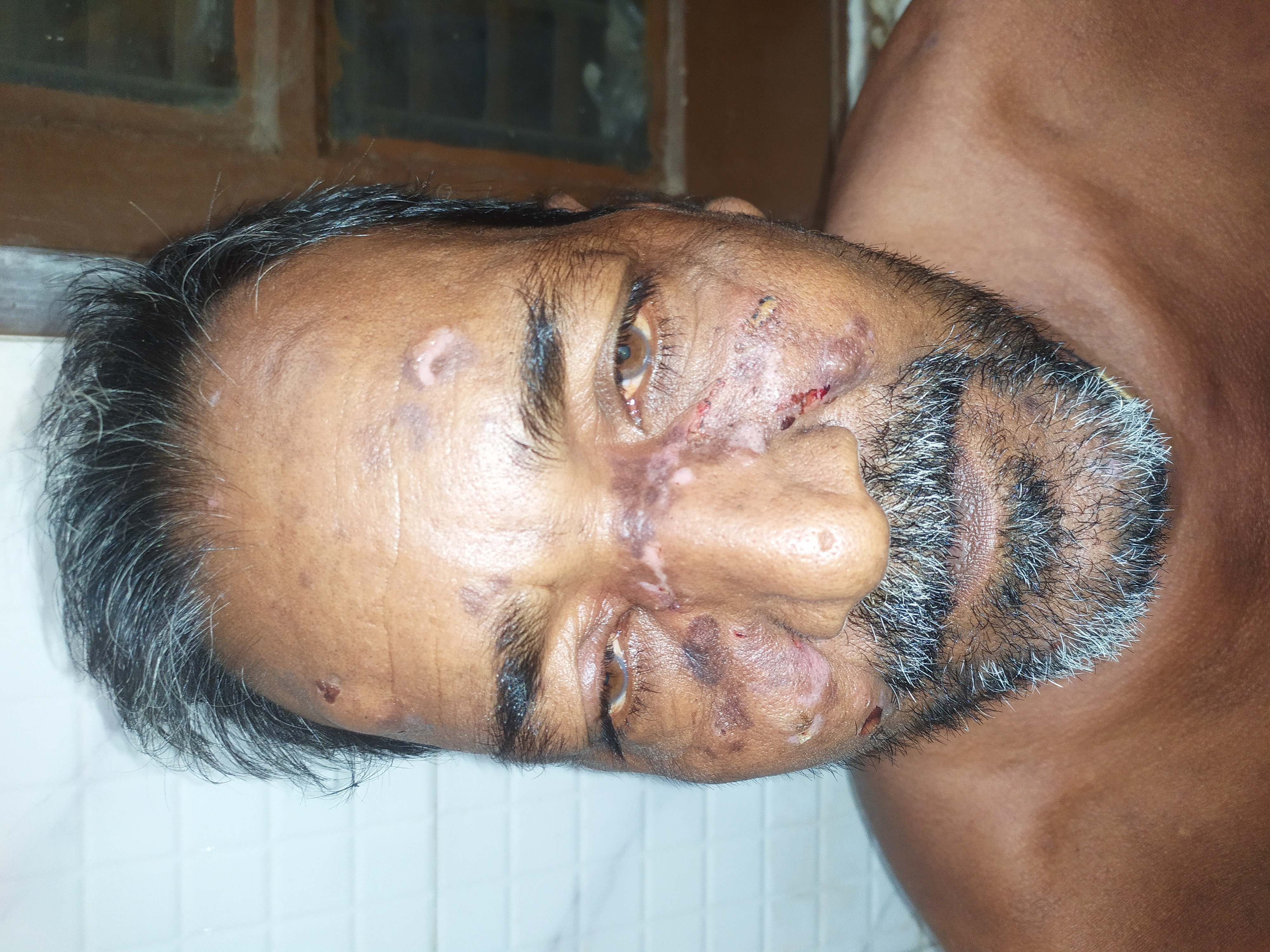
Clinical photo of pemphigus vulgaris with crusted erosions over the face

Figure 1: Pemphigus vulgaris - flaccid blisters rupture into painful crusted erosions, with a positive Nikolsky sign.
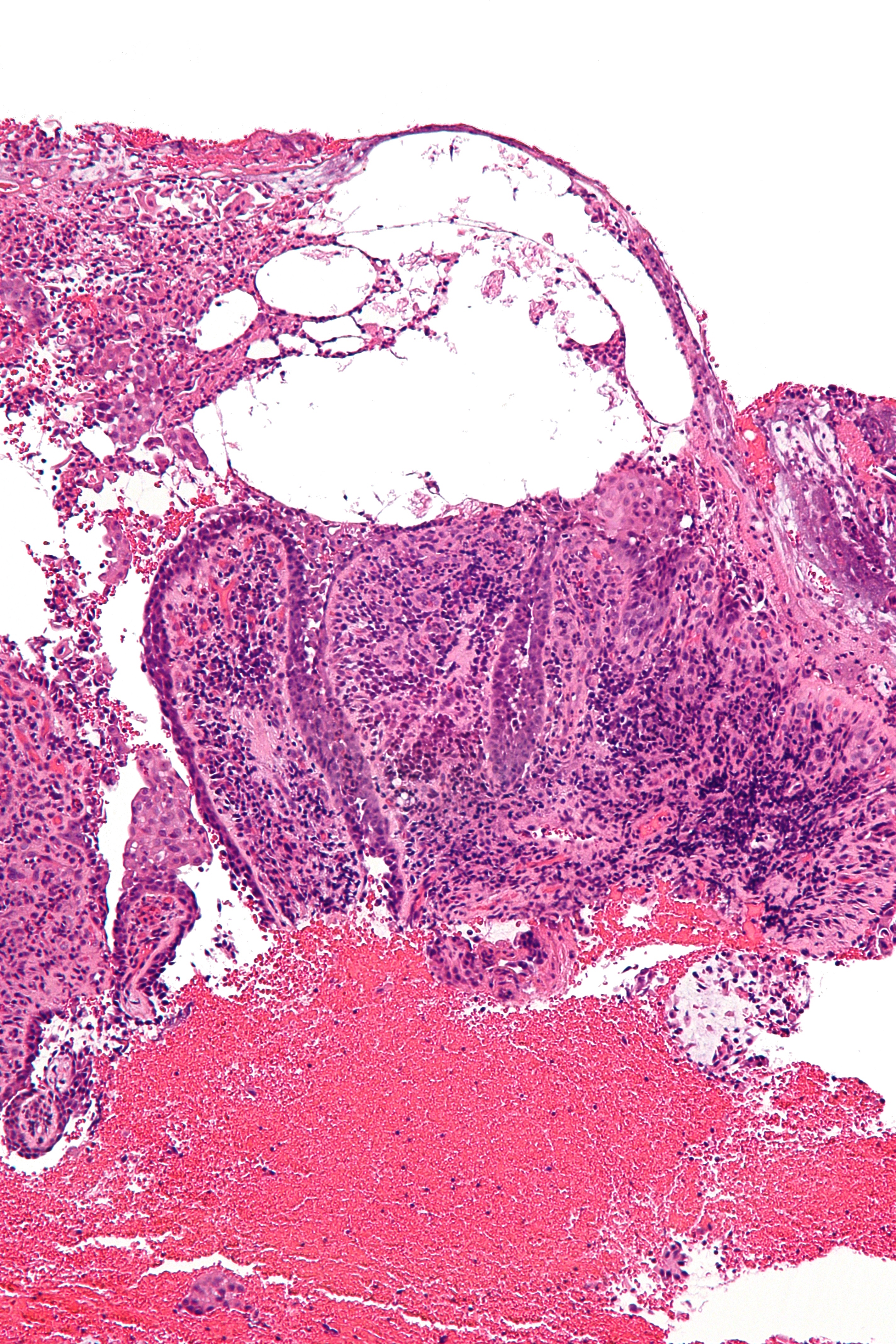
H&E histology of pemphigus vulgaris showing a suprabasal blister with
  acantholysis and a tombstone row of basal cells

Figure 2: Pemphigus vulgaris histology - suprabasal acantholytic blister with a 'tombstone' layer of retained basal keratinocytes.

Question 2 · INICET 2025

Evaluate the following statements concerning the embryological origin and structural properties of the human skin:

  1. The epidermis possesses the capacity to regenerate from the hair follicle bulbs and sebaceous glands.
  2. The stratum corneum constitutes the outermost viable cellular layer.
  3. The epidermis is derived from the ectoderm.
  4. The dermis and hypodermis are derived from the endoderm.

Which combination of the above statements is CORRECT?

  1. A.1 and 3 only
  2. B.1, 2 and 3
  3. C.2 and 3 only
  4. D.1 and 4 only
Show answer and explanation

Answer: A. 1 and 3 only

Correct Answer: 1 and 3 only

Clinical Reasoning:

1. Regeneration (Statement 1 is TRUE):

  • The skin appendages (hair follicles, sebaceous glands, and sweat glands) are invaginations of the epidermis deep into the dermis.
  • They contain epithelial stem cells (specifically in the "bulge" region of the hair follicle). In the event of superficial trauma or burns (partial-thickness) where the surface epidermis is destroyed, re-epithelialization occurs via the migration of these stem cells from the appendages upwards to the surface.

2. Embryological Origin (Statement 3 is TRUE, Statement 4 is FALSE):

  • Epidermis: Derived from the Surface Ectoderm.
  • Dermis & Hypodermis: Derived from the Mesoderm (specifically paraxial mesoderm/dermatomes for the dorsal skin and lateral plate mesoderm for ventral skin), not the endoderm.
  • Melanocytes: Derived from the Neural Crest (neuroectoderm).

3. Stratum Corneum (Statement 2 is FALSE):

  • The Stratum Corneum is indeed the outermost layer, but it consists of dead, anucleated corneocytes (flattened squames filled with keratin), not viable cells. The term "cellular layer" in this context typically implies living, nucleated cells (the outermost living layer is the Stratum Granulosum).
Question 3 · INICET 2025

Identify the known local adverse effects associated with the prolonged application of topical corticosteroids from the list below:

  1. Blue discoloration of the skin
  2. Skin atrophy
  3. Acneiform eruptions
  4. Hypertrichosis
  1. A.2, 3 and 4
  2. B.1, 2 and 3
  3. C.1, 2 and 4
  4. D.2 and 4 only
Show answer and explanation

Answer: A. 2, 3 and 4

Correct Answer: 2, 3 and 4 (Skin atrophy, Acneiform eruptions, Hypertrichosis)

Clinical Reasoning:

Local Side Effects of Topical Corticosteroids:

Topical steroids are the mainstay of dermatological therapy, but their prolonged use, especially of high-potency agents or on sensitive areas (face, flexures), leads to specific local adverse events:

  • Skin Atrophy (Statement 2): This is the most common side effect. Steroids inhibit fibroblast proliferation and collagen synthesis, leading to thinning of both the epidermis and dermis. This manifests as transparency of the skin, fragility, and striae (stretch marks).
  • Acneiform Eruptions (Statement 3): Often referred to as "Steroid Acne." Unlike vulgaris, these lesions are typically monomorphic (papules and pustules in the same stage of development) and lack comedones initially. They commonly occur on the chest or back.
  • Hypertrichosis (Statement 4): Increased hair growth (hirsutism/hypertrichosis) at the site of application is a well-documented side effect.
  • Other common local effects: Telangiectasia (visible blood vessels), Striae distensae (irreversible), Hypopigmentation (lightening of skin), and predisposition to secondary bacterial or fungal infections (Tinea incognito).

Why Statement 1 is Incorrect:

  • Blue Discoloration: Corticosteroids cause hypopigmentation (whitening/lightening) by inhibiting melanocyte function, not blue discoloration.
  • Blue-black or slate-grey discoloration is characteristic of drugs like Minocycline, Amiodarone, or conditions like Ochronosis (associated with Hydroquinone use), but not corticosteroids.

Dermatology concept guides

Dermatology images to recognise

Browse the full concept library and clinical image atlas.

Practise the rest: open the Kinase question bank, choose Dermatology, set the exam to INICET and switch on PYQs only. Build 50-question custom tests to rehearse one 45-minute INICET section.

Frequently Asked Questions

How many INICET Dermatology PYQs does Kinase have?▼
Kinase has 91 INICET Dermatology previous year questions from 2018 to 2026, each with an explanation — 2.7% of all INICET PYQs in the bank. There are also 41 NEET-PG Dermatology PYQs for extra practice.
What are the most-asked Dermatology topics in INICET?▼
In Kinase's INICET Dermatology PYQs, the most-asked topics are Skin Infections & Infestations, Clinical Dermatology, Papulosquamous Disorders. Skin Infections & Infestations alone accounts for 20 of the 91 questions.
How is INICET Dermatology marked?▼
Like every INICET subject, Dermatology questions are +1 for a correct answer and −1/3 for a wrong one. INICET has 200 MCQs in four 45-minute sections of 50, for 200 marks.
Are INICET Dermatology PYQs different from NEET-PG?▼
Both exams test the MBBS syllabus, so most Dermatology concepts overlap. INICET is conducted by AIIMS New Delhi twice a year and marked +1 / −1/3; NEET-PG is conducted by NBEMS once a year and marked +4 / −1.
When is the next INICET?▼
INICET November 2026 is on 1 November 2026, with registration from 16 September to 13 October 2026 on aiimsexams.ac.in.
91 Dermatology PYQs
2018–2026 papers
Topic + year tagged

Ready to Start Practicing?

INICET November 2026 is on 1 November — registration closes 13 October.

Start Free Practice

No credit card required