INICET Anatomy Previous Year Questions (2017–2026)

213 INICET Anatomy PYQs from 2017 to 2026, tagged by topic, with an explanation for every question. Practise AIIMS-pattern Anatomy questions before INICET November 2026.

Last verified: 24 September 2026 against AIIMS New Delhi notices and aiimsexams.ac.in.

Quick Answer

Kinase has 213 INICET Anatomy PYQs from 2017 to 2026 — 6.4% of all INICET PYQs in the bank. The most-asked topic is Head and Neck (42 questions). INICET is marked +1 / −1/3, so a blind guess is worth nothing on average.

Anatomy in INICET at a glance

INICET Anatomy PYQs on Kinase213 (6.4% of all INICET PYQs)
Years covered2017–2026
Marking+1 correct, −1/3 wrong
NEET-PG Anatomy PYQs on Kinase92

Most-asked Anatomy topics in INICET PYQs

TopicINICET PYQsShare of subject
Head and Neck4220%
Neuroanatomy4119%
Abdomen and Pelvis2512%
Upper Limb2311%
Histology2210%

Across NEET PG and INI-CET papers: Most repeated Anatomy topics →

Sample INICET Anatomy PYQs with answers

Question 1 · INICET May 2026

Match each organ with its embryological origin:

Organ:
1. Thyroid
2. Adrenal medulla
3. Kidney

Embryological origin:
a. Ectoderm
b. Intermediate mesoderm
c. Endoderm
d. Neural crest cells

  1. A.1-a, 2-c, 3-d
  2. B.1-c, 2-d, 3-b
  3. C.1-b, 2-c, 3-d
  4. D.1-c, 2-a, 3-b
Show answer and explanation

Answer: B. 1-c, 2-d, 3-b

The correct answer is 1-c, 2-d, 3-b.

The thyroid arises from endoderm - a median endodermal thickening (thyroid diverticulum) in the floor of the pharynx (1-c). The adrenal medulla develops from neural crest cells (chromaffin cells from adjacent sympathetic ganglia), whereas the adrenal cortex is mesodermal (2-d). The kidney develops from the intermediate mesoderm (pronephros to mesonephros to metanephros) (3-b). Hence 1-c, 2-d, 3-b.

Why the other options are wrong:

  • 1-a, 2-c, 3-d: thyroid is endoderm (not ectoderm) and the kidney is intermediate mesoderm (not neural crest).
  • 1-b, 2-c, 3-d: thyroid is endoderm (not mesoderm); adrenal medulla is neural crest (not endoderm).
  • 1-c, 2-a, 3-b: adrenal medulla is from neural crest, not surface ectoderm - so 2-a is wrong.

High-Yield Facts:

  • Thyroid = endoderm (pharyngeal floor diverticulum).
  • Adrenal medulla = neural crest; adrenal cortex = mesoderm.
  • Kidney and gonads = intermediate mesoderm.
  • Neural crest also forms melanocytes, Schwann cells, dorsal root ganglia, and enteric neurons.
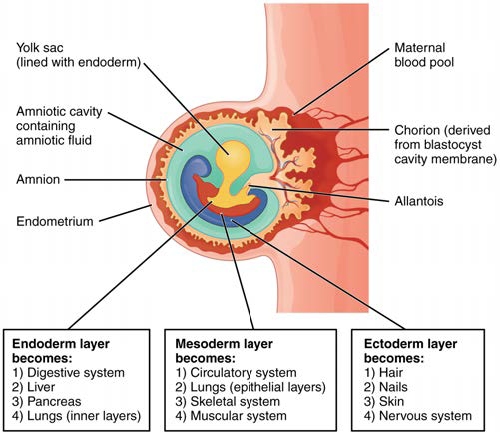
Diagram of the fates of the three germ layers - endoderm, mesoderm, and
  ectoderm - and the organ systems each forms

Figure: Fates of the germ layers - endoderm (gut/glands), mesoderm (kidney, muscle, circulatory), and ectoderm (skin, nervous system, including neural-crest derivatives).
Question 2 · INICET May 2026

A 4-year-old child inhaled a small toy while playing; chest X-ray shows the toy on the RIGHT side of the chest. Which of the following statements form the anatomical basis for this finding?

1. Right bronchus is in direct line with the trachea
2. Right bronchus is wider
3. Right bronchus is longer
4. Right lung has 3 lobes

  1. A.1, 2, 3 and 4
  2. B.1 and 2
  3. C.1, 2 and 3
  4. D.1, 2 and 4
Show answer and explanation

Answer: B. 1 and 2

The correct answer is 1 and 2.

An inhaled foreign body preferentially enters the right main bronchus because it is more vertical (in direct line with the trachea) (statement 1) and wider in diameter (statement 2). The right main bronchus is also SHORTER, not longer - so statement 3 is FALSE. Statement 4 (the right lung having 3 lobes) is a true anatomical fact but is NOT the reason a foreign body lodges on the right; lobe number does not determine the side of aspiration. Hence only statements 1 and 2 are the correct anatomical basis.

Why the other options are wrong:

  • 1, 2 and 3: includes statement 3, which is false - the right bronchus is shorter, not longer.
  • 1, 2 and 4: the 3-lobed right lung is true but is not the anatomical basis for the side of aspiration.
  • 1, 2, 3 and 4: wrong because statement 3 is false and statement 4 is not the basis.

High-Yield Facts:

  • Right main bronchus is wider, shorter, and more vertical.
  • Aspirated foreign bodies therefore lodge on the right.
  • The right bronchus is SHORTER (not longer) - a common trap.
  • The carina sits slightly left of midline, reinforcing right-sided entry.
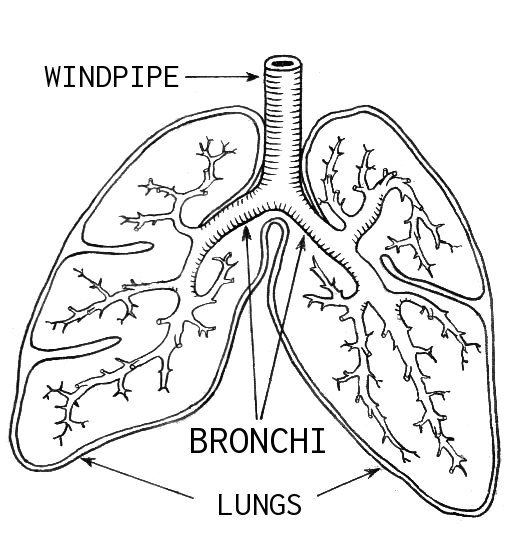
Labeled diagram of the windpipe (trachea) dividing into the right and left main bronchi
  within the lungs

Figure: The trachea (windpipe) divides into the main bronchi; the right main bronchus is wider, shorter, and more vertical, so aspirated objects tend to enter it.

Question 3 · INICET May 2026

A lesion at the level of the sensory decussation (decussation of the medial lemniscus) in the medulla would affect which of the following nuclei?

1. Lateral vestibular nucleus
2. Nucleus gracilis
3. Spinal nucleus of trigeminal nerve
4. Dorsal motor nucleus of vagus
5. Hypoglossal nucleus

  1. A.1, 2, 4 and 5
  2. B.2, 3, 4 and 5
  3. C.2, 3 and 5
  4. D.3, 4 and 5
Show answer and explanation

Answer: B. 2, 3, 4 and 5

The correct answer is 2, 3, 4 and 5.

The sensory decussation is in the caudal (closed) medulla, where internal arcuate fibers from the dorsal column nuclei cross to form the medial lemniscus. At this level the structures present include the nucleus gracilis (the source of those crossing fibers, #2), the spinal nucleus of the trigeminal nerve (which runs the whole length of the medulla, #3), and the centrally placed hypoglossal nucleus (#5) with the adjacent dorsal motor nucleus of vagus (#4). The lateral vestibular nucleus (#1) lies more ROSTRALLY (around the pontomedullary junction), so it is not affected here - making 2, 3, 4, 5 correct.

Why the other options are wrong:

  • 1, 2, 4, 5: includes the lateral vestibular nucleus, which is rostral (pontomedullary) and not at the sensory decussation.
  • 2, 3, 5: omits the dorsal motor nucleus of vagus, which is present centrally at this level.
  • 3, 4, 5: omits the nucleus gracilis, which IS present (it gives rise to the decussating internal arcuate fibers).

High-Yield Facts:

  • Sensory decussation = caudal/closed medulla (medial lemniscus forms here).
  • Dorsal column nuclei (gracilis, cuneatus) give internal arcuate fibers.
  • The spinal trigeminal nucleus spans the entire medulla.
  • Vestibular nuclei are rostral (pontomedullary), not at this level.
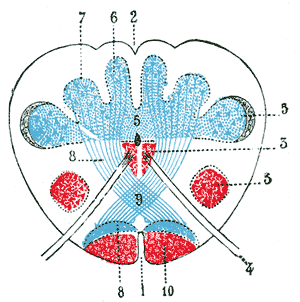
Labeled cross-section of the closed medulla at the level of the sensory decussation showing
  internal arcuate fibers decussating

Figure: Closed medulla at the sensory decussation - internal arcuate fibers from the dorsal column nuclei cross the midline (9) to form the medial lemniscus.

Anatomy concept guides

Browse the full concept library and clinical image atlas.

Practise the rest: open the Kinase question bank, choose Anatomy, set the exam to INICET and switch on PYQs only. Build 50-question custom tests to rehearse one 45-minute INICET section.

Frequently Asked Questions

How many INICET Anatomy PYQs does Kinase have?▼
Kinase has 213 INICET Anatomy previous year questions from 2017 to 2026, each with an explanation — 6.4% of all INICET PYQs in the bank. There are also 92 NEET-PG Anatomy PYQs for extra practice.
What are the most-asked Anatomy topics in INICET?▼
In Kinase's INICET Anatomy PYQs, the most-asked topics are Head and Neck, Neuroanatomy, Abdomen and Pelvis. Head and Neck alone accounts for 42 of the 213 questions.
How is INICET Anatomy marked?▼
Like every INICET subject, Anatomy questions are +1 for a correct answer and −1/3 for a wrong one. INICET has 200 MCQs in four 45-minute sections of 50, for 200 marks.
Are INICET Anatomy PYQs different from NEET-PG?▼
Both exams test the MBBS syllabus, so most Anatomy concepts overlap. INICET is conducted by AIIMS New Delhi twice a year and marked +1 / −1/3; NEET-PG is conducted by NBEMS once a year and marked +4 / −1.
When is the next INICET?▼
INICET November 2026 is on 1 November 2026, with registration from 16 September to 13 October 2026 on aiimsexams.ac.in.
213 Anatomy PYQs
2017–2026 papers
Topic + year tagged

Ready to Start Practicing?

INICET November 2026 is on 1 November — registration closes 13 October.

Start Free Practice

No credit card required